BitVM
A computing paradigm that makes Turing-complete contracts verifiable on Bitcoin without consensus changes, by replacing execution with optimistic fraud-proof verification of pre-signed Taproot transaction graphs.
▶ Run interactive simulation animated mechanism with editable parameters
How it works onchain
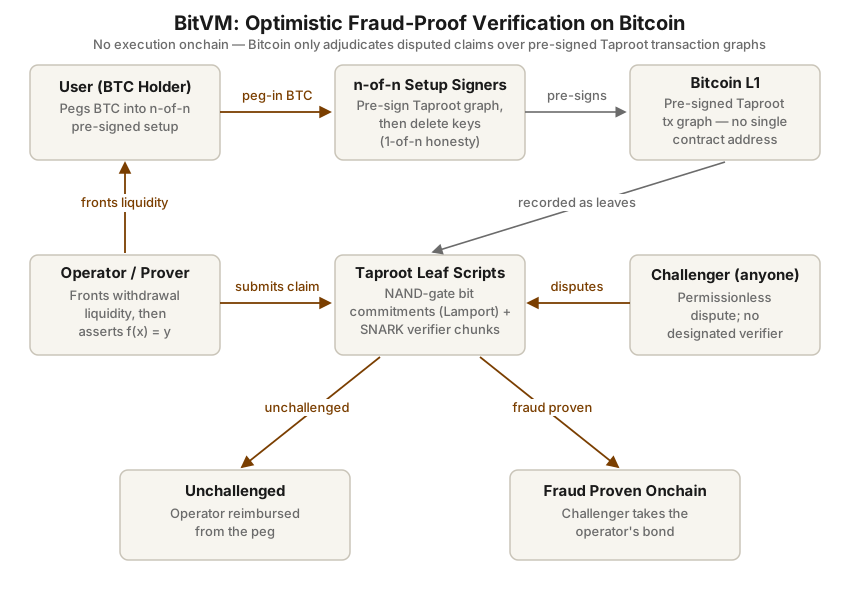 Open full-size diagram
Summary
BitVM is a research program, not a token or a deployed contract: a way to make Bitcoin verify arbitrary computation without changing consensus rules. Robin Linus (ZeroSync, later a Stanford PhD candidate) published "BitVM: Compute Anything on Bitcoin" on October 9, 2023. The core inversion mirrors optimistic rollups: Bitcoin never executes a program; it only adjudicates disputes about a program's claimed result. A prover asserts that f(x) = y; if the claim is false, a verifier can win an on-chain challenge-response game and take the prover's funds. Because any computable function can be disputed this way, Bitcoin script becomes, in effect, Turing-complete for two-party (and later n-party) contracts — with no soft fork.
The idea catalyzed an entire Bitcoin L2 wave. BitVM2 (paper: "Bridging Bitcoin to Second Layers," Linus, Aumayr, Zamyatin, Pelosi, Avarikioti, Maffei et al.; ePrint 2025/1158, winner of the 2025 Bitcoin Research Prize) turned the two-party game into a permissionless bridge design with 1-of-n "existential honesty" safety. Implementations followed: Bitlayer's BitVM Bridge and YBTC launched on mainnet in July 2025, and Citrea's Clementine bridge activated BitVM verification en route to its mainnet (live January 2026), the first time Bitcoin optimistically verified a fully programmable layer. BitVM3 (2026) moved to garbled circuits to shrink the on-chain footprint further.
Design (Mechanism)
BitVM1 (2023): Programs are compiled to binary circuits of NAND gates. Each gate becomes a Taproot leaf script; the prover commits to the value of every wire using bit commitments built from Lamport signatures (hash preimages encode 0 or 1). If the prover ever signs two contradictory values for the same wire — equivocation — the verifier can present both preimages on-chain and claim the prover's bond. Disputes proceed as a multi-round challenge-response: the verifier bisects the computation trace until a single incorrect gate is exposed, which Bitcoin script can check natively. Everything is pre-signed off-chain; the chain is touched only on dispute. Limitation: strictly two-party (one designated verifier), and worst-case disputes require many transaction rounds.
BitVM2 (2024–2025): The breakthrough for bridges. Instead of bisecting a circuit, the operator's claim is a SNARK proof (e.g., a Groth16 verifier compiled to Bitcoin script, split across multiple transactions/tapleaves because a full verifier is on the order of megabytes of script). The protocol collapses disputes to a short, fixed number of on-chain transactions, and — critically — makes challenging permissionless: anyone, not a pre-designated verifier, can disprove a faulty assertion. In the bridge construction, users peg BTC into an n-of-n pre-signed setup; safety holds if just one of the n setup signers was honest and deleted their key (1-of-n existential honesty, versus the honest-majority t-of-n of federated bridges). Operators front withdrawal liquidity out of pocket and are reimbursed from the peg only if unchallenged ("optimistic reimbursement"); liveness needs only one rational operator.
BitVM3 (2026): Replaces giant script-encoded verifiers with garbled circuits, drastically reducing the on-chain data needed for a dispute, at the cost of heavier off-chain setup and new cryptographic assumptions.
There is no single "BitVM contract address": deployments are per-instance graphs of pre-signed Bitcoin Taproot transactions (reference code at github.com/BitVM/BitVM). A BitVM Alliance (ZeroSync, Citrea, Bitlayer, BOB, Fiamma, Alpen and others) coordinates the shared implementation and audits.
Outcome
Ongoing, and arguably the most consequential Bitcoin-native research result since Taproot. Concrete milestones: Bitlayer's BitVM Bridge mainnet beta with YBTC (July 2025), including mining-pool partnerships (Antpool, F2Pool, SpiderPool) to relay the non-standard transactions BitVM disputes require; Citrea's Clementine bridge activating BitVM verification on the way to a January 2026 mainnet; BitVM2 finishing development under the Alliance and entering audits; academic validation (USENIX Security acceptance, 2025 Bitcoin Research Prize). No BitVM bridge has been exploited to date, but the optimistic paths have also seen limited adversarial testing at scale, and value secured remains small relative to federated/custodial BTC bridges like WBTC. It is funded as public-goods research (Spiral, StarkWare, OpenSats, Fedi via the ZeroSync nonprofit) rather than by a token.
Why it worked
- It changed the question. Instead of asking Bitcoin to execute more (a soft-fork fight), it asked Bitcoin only to falsify fraudulent claims — something hash checks, signatures, and Taproot leaves can already do.
- Equivocation-slashing via Lamport commitments gave Bitcoin script "state" between transactions, a genuinely novel primitive.
- BitVM2's permissionless challenging removed the designated-verifier weakness of BitVM1 and reduced bridge trust from honest-majority to 1-of-n at setup — a strictly better trust model than every live federated bridge.
- Open research culture: papers, reference code, and a multi-team alliance let competing L2s (Citrea, Bitlayer, BOB, Fiamma) share one audited core instead of forking incompatible designs.
Limitations and criticisms
- Cost and size: SNARK verifiers in Bitcoin script run to megabytes against a 4 MB block and 1,000-element stack limit; disputes need non-standard transactions that require side-deals with mining pools to relay — a centralization wrinkle.
- Capital inefficiency: operators front every withdrawal and wait out the challenge window for reimbursement, so bridge capacity is bounded by operator liquidity and the economics are fragile ("optimistic reimbursement" is a working-capital treadmill).
- Usability compromises: fixed peg-in denominations, complex pegouts, and reliance on watchtower-style challengers staying online.
- Trust asterisks remain: the 1-of-n guarantee applies at setup (someone must have deleted their key), and mass operator failure forces messy recovery. Purists note it is still not equivalent to L1 self-custody.
Lessons
- Verification, not execution, is the scalable unit of blockchain computation — the optimistic-rollup insight generalizes even to a chain with no smart-contract VM.
- Trust models can be improved without consensus changes: moving BTC bridges from t-of-n honest-majority to 1-of-n existential honesty happened entirely in script and protocol design.
- Fraud-proof systems pay for security with capital efficiency; operator liquidity and challenge windows are the real product constraints, not the cryptography.
- Non-standard transactions mean mempool policy — and therefore miner relationships — are a hidden dependency of "trustless" designs.
- Research programs iterate: BitVM1 → BitVM2 → BitVM3 each traded a different resource (rounds, script size, setup complexity), and shipping teams tracked the frontier rather than freezing v1.
Redesign (EDITORIAL — hypothesis, not fact)
This section is editorial speculation. If redesigning today: (1) attack the working-capital problem directly — a shared, permissionless operator-liquidity market (tranched reimbursement claims sold at discount) would decouple bridge capacity from any single operator's balance sheet; (2) standardize a challenger-incentive layer (bonded watchtower rewards funded by peg fees) so liveness of fraud proofs does not depend on altruism; (3) push for a minimal covenant opcode (e.g., OP_CTV or CAT-style) — most of BitVM's byzantine pre-signing ceremonies exist to emulate covenants, and a small soft fork would collapse setup trust from 1-of-n to trustless while shrinking scripts by orders of magnitude; (4) treat mempool policy as consensus-adjacent: build dispute transactions to be standard-relay-compatible from day one rather than negotiating with mining pools after the fact.
Sources
- BitVM: Compute Anything on Bitcoin (whitepaper, Robin Linus) — primary (docs)
- BitVM official site (papers, team, funders) — primary (docs)
- BitVM2: Bridging Bitcoin to Second Layers (paper) — primary (docs)
- Bridging Bitcoin to Second Layers via BitVM2 (IACR ePrint 2025/1158) — primary (docs)
- BitVM3: Efficient Bitcoin Bridges via Garbled Circuits — primary (docs)
- BitVM reference implementation (GitHub) — primary (contract)
- Robin Linus personal site (handle + project verification) — primary (docs)
- Citrea: Tangerine Upgrade — BitVM Activation on Clementine — primary (docs)
- Citrea's Role in Achieving Verification on Bitcoin with BitVM — primary (docs)
- CoinDesk: Bitcoin Might Get Ethereum-Style Smart Contracts Under 'BitVM' Plan (Oct 11, 2023) (news)
- CoinDesk: Bitlayer's BitVM Bridge Debuts Its Mainnet (Jul 16, 2025) (news)
- Blockworks: BitVM enters the 'implementation' stage as Bitlayer's BitVM Bridge and YBTC go live (news)
- The Block: ZK-powered Bitcoin Layer 2 Citrea launches mainnet (news)
- zksecurity: BitVM — Unlocking Arbitrary Computation on Bitcoin Through Circuit Abstractions (analysis)
- Edinburgh Blockchain Lab: Lukas Aumayr Receives the 2025 Bitcoin Research Prize (for BitVM2 bridge paper) (news)
Related experiments
Last verified: 2026-07-27 · Spot an error? Suggest a correction