CryptoCelebrities
A January 2018 Ethereum 'hot potato' game where unique celebrity tokens could be forcibly bought from their owners at a formula-escalated price, moving ~31,000 ETH before the team shut the website down within weeks.
▶ Run interactive simulation animated mechanism with editable parameters
How it works onchain
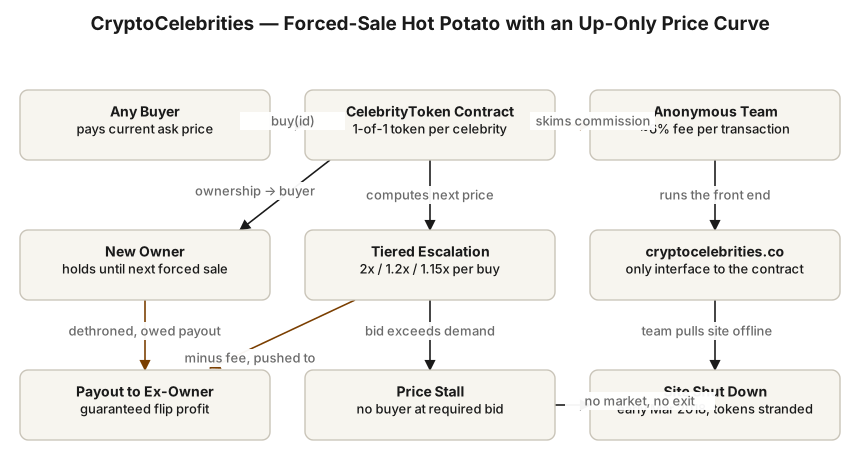 Open full-size diagram
Summary
CryptoCelebrities was one of the first and most widely covered "hot potato" games on Ethereum, launched in January 2018 at the absolute peak of the post-CryptoKitties collectible mania. The site (cryptocelebrities.co) let anyone buy a unique on-chain "Celebrity Smart Contract" token — one per famous person, from Donald Trump and Rihanna to Elon Musk and Vitalik Buterin. The defining twist: an owner could never refuse a sale. Anyone could seize your celebrity at any time by paying the next price on a deterministic escalation curve, with the payment routed to you automatically. Because the next price started at double the last one, every flip was guaranteed profit — as long as another buyer showed up.
For roughly two weeks, buyers kept showing up. Nearly $1 million in ETH moved through the game in its first 24 hours, and by the end, players had spent approximately 31,000 ETH (about $18 million at the time) on celebrity tokens, with the anonymous developers skimming a roughly 6% fee per transaction. Vitalik Buterin's own token traded above 20 ETH (~$20,000). Then demand stalled at the now-absurd price levels, the music stopped, and by early March 2018 the team took the website offline entirely — leaving late buyers holding unique but effectively worthless tokens with no interface to trade them.
Design (Mechanism)
- 1-of-1 celebrity tokens. Each celebrity existed as a single token in the CelebrityToken contract (0xbb5ed1edeb5149af3ab43ea9c7a6963b3c1374f7) on Ethereum mainnet, purchased via MetaMask. This was the CryptoKitties-era pre-ERC-721 pattern of bespoke ownership contracts.
- Forced sale, no refusal. Ownership carried no veto. Any address could call buy on any token by paying the current ask; the contract paid the previous owner and transferred ownership atomically. Holding was always temporary custody, never final possession.
- Deterministic tiered price escalation. Tokens started at 0.0001 ETH (~$0.10 in January 2018). Below 0.05 ETH the price doubled with each purchase; from 0.05–0.5 ETH it rose 1.2x per purchase; above 0.5 ETH it rose 1.15x. Early flips were spectacular percentage gains; late flips demanded ever-larger absolute sums for shrinking percentage upside.
- Developer fee. The team collected a commission on each transaction — approximately 6% per Calcalist's post-shutdown reporting — meaning the flip profit sellers received was slightly less than the headline spread. On ~31,000 ETH of volume this was a substantial anonymous payday.
- Celebrity royalty (largely unrealized). The site advertised that real celebrities could "verify" their contract, Twitter-style, and earn 3% of every sale of their token or direct it to charity, with royalty payouts slated to begin March 2018 — the same window in which the site went dark. No prominent celebrity verification is documented.
Outcome
The game's arc was compressed into about six weeks. Launched in January 2018, it hit a frenzy in late January (Elon Musk and Vitalik Buterin tokens near $20,000; Angelina Jolie at $13,000), leveled off in February as prices exceeded what any greater fool would pay, and was dead by early March, when the developers shut down the website. Total flow was reported at ~31,000 ETH ($18M). Token holders retained on-chain ownership but no market, no interface, and no exit. The anonymous ~8-person team, operating through Discord under a Hong Kong entity (CryptoCelebrities Ltd) — though at least one contemporaneous report described the operation as San Francisco-based — reportedly received threatening emails ("Either pay or pray") and death threats from losing players. One developer's response to complaints: "some people spend more than they can afford and act irresponsibly." Outcome: abandoned — the economic game had already failed as a hot potato must, and the per-transaction fee model meant transaction revenue had already been captured independent of whether the mechanism reached a sustainable end state.
Why it worked
- Guaranteed-profit framing was viscerally compelling. Unlike CryptoKitties, where you had to find a buyer, here the contract itself paid you the instant anyone wanted your token — flipping felt riskless during the growth phase.
- Perfect timing and memetic assets. It launched into peak ETH euphoria (ETH ~$1,000) days after CryptoKitties proved demand for collectibles, and celebrity names are pre-loaded with recognition, rivalry, and status signaling.
- Radical simplicity. One contract, one action (buy), deterministic prices. No breeding mechanics or metadata complexity — the entire game legible in one sentence.
- Forced sales guaranteed liquidity events. Every token was always for sale, so activity compounded on itself and headline prices ("someone paid $20K for Vitalik") became free marketing.
Where the design broke
- The escalation curve guarantees a final holder. Every token's final holder loses their entire purchase price; aggregate player losses equal aggregate player gains plus the ~6% developer rake. Once inflow slowed, the last cohort of buyers absorbed all prior profits.
- The price curve mathematically guaranteed a stall. With prices only ever ratcheting up (no decay, no reset), each token's required next bid grew until it exceeded any plausible buyer's willingness to pay — then that token froze forever. The doubling tier accelerated tokens into the dead zone within dozens of trades.
- Total dependence on a centralized front end run by anonymous operators. The tokens lived on-chain, but the game lived on cryptocelebrities.co. When the anonymous team pulled the site, the game effectively ceased to exist — there was no community fork, no standard (pre-ERC-721) interface for third-party markets to pick it up.
- No underlying value or rights. "Owning" a celebrity conferred nothing — no likeness rights, no cash flow (the 3% celebrity royalty program never materially launched), no utility. When speculation stopped, value was exactly zero.
Lessons
- Deterministic up-only price curves encode their own death. Any mechanism where the ask ratchets monotonically upward converges on a state where every asset is priced above market clearing; a viable design needs price decay, resets, or owner-set asks (as later Harberger-tax experiments used).
- On-chain ownership without on-chain (or standardized) markets is contingent ownership. Assets in bespoke contracts died with their front ends; ERC-721's later ubiquity exists precisely so tokens outlive their creators' websites.
- A per-transaction rake plus anonymity is a structural misalignment. When operator revenue is a fee on volume rather than a stake in outcomes, and operators are pseudonymous with no persistent reputation at risk, nothing in the mechanism ties continued availability of the front end to the game reaching a sustainable end state — which is what happened here.
- "Guaranteed instant liquidity" depends on continued inflow. The forced-sale mechanic made exit feel certain, but exits only existed while new money kept entering; once inflow stopped, the current holder was left with a token that had no further buyer at the required price.
- CryptoCelebrities was an unwitting ancestor of forced-sale ownership designs. Its no-refusal buyout is a crude cousin of Harberger/partial-common-ownership schemes later explored seriously (e.g., "This Artwork Is Always On Sale") — the difference being that legitimate versions tax holders and let owners set prices rather than hard-coding an up-only spiral.
Redesign (EDITORIAL — hypothesis, not fact)
This section is editorial speculation, not historical fact. A defensible redesign would replace the fixed escalation curve with a Harberger-style partial common ownership model: owners self-assess a price at which anyone may buy the token, and pay a continuous holding tax (say 5%/year) on that self-assessment, streamed to the depicted celebrity's verified address or a charity escrow. This preserves the "always for sale" liveliness while letting prices fall as well as rise, eliminating the frozen-token death spiral. Tokens should be standard ERC-721s from day one so marketplaces and forks can outlive the front end, with the site's metadata pinned to IPFS. The operator fee should be a small tax share rather than a per-flip rake, aligning revenue with sustained engagement instead of churn. Finally, likeness rights are a real legal exposure; a legitimate version would onboard celebrities first (opt-in, revenue-sharing, right-of-publicity licenses) rather than tokenizing people without consent — arguably the deepest flaw in the original beyond its economics.
Sources
- CryptoCelebrities (CelebrityToken) Token Tracker — Etherscan — primary (contract)
- CryptoCelebrities Game's Website Shuts Down, Token Holders Stuck with 'Hot Potato' — CTech/Calcalist (news)
- There's a New Crypto Marketplace that Lets You 'Buy' Celebrities — CTech/Calcalist (news)
- You can buy celebrities with Ethereum now — TheNextWeb (Jan 23, 2018) (news)
- Move Over, CryptoKitties! CryptoCelebrities Has Arrived — Bitcoinist (Jan 24, 2018) (news)
- CryptoCelebrities: the Newest Hyped Ethereum-Based Game — Coin Bureau (analysis)
Last verified: 2026-07-27 · Spot an error? Suggest a correction