Forsage
A smart-contract 'matrix' MLM that hard-coded a pyramid scheme into instantly-routing Ethereum (later Tron and BSC) contracts, drew hundreds of millions of dollars from millions of participants, and collapsed once recruitment saturated and new inflows dried up.
▶ Run interactive simulation animated mechanism with editable parameters
How it works onchain
 Open full-size diagram
Summary
Forsage launched on January 31, 2020 as a "crowdfunding via smart contract" platform that was, in substance, a recruitment pyramid encoded directly in Ethereum contracts. Members bought "slots" in x3 and x4 referral matrices; every payment was instantly routed peer-to-peer to uplines, and the only way to profit was to recruit new payers below you. The scheme spread from Ethereum to Tron (2020) and BNB Chain (2021), adding xGold and xQore variants. It became one of the most heavily used contracts on Ethereum in mid-2020 by gas consumption. Academic analysis of the full on-chain record found roughly 88% of participants lost money while top-of-pyramid addresses reaped multi-million-dollar gains.
Design (Mechanism)
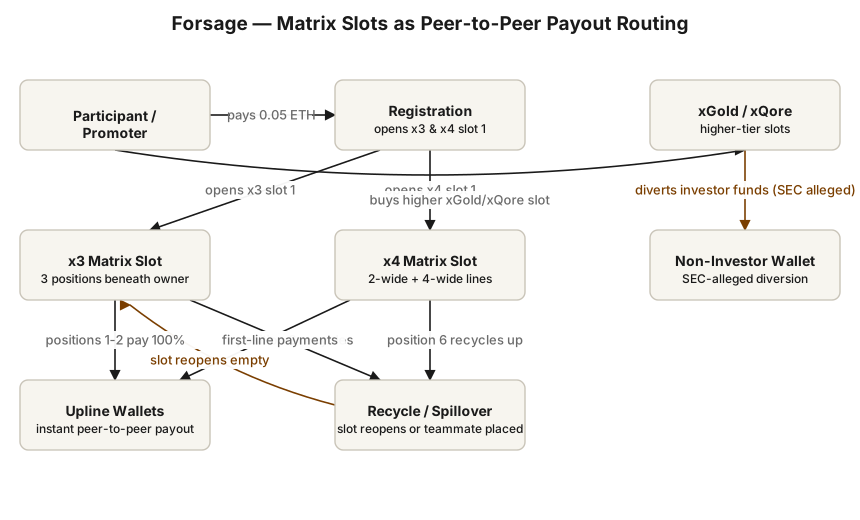
Registration cost 0.05 ETH and simultaneously opened the first slot in two programs, x3 and x4. Each program had 12 slot levels, with each level costing double the previous one; higher slots earned proportionally larger recruitment flows.
- x3: each slot has 3 positions beneath the owner. Payments from positions 1 and 2 go 100% to the slot owner's wallet; the 3rd payment "recycles" the slot (reopens it empty) and passes the money to the owner's upline.
- x4: a 2-wide first line and 4-wide second line. First-line payments pass to the upline (or "spill over" into teammates' matrices); second-line positions 3–5 pay the owner and position 6 recycles the slot upward.
Critically, the contracts held essentially no balance: every inbound payment was routed in the same transaction to some other participant's address. Promoters leaned on this design rhetorically — "the contract can't hold or steal your money, therefore it can't be a Ponzi" — and on the immutability of verified code as proof of trustworthiness. There was no product, yield source, or external revenue; all payouts were other members' buy-ins, making the system zero-sum minus gas. The later xGold contract on Ethereum was coded to divert a portion of investor funds to a wallet not associated with any investor's Forsage ID, contradicting the "100% peer-to-peer" marketing.
Outcome
Forsage grew explosively through 2020, particularly in the Philippines, India, Nigeria, and Russia, and was periodically among the largest gas consumers on Ethereum. It kept operating and redeploying onto new chains through 2021. The Kell et al. study of the complete Ethereum and Tron transaction history found ~88% of participants lost money. New inflows collapsed as recruitment saturated — the mathematically inevitable end state of a pure pyramid.
Why it worked
As a growth mechanism (not as an investment), Forsage was brutally effective. Instant, visible, on-chain payouts to recruiters created powerful word-of-mouth incentives; there was no withdrawal step to fail or treasury to rug, so early participants' testimonials were genuine. The "trustless smart contract" framing weaponized crypto's core credibility narrative: code was verified on Etherscan, could not be altered, and could not be shut down by any operator — all true, and all irrelevant to the arithmetic that every payout was funded by newer entrants' buy-ins rather than any external revenue source. Low entry cost (0.05 ETH), doubling slot tiers that gave "whales" a progression ladder, and spillover mechanics that let downlines occasionally receive unearned placements all sustained engagement. Multi-chain redeployment (Tron, then BSC) reset gas costs and reopened fresh recruitment pools when Ethereum fees priced out the small-ticket demographics the scheme depended on.
Why it failed or underperformed
Forsage failed because it was a pyramid: payouts were funded solely by new entrants, so ~88% of participants had to lose for the top to win. Recruitment saturates; when it slowed, the flows stopped, and slot purchases became pure donations to uplines. The same transparency that marketed the scheme also exposed it — the public ledger let researchers reconstruct every flow, including the hidden xGold diversion to founder-controlled wallets. The contracts still technically execute today; nobody rational feeds them.
Lessons
- Non-custodial routing does not guarantee where funds end up. A contract that "can't steal your funds" can still be structured so every payment routes to earlier participants rather than any external revenue source; "the code holds no balance" was Forsage's most effective sales line, true about custody and silent on the payout structure's zero-sum math.
- On-chain transparency cuts both ways. The same public ledger used as marketing proof let researchers quantify that ~88% of users lost money — smart-contract scams leave permanent evidence.
- Mechanism shape reveals intent. Any design where the sole inflow is entry fees and the sole outflow is recruiter rewards is a pyramid regardless of the technology wrapper; auditing tokenomics for external value sources is the first-order scam filter.
- Gas-market footprint is a detectable metric. When a no-product referral game becomes one of a chain's top gas consumers, the chain's fee data itself surfaces the location and scale of the recruitment-driven payment volume.
Redesign (EDITORIAL — hypothesis, not fact)
There is no honest redesign of Forsage's economics — a pure recruitment matrix is unsalvageable. The interesting editorial question is what its genuinely novel property (instant, non-custodial, code-enforced payout routing) could power if attached to real value flows. The same x3/x4 splitter pattern could implement transparent affiliate revenue-sharing for an actual product: commissions on real sales routed instantly through an on-chain referral tree, with caps on depth so payouts track marketing contribution rather than position in a pyramid. A legitimate variant would need (1) an external revenue source, so the game is positive-sum; (2) depth-limited, decaying referral rewards to remove the infinite-chain-letter structure; and (3) an on-chain disclosure dashboard showing aggregate P&L per cohort — precisely the statistic (88% lose) whose visibility would have killed Forsage's recruitment instantly. One could also imagine mandating simulation-verifiable "loss distribution" labels for referral contracts, the mechanism-design equivalent of a cigarette warning.
Sources
- Forsage.io contract (verified source, deployed 2020-01-31) — Etherscan — primary (contract)
- Forsage: x3/x4 BUSD contract — BscScan — primary (contract)
- SEC Charges Eleven Individuals in $300 Million Crypto Pyramid Scheme (Press Release 2022-134) — primary (news)
- DOJ: Forsage Founders Indicted in $340M DeFi Crypto Scheme (Feb 22, 2023) — primary (news)
- Kell, Yousaf, Allen, Meiklejohn, Juels — 'Forsage: Anatomy of a Smart-Contract Pyramid Scheme' (Financial Cryptography 2023 / arXiv:2105.04380) — primary (analysis)
- SEC charges 11 people in alleged $300 million crypto Ponzi scheme — CNBC (news)
- Alleged Forsage co-founder extradited from Thailand, pleads not guilty in $340 million Ponzi case — The Block (news)
- SEC Slaps Founders, Promoters of Alleged Ponzi Scheme Forsage With Fraud Charges — CoinDesk (news)
Last verified: 2026-07-27 · Spot an error? Suggest a correction