Messari Registry
Messari's 2018 voluntary crypto-disclosures registry — a planned token-curated registry (with a native 'LUCA' token, staked challenges, and bounty contracts) that launched as a centrally validated database, peaked at ~50+ projects, never decentralized onchain, and was quietly retired.
▶ Run interactive simulation animated mechanism with editable parameters
How it works onchain
 Open full-size diagram
Summary
The Messari Registry (formally the "Open Source Disclosures Registry") was Messari's attempt to build a self-regulatory "EDGAR for crypto": a standardized, freely accessible database of token-project disclosures — token design, supply schedules, treasury management, audits, team/investor details, and official channels. Conceived by Ryan Selkis (ex-CoinDesk, DCG, ConsenSys EIR) in late 2017 and launched November 27, 2018 at CoinDesk's Consensus: Invest with 12 founding projects (Aion, Blockstack, Civic, Decent, District0x, Aurora/IDEX, Mainframe, Melonport, Metronome, Ocean Protocol, Tierion, Zilliqa), it belongs in the atlas because of its design, not its deployment: the registry was explicitly architected as a token-curated registry (TCR) — with a native token ("LUCA"), staked challenges, and smart-contract bounties — to be progressively decentralized. That onchain layer never shipped. The registry ran as a Phase-1, Messari-validated database, grew to 50+ projects by mid-2019, and was quietly retired around 2021 as Messari pivoted to its subscription research and data business.
Design (Mechanism)
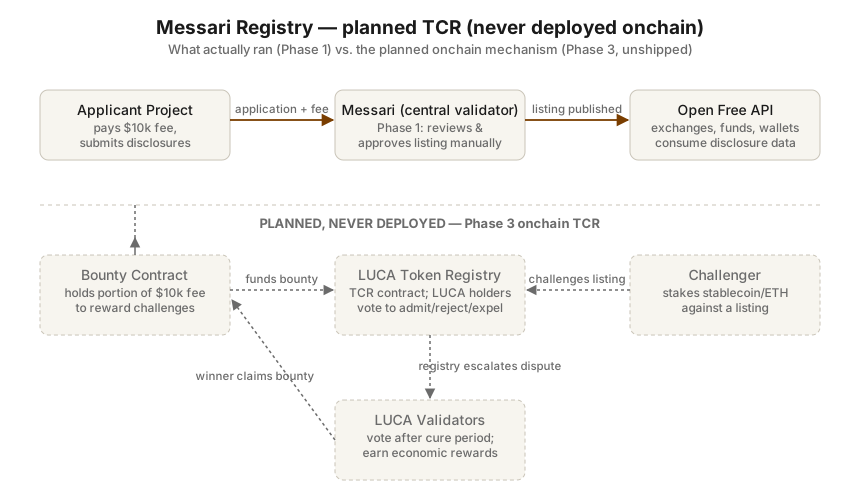
Per the official fact sheet, the design had three participant classes and a three-phase path to decentralization:
- Applicants (token projects) paid a $10,000 application fee, submitted standardized disclosures, committed to regular updates, and had to respond to challenges within a "cure period." A portion of the fee was to be held in a smart-contract bounty "to ward off / reward challenges to registry status." Post-decentralization, projects would pay $10,000 annually to remain listed.
- Validators. Phase 1: Messari validates centrally to bootstrap and stabilize the list. Phase 2: third parties join curation and voting. Phase 3: validation opens to all holders of the registry's native token, LUCA, which would confer "registry enforcement rights (voting power to admit, reject, or expel applicants) and economic rewards" for verification work — a classic Goldin-style TCR with fee revenue split between validators and an accuracy bounty pool.
- Challengers. Phase 1: Messari and community members raise concerns informally. Phase 2: third-party challenges resolved centrally. Phase 3: anyone can post a stablecoin/ETH stake against a listing; validators vote after the cure period, and winning challengers claim the issuer's bounty.
Distribution was the demand-side flywheel: registry data was free via an open API, so exchanges, funds, and wallets could embed the disclosures, making listing a credible transparency signal.
Outcome
The registry operated entirely in Phase 1. No LUCA token was issued, no registry or bounty contracts are known to have been deployed, and challenge staking never went live. Adoption: 12 projects at launch, 30+ by April 2019 (including Cosmos, Zcash, Qtum, Crypto.com, Fantom, AirSwap, Veil), and 54 by August 2019 — which Messari itself estimated at ~10% of its target market of assets with >$20M market cap or >$10M raised. Selkis's April 2019 retrospective reported that of ~100 projects pitched, ~30% joined, ~40% were warm, and ~30% refused — objecting to the $10k fee, claiming they were "already transparent," or citing security/liability concerns. Momentum faded after 2020; the messari.io/registry page's last substantive archive snapshot is July 2021, after which the product disappeared while Messari the company thrived as a research/data vendor. Outcome status: abandoned (the disclosure-standards idea partially lived on inside Messari's commercial asset profiles, but the registry — and especially its onchain TCR — was dropped).
Why it worked
- Real demand-side insight: crypto genuinely lacked standardized reference/disclosure data, and "free open API + credible brand validation" got a nontrivial cohort (including top-30 assets) to pay $10k/year for a transparency signal.
- Progressive decentralization was honest sequencing: centralize validation first to establish quality, only then hand curation to token holders — avoiding the cold-start curation failures of pure TCRs like AdChain.
- The challenge/bounty design correctly identified that disclosure accuracy needs adversarial incentives, not just goodwill.
Where the design broke
- Voluntary disclosure adverse selection: the projects most willing to disclose were the ones with least to hide; opaque projects — the registry's actual target — simply declined, and no regulator forced the issue. In the 2018–19 bear market, a $10k fee for a virtue signal was a hard sell.
- The token never made sense to ship: by 2019, the TCR literature's core critiques (low-information token voting, weak incentive to challenge, circular token value) were becoming consensus, undermining the case for launching LUCA at all. Phases 2–3 were quietly shelved.
- Business-model gravity: Messari found product-market fit selling research and data (Messari Pro, enterprise, protocol services). Free registry data undercut the paid product; the commercial arm absorbed the disclosure work and the open registry lost its champion.
- Network-effect chicken-and-egg: exchanges never made registry membership a listing requirement, so the "regulatory signal" never acquired teeth.
Lessons
- Transparency registries face adverse selection: opt-in disclosure attracts the already-transparent. Without an enforcement hook (exchange listing requirements, regulatory safe harbor), the marginal opaque project just opts out.
- "Progressive decentralization" often terminates at Phase 1. If the centralized version works commercially, the incentive to ship the token/decentralized phase evaporates; the onchain mechanism must deliver value the centralized version cannot, or it will remain a whitepaper.
- TCR token value is circular for low-frequency, high-judgment curation. Verifying legal/financial disclosures is expert work; distributing it to token-weighted voters adds Sybil and plutocracy problems without adding verification quality — a staked-challenge bounty on a centrally curated list captures most of the benefit.
- Free open data and a paid data business are structurally in tension inside one company; a public-good registry probably needs a foundation/consortium home, not a venture-backed startup.
- Selling to projects (fees) misprices the beneficiary: the consumers of disclosure data (investors, exchanges) capture the value; the issuers pay the cost.
Redesign (EDITORIAL — hypothesis, not fact)
This section is speculative analysis, not a description of anything Messari built or proposed. A modern redesign would drop the curation token entirely and keep the adversarial bounty: issuers escrow a stablecoin accuracy bond onchain, disclosures are posted as signed, hash-committed attestations (e.g., EAS on an Ethereum L2), and anyone can stake to challenge a specific claim, with disputes resolved by an optimistic-oracle or Kleros-style arbitration rather than registry-token voting. Enforcement teeth would come from the demand side, not fees: exchanges, structured-product issuers, and index providers commit (verifiably, onchain) to requiring a live, unchallenged attestation set as a listing precondition — converting the transparency signal into an economic gate. Much of the original disclosure schema (supply, unlocks, treasury, insider holdings) is now directly verifiable onchain, so the registry should auto-attest what chains can prove and reserve human bounties for offchain claims (audits, legal entities, team identity). Governance and hosting belong with a neutral consortium/foundation funded by data consumers, so the registry cannot be quietly absorbed by any single vendor's paid product — the failure mode that ended the original.
Sources
- Messari Launches a Disclosures Registry (official press release, 2018-11-27) — primary (docs)
- Open Source Disclosures Registry — Fact Sheet (LUCA token, phases, fees, challenge mechanism) — primary (docs)
- Messari early site — TCR vision ('Self-regulating the token economy may require…a token') — primary (docs)
- 18 Months of Transparency — Unqualified Opinions (founder retrospective, April 2019) — primary (retrospective)
- Messari Opens Disclosure Registry for Crypto Projects (CoinDesk, 2018-11-27) (news)
- Messari launches disclosures registry with 12 initial blockchain projects (CryptoNinjas) (news)
- Messari Disclosures Registry Tops 50 Cryptocurrencies (CoinDesk, 2019-08-20) (news)
- Token Curated Registries — Reflections from Ryan Selkis (Pillar VC, June 2018) (analysis)
- messari.io/registry — last substantive Wayback snapshot (2021-07-04), page later removed — primary (archive)
Last verified: 2026-07-26 · Spot an error? Suggest a correction