Unisocks
A 2019 Uniswap experiment that sold 500 pairs of physical socks as ERC-20 tokens (SOCKS) priced on an automated bonding curve, redeemable for real socks by burning the token.
▶ Run interactive simulation animated mechanism with editable parameters
How it works onchain
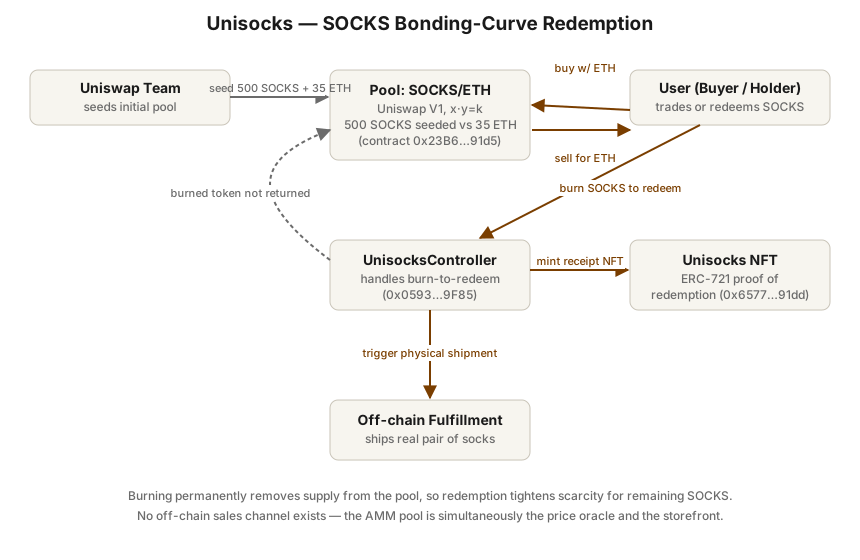 Open full-size diagram
Summary
Unisocks is one of the earliest and most-referenced "tokenized merch" experiments in DeFi. Launched by the Uniswap team on 9 May 2019 at the Fluidity Summit in New York, it created 500 pairs of limited-edition physical socks and represented each pair as a fungible ERC-20 token called SOCKS. Instead of a fixed retail price, the socks were sold through a Uniswap liquidity pool: 500 SOCKS were seeded against 35 ETH, and each purchase pushed the price up along a constant-product bonding curve. A holder could sell a SOCKS token back into the pool at any time, or burn it to redeem a real pair of socks shipped anywhere in the world, receiving a commemorative ERC-721 NFT as digital proof of redemption. The experiment was deliberately small and playful, but it became a canonical demonstration of AMM-based dynamic pricing and of using an on-chain market as the primary sales channel for a real-world good.
Design (Mechanism)
The core primitive is Uniswap's constant-product automated market maker, x * y = k. Uniswap minted 500 SOCKS (ERC-20, contract 0x23B6...91d5) and deposited all of them into a Uniswap V1 pool alongside 35 ETH. Price is therefore purely a function of the pool reserves: as SOCKS leave the pool, ETH reserves rise and remaining SOCKS become exponentially more expensive. The curve is extreme by design — the first pairs cost roughly $12, while contemporaneous coverage noted the 499th pair would cost on the order of 8,750 ETH and the last pair "more than all the ETH in existence." This scarcity gradient rewards early buyers and is the whole point: the AMM itself is the pricing oracle and the storefront.
Redemption is handled by the UnisocksController contract (0x0593...9F85). To claim a physical pair, a holder burns one SOCKS token; the controller mints them a Digital Unisocks ERC-721 NFT (0x6577...91dd) that serves as an on-chain receipt / proof-of-purchase, and the physical socks are shipped off-chain. Burning permanently removes a SOCKS from circulation, so redemption tightens supply and — because the burned token is not returned to the pool — increases scarcity for the remaining tokens. The design elegantly bridges a fungible tradable asset (SOCKS) with a non-fungible collectible (the redemption NFT) and a real object (the socks), all mediated by open smart contracts. The front-end (unisocks.exchange) and redemption flow were built by Uniswap engineers including Noah Zinsmeister, with design work by Callil Capuozzo (per GitHub PR history).
Outcome
Unisocks is best characterized as a major success relative to its modest goals. The initial ~$12 socks became a widely traded speculative and collectible asset. Media covered SOCKS crossing ~$92,000 per token in early 2021, and market-data aggregators record an all-time high around $198,000 in September 2021, an ROI in the thousands of percent for the earliest buyers. Over time a substantial fraction of the supply was redeemed and burned — circulating supply fell from 500 toward roughly 300 tokens — meaning hundreds of real pairs of socks were actually claimed and shipped. The contracts have run autonomously since 2019 with no exploits, and the GitHub repository was archived in July 2025, marking the experiment as effectively complete. As a marketing and conceptual artifact, it far outperformed its "sell some socks" premise: Unisocks is routinely cited as the origin reference for bonding-curve merch and tokenized real-world goods.
Why it worked
- Legendary simplicity. It reused Uniswap's existing AMM verbatim; no bespoke pricing math or oracle was needed. The pool is the price discovery, the treasury, and the exit liquidity.
- Real redemption backstop. Because every SOCKS could be burned for a genuine pair of socks, the token had a concrete floor of utility, distinguishing it from pure vaporware and giving speculation a tangible anchor.
- Narrative and timing. It launched as DeFi and AMMs were gaining attention, from the team building the canonical AMM. The absurd-yet-real "socks worth a house" story was inherently viral and doubled as a Uniswap demo.
- Verifiable scarcity. Fixed 500 supply plus burn-on-redemption made scarcity credible and monotonically increasing, aligning collector incentives.
Limitations and criticisms
Unisocks succeeded on its own terms, but its limits are instructive. As a commercial enterprise it was trivial (500 pairs), so "success" is cultural rather than economic. The extreme bonding curve meant almost no one could realistically buy socks at the "product" price once early demand hit — the mechanism optimized for speculation and collectibility over accessible retail, which undercuts it as a template for actually selling merch at scale. Liquidity thinned dramatically as tokens were redeemed and burned, leaving very few SOCKS in the pool and making the quoted market price highly illiquid and volatile (a large notional "price" backed by minimal depth). It was also never designed to be repeatable or extensible into a broader product line; it remained a one-off "Edition 0."
Lessons
- An AMM can be a storefront. Pairing a redeemable ERC-20 against ETH in a constant-product pool turns price discovery, sales, and buyback into a single permissionless contract — a reusable pattern for dynamically priced goods.
- Back tokens with real redemption to create a floor. Burn-to-redeem for a physical (or otherwise useful) asset gives a token grounded utility and turns holders into a mix of users and speculators; it also creates deflationary scarcity that reinforces collector value.
- Bonding-curve steepness is a policy choice with tradeoffs. A steep curve maximizes early-adopter upside and viral scarcity but sacrifices affordability and post-launch liquidity — great for a collectible meme, poor for broad retail distribution.
- Small, self-contained experiments can have outsized narrative ROI. A 500-unit stunt became a lasting reference point; conceptual clarity and shareability mattered more than scale.
Redesign (EDITORIAL — hypothesis, not fact)
The following is the researcher's editorial hypothesis, not established fact.
A modern redesign could preserve the charm while fixing the accessibility/liquidity tension. First, consider a dual-tier design: a fixed-price redemption tranche (affordable socks for real users) alongside a smaller bonding-curve tranche for collectors, so the mechanism doesn't force every buyer into a speculative curve. Second, replace the single V1-style constant-product pool with a concentrated-liquidity or explicitly-specified bonding curve (e.g., a documented, gentler polynomial) so pricing intent is transparent rather than an emergent artifact of x*y=k, and so liquidity doesn't evaporate as supply burns. Third, make the proof-of-redemption NFT richer: on-chain metadata capturing edition, redemption date, and shipping-region hash, enabling verifiable provenance and secondary collectible markets independent of the fungible token. Fourth, add an optional protocol-owned liquidity floor funded from a small mint/redemption fee, so late holders can always exit at a defensible minimum rather than facing a near-empty pool. Finally, a redesign might ship the socks as an ERC-1155 hybrid (fungible-until-claimed, then a unique claimed edition), collapsing the three-contract architecture into one auditable contract and reducing the surface area between "tradable," "burned," and "collectible" states. The goal: keep the viral scarcity story but make the good actually purchasable and the market durably liquid.
Sources
- Uniswap/unisocks GitHub repository (An experiment in dynamically priced merch) — primary (contract)
- Uniswap/unisocks-erc721 README (contract addresses) — primary (contract)
- SOCKS token on Etherscan (0x23b6...91d5) — primary (contract)
- launch redemption PR #2 (Noah Zinsmeister) — primary (contract)
- Unisocks Explained (analysis)
- People Are Selling Digital Socks for $92,000 on Ethereum's Uniswap (news)
- Uniswap socks-backed tokens reach $92K (news)
- Unisocks (SOCKS) market data (analysis)
Last verified: 2026-07-26 · Spot an error? Suggest a correction