Unstoppable Domains
NFT-based blockchain domain names (.crypto, .nft, .wallet, etc.) sold as one-time-purchase ERC-721 tokens meant to replace crypto wallet addresses and, eventually, resist censorship of DNS — later pivoted into a traditional ICANN-accredited registrar.
▶ Run interactive simulation animated mechanism with editable parameters
How it works onchain
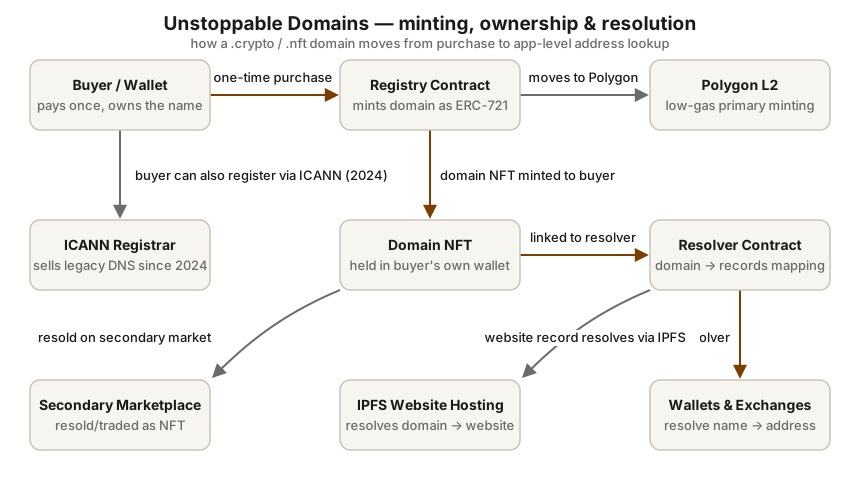 Open full-size diagram
Summary
Unstoppable Domains sells human-readable blockchain "domain" names — .crypto, .nft, .wallet, .x, .888, .zil, and others — as ERC-721 NFTs. A domain like alice.crypto is minted once, owned outright by its buyer's wallet, and requires no annual renewal, in contrast to ICANN-registered DNS names leased under yearly contracts. The pitch was twofold: (1) a much shorter, memorable stand-in for long hexadecimal wallet addresses across hundreds of integrated wallets and exchanges, and (2) eventually, a website-naming layer that no registrar, court order, or government could suspend, because ownership lives on-chain rather than in a centrally administered registry. The company was founded in 2018 by Matthew Gould and Brad Kam (with other early collaborators from a 2017 Silicon Valley crypto meetup, including Braden Pezeshki, credited in company retrospectives), raised a $65 million Series A led by Pantera Capital at a $1 billion valuation in 2022, and by 2024–2026 had also become an ICANN-accredited registrar selling conventional DNS names alongside its blockchain TLDs.
Design (Mechanism)
The original architecture — the Crypto Name Service (CNS), later folded into the broader Unstoppable Name Service (UNS) — is built from two core Ethereum smart contracts: a Registry contract that mints domains as ERC-721 tokens and tracks ownership/subdomain issuance, and a Resolver contract that maps a domain to records (cryptocurrency addresses for dozens of chains, IPFS website hashes, social handles, etc.). Because each domain is an NFT sitting in the buyer's own wallet, transferring or updating it is just a normal token operation — no renewal invoice, no third-party approval step embedded in the base registry logic. To cut Ethereum gas costs, Unstoppable later moved primary minting to Polygon while keeping cross-chain compatibility (and, still later, added support for resolving .eth names from ENS to broaden coverage). Domains are sold as one-time purchases with tiered pricing by name length/desirability, funded by the initial sale plus a native UD utility/governance token and partner integration fees. Adoption was pursued by integrating the resolver into wallets, exchanges, and browsers (several hundred partner apps, and native resolution in Brave and Opera) rather than by getting .crypto/.nft/.wallet accepted into the ICANN root zone that mainstream browsers consult by default.
Outcome
Commercially, Unstoppable Domains reached unicorn status: a $65 million Series A at a $1 billion valuation in July 2022 (Pantera Capital-led, following roughly $7 million in earlier funding from Boost VC and Draper Associates), millions of domains minted, and integrations across a large share of the wallet/exchange ecosystem as a wallet-address shorthand. As pure "unstoppable, censorship-resistant websites," however, the mechanism never achieved the universal, no-extension browser resolution its name promised: Chrome, Safari, Firefox, and Edge still do not resolve .crypto/.nft/.wallet addresses natively, requiring a browser extension, a custom DNS resolver, or a crypto-native browser (Brave, Opera). By 2024 the company had obtained ICANN registrar accreditation and by 2026 was marketing itself as an "ICANN-Accredited Registrar" selling conventional DNS names in addition to blockchain domains — a structural blending back into the very centrally administered namespace the original design was built to route around.
Why it worked
- Wallet-address UX was a real, immediate pain point. Replacing a 42-character hex address with
alice.cryptoinside wallets/exchanges solved a genuine usability problem independent of any browser-resolution ambitions, and this narrower use case is what actually drove adoption. - No renewal fees removed a recurring friction/revenue-extraction point that DNS registrars use, which was an easy, legible pitch to consumers used to annual domain bills.
- NFT ownership made the asset itself investable/tradeable, attracting speculative secondary-market demand (rare/short names, matching-brand names) that subsidized growth independent of the underlying naming utility.
- Multi-chain, low-friction integration strategy (partnering with wallets and exchanges rather than trying to force browser vendors to adopt a new TLD root) let the resolver format spread quickly through crypto-native applications where it mattered most.
Limitations and criticisms
- Browser resolution never became universal. The core "unstoppable website" promise depends on ordinary users being able to type a
.cryptoaddress into any mainstream browser and reach a site; in practice this required extensions or niche browsers for most users, which is the same adoption barrier every alt-root naming system (Handshake, ENS-as-website, .bit, etc.) has faced. - Sitting outside the ICANN root creates collision risk, not just neutrality. Because
.wallet,.nft, and similar strings were sold by Unstoppable before/alongside ICANN's own new-gTLD expansion process, a traditional ICANN-approved.wallet(or similar) can create naming collisions where the blockchain version simply does not resolve the way buyers expected when they purchased it as a "permanent," "unstoppable" name. - The 2024–2026 pivot to ICANN accreditation is a structural concession. A protocol whose branding is built on bypassing centralized domain administration voluntarily becoming an accredited participant in that same centralized system is a strong signal that the alt-root approach alone could not deliver mainstream naming utility.
- "No renewal fee" shifts, rather than eliminates, the incentive question. Ongoing resolver infrastructure, dispute/abuse handling, and support costs still exist; a one-time purchase model works financially only as long as new sales and secondary trading (or a parallel accredited-registrar business) keep funding the company that maintains those services.
Lessons
- A naming system's cryptographic ownership guarantees (NFT in your wallet, no admin key) do not automatically translate into the "unstoppable" property users infer from the name — resolution still depends on browsers, DNS resolvers, or extensions that a company, standards body, or ISP can choose not to support.
- Solving a narrow, well-defined UX problem (short names for wallet addresses) can generate real commercial success even when the more ambitious framing (censorship-resistant websites) is not achieved — the two should be evaluated separately.
- Operating a namespace outside an existing coordinated root (ICANN) avoids that root's governance, but at the cost of potential string collisions if the legacy root ever issues the same strings — a risk that only becomes visible years after initial sales.
- A "no renewal fee, forever" pricing promise is a strong marketing lever, but it commits the issuer to funding indefinite infrastructure maintenance from one-time sales, secondary-market activity, or diversification into other revenue lines (as the shift toward conventional registrar services suggests).
Redesign (EDITORIAL — hypothesis, not fact)
A design more likely to deliver on the literal "unstoppable" promise might have separated the two products from day one: (1) a wallet-address-resolution NFT name (what actually succeeded) marketed purely as UX convenience, with no implication of website permanence; and (2) a genuinely separate "censorship-resistant hosting" product that pursued browser-vendor and OS-level resolver adoption as an explicit, funded, multi-year standards effort (comparable to how HTTPS or WebAuthn achieved default support) rather than relying on extensions and niche browsers to carry the whole distribution burden. Coupling the resolver to a public, auditable "collision registry" cross-referenced against ICANN's gTLD application queue — so buyers of .wallet-style names could see collision risk before purchase — would have made the one-time-purchase promise more honest. Finally, if the end goal was always partial interoperability with the legacy DNS system (as the 2024 ICANN accreditation suggests), an earlier and more transparent statement of that dual-track strategy — blockchain-native identity now, negotiated interoperability with ICANN later — would have set more accurate expectations for buyers who purchased names specifically for their "unstoppable" censorship-resistance property.
Sources
- The Unstoppable Origin Story — primary (company blog)
- Unstoppable Domains — About — primary (company site)
- UD Token contract on Etherscan — primary (block explorer)
- Displaying your domain on Twitter (support article referencing @unstoppableweb) — primary (company support docs)
- Registrar Unstoppable Domains Raises $65 Million To Make Website Domains Into NFTs (news)
- Unstoppable Domains: Blockchain-Based Crypto Domain (explainer)
- What's the Difference Between HNS, ENS, & Unstoppable Domains? (comparison article)
- Comparing decentralized DNS providers (3DNS, ENS, Unstoppable, Handshake, D3) (comparison article)
- Web3 Domains Are Dead: Unstoppable Domains Admits Defeat and Pivots to Traditional DNS (analysis)
Last verified: 2026-07-28 · Spot an error? Suggest a correction