Huma Finance
Self-styled 'first PayFi network' that lends stablecoin liquidity against short-duration payment receivables (mainly cross-border settlement advances via merged partner Arf), generating real fee yield while its HUMA token fell ~80% under unlock pressure.
▶ Run interactive simulation animated mechanism with editable parameters
How it works onchain
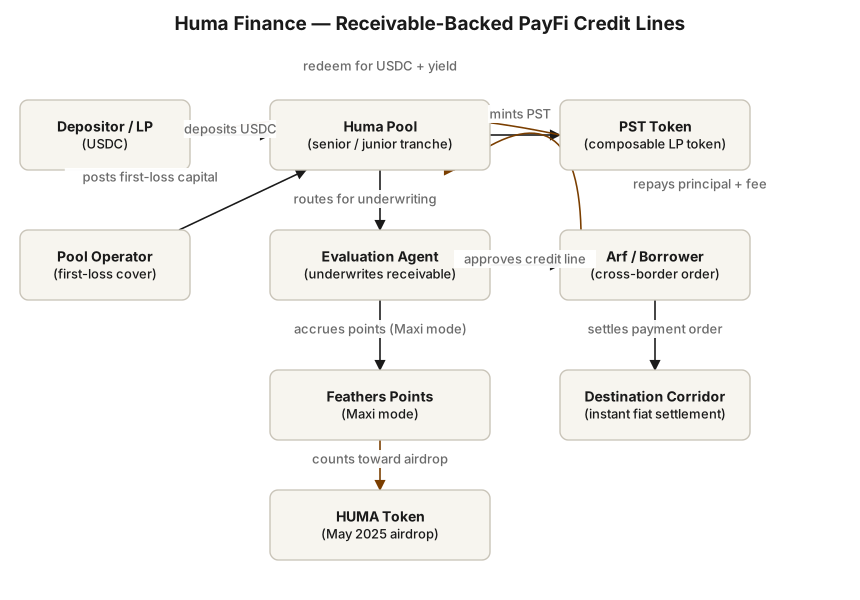 Open full-size diagram
Summary
Huma Finance, founded in 2022 by ex-Facebook/Lyft/Earnin product lead Erbil Karaman and ex-Google engineering lead Richard Liu (with co-founders Ji Peng and Lei Du), began as "income-backed lending for the 99%" — credit lines underwritten against future income streams — and pivoted into what it branded the first "PayFi" (payment financing) network. The core experiment: fund real-world payment flows (chiefly cross-border settlement advances) with on-chain stablecoin liquidity, so depositors earn yield from transaction fees on genuine commerce rather than token emissions. After merging with Swiss cross-border liquidity platform Arf in April 2024 and raising $38M in September 2024 (Distributed Global lead; Stellar Development Foundation contributed $10M), Huma launched a permissionless "Huma 2.0" on Solana in April 2025 and a HUMA token in May 2025. The lending business has performed — billions in financed volume with no reported credit defaults through 2024 — while the token has been a poor performer, down roughly 80% from its listing-day high amid heavy unlocks.
Design (Mechanism)
Huma V1 (2023, Ethereum/Polygon, later Celo) was a generalized receivable-financing protocol: borrowers tokenize receivables (invoices, remittance orders, future income) and draw revolving stablecoin credit against them, with underwriting delegated to "Evaluation Agents" and lender protection via tranching (senior/junior) plus first-loss cover posted by pool operators — a structure borrowed from securitization.
The PayFi pivot narrowed this to payment settlement finance. A licensed cross-border payment institution (Arf being the flagship, in-house borrower after the merger) needs same-day liquidity at the destination corridor while fiat settlement takes days. It tokenizes the payment order/receivable, borrows USDC against it for a 1–6 day term, settles instantly, and repays with a daily fee when fiat arrives. Because capital recycles dozens of times per year, small per-transaction fees compound into double-digit annualized yields on modest credit risk — short-duration, self-liquidating receivables rather than speculative loans.
Huma 2.0 (April 2025, Solana-only) made deposit access permissionless and composable: depositors choose "Classic" mode (stable real USDC yield, ~10%+ at launch) or "Maxi" mode (foregoing yield for multiplied "Feathers" points ahead of the airdrop), and receive the PayFi Strategy Token (PST), an LP token designed to plug into Solana DeFi (Jupiter, Kamino, RateX). The HUMA token launched May 26, 2025 via airdrop and exchange listings, intended for governance and ecosystem incentives. Contracts were audited by Halborn (Solana programs, multiple rounds), Spearbit (v1/v2 EVM), with Certora formal verification per third-party summaries.
Outcome
Operationally strong, token-wise weak — an increasingly familiar RWA split. Huma/Arf surpassed $1.8B in cumulative payment financing by September 2024, claimed over $2B processed in 2024 with zero credit defaults, and reported $4.4B+ cumulative volume and 50,000+ depositors around the Huma 2.0 launch; annualized protocol revenue reportedly reached $17M by August 2025. Partnerships expanded the model (December 2025: Tala, a fintech serving underbanked borrowers, building tokenized lending on Huma/Solana). The HUMA token hit its all-time high ($0.117) on listing day, May 26, 2025, then fell ~80%, hitting all-time lows ahead of a 378M-token unlock; sustained supply inflation has outrun demand. A May 2026 exploit drained about $101K from deprecated contracts — embarrassing but immaterial to active pools. Status: ongoing.
Why it worked
- Real, short-duration cash flows. Financing settlement gaps in payments is one of the few RWA categories where blockchain speed is the product: 1–6 day self-liquidating advances with high capital turnover produce genuine fee yield without duration or speculative credit risk.
- Vertical integration via Arf. Merging with its largest borrower gave Huma proprietary, regulated origination flow — solving the borrower-sourcing problem that starves most on-chain credit protocols.
- Structured-finance protections. Tranching and first-loss cover gave senior stablecoin LPs a familiar, defensible risk position; zero reported defaults validated the underwriting through 2024–2025.
- Credible team and backers (ex-Google/Facebook founders; Distributed Global, HashKey, Stellar Development Foundation, Solana Foundation endorsement) helped it survive the post-2022 credit-protocol winter that killed peers.
Limitations and criticisms
- Token–protocol disconnect. HUMA accrues little of the fee revenue; with aggressive unlocks (e.g., the 378M unlock) and points-farmed airdrop supply, price fell ~80% from listing, damaging community trust regardless of business health.
- Borrower concentration and related-party risk. Post-merger, the dominant borrower (Arf) is an affiliate — "zero defaults" is partly self-reported performance of an in-house counterparty, limiting the claim's independence.
- Opacity trade-off. Receivables are tokenized "in a privacy-preserving manner"; LPs cannot independently verify the underlying payment orders and must trust Huma's risk reporting.
- Hygiene lapse: the May 2026 deprecated-contract exploit (~$101K), though small, showed decommissioning gaps.
Lessons
- Payment-settlement finance is a rare RWA niche where crypto's settlement speed creates the yield (capital velocity), not just distributes it — short, self-liquidating receivables beat long-dated loans on-chain.
- On-chain private credit tends to converge on vertical integration: when permissionless underwriting fails to source good borrowers, protocols acquire their borrower — gaining volume but reintroducing related-party trust assumptions.
- A healthy lending business does not make a healthy token; without direct fee accrual, unlock schedules and points-mercenary supply dominate price discovery.
- "Zero defaults" claims need independent attestation; privacy-preserving collateral means LP yield rests on the operator's credibility.
- Deprecated contracts remain attack surface — decommissioning is a security process, not a status change.
Redesign (EDITORIAL — hypothesis, not fact)
This section is editorial hypothesis, not reported fact. A redesign would tie the token to the business from day one: route a fixed share of net financing fees to staked HUMA, since the business is already fee-generating. Publish per-pool, per-counterparty performance attested by an independent trustee or proof-of-receivable oracle, so "zero defaults" is verifiable, and cap affiliate (Arf) exposure per pool to force third-party origination. Replace Maxi-mode points farming with lockups that vest against realized protocol revenue, aligning depositors with duration rather than airdrop timing. Finally, adopt formal sunset procedures — pausing, draining, and revoking approvals on deprecated contracts — as a standing security discipline.
Sources
- Huma Raises $38M to Hyper-scale its Payment Financing (PayFi) Network — primary (docs)
- Huma Finance and Arf Merge to Transform Global Finance Through Real World Asset Tokenization — primary (docs)
- Huma Finance documentation — primary (docs)
- Halborn — Huma Solana Programs Audit (permissionless program, March 2025) — primary (audit)
- Huma Finance 2.0 Launches on Solana, Bringing Composable Real Yield to DeFi Users (Decrypt) (news)
- Tokenization platform Huma Finance merges with Circle-backed liquidity platform Arf (The Block) (news)
- Huma Expands Payment Financing Reach With Launch on Solana (PYMNTS) (news)
- Huma Finance (HUMA) Falls to All-Time Low Ahead of 378M Token Unlock (CCN) (analysis)
- Understanding Huma Finance: A Comprehensive Overview (Messari) (analysis)
- Tala Partners with Huma Finance to Launch Tokenized Lending Platform for the Global Underbanked (news)
Related experiments
Last verified: 2026-07-27 · Spot an error? Suggest a correction