Anchor Protocol
Terra's flagship savings protocol that paid a ~19.5% 'Anchor Rate' on UST deposits by recycling staking rewards from bonded-asset collateral — and became the demand engine whose unsustainable subsidy helped detonate the entire Terra ecosystem in May 2022.
▶ Run interactive simulation animated mechanism with editable parameters
How it works onchain
 Open full-size diagram
Summary
Anchor Protocol was the savings layer of the Terra ecosystem: a CosmWasm money market, launched on mainnet on March 17, 2021, that promised depositors of TerraUSD (UST) a stable "Anchor Rate" of roughly 19.5–20% APY. The whitepaper (June 2020, by Terraform Labs' Nicholas Platias, Eui Joon Lee, and Harvard's Marco Di Maggio) pitched it as the "gold standard for passive income" — a benchmark risk-free-rate for crypto derived from proof-of-stake block rewards rather than speculative lending demand. Anchor grew into DeFi's third-largest protocol ($16–17B TVL, ~$14B in UST deposits at peak) and at times held roughly three-quarters of all circulating UST. That concentration made it the single largest source of demand for Terra's algorithmic stablecoin, and when the subsidized rate proved structurally underfunded, Anchor became the accelerant of the May 2022 UST/LUNA death spiral — one of the largest wealth destructions in crypto history ($40–50B).
Design (Mechanism)
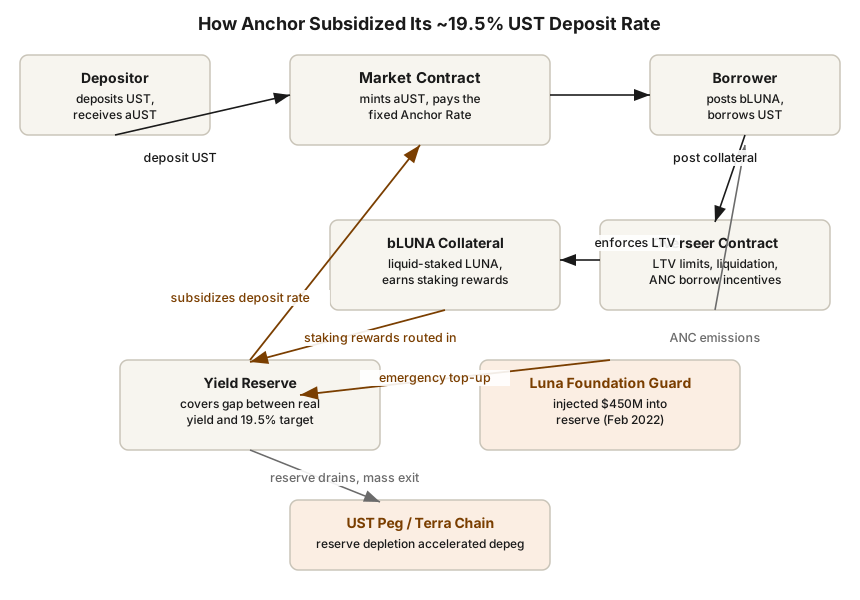
Anchor was a two-sided money market with an asymmetric twist. Depositors supplied UST and received aUST, an interest-accruing receipt token redeemable for principal plus yield. Borrowers posted "bAssets" — liquid-staking derivatives of PoS assets, initially bLUNA and later bETH — as collateral to borrow UST against a maximum loan-to-value ratio, with undercollateralized positions liquidated via a liquidation-queue contract.
The core innovation was the yield source: instead of paying depositors only the borrow interest, Anchor confiscated the staking rewards thrown off by borrowers' bAsset collateral and used them to subsidize the deposit rate toward a governance-set target (the Anchor Rate, ~19.5%). The theory: staking yields are stabler than money-market rates, so a savings product built on them could offer a stable benchmark rate.
Two shock absorbers papered over the gap between real yield (borrow interest + staking rewards) and the promised rate. First, a yield reserve: when real yield fell short, the difference was drained from a protocol-owned reserve; when it exceeded the target, the surplus refilled it. Second, ANC token emissions: borrowers were paid ANC incentives that ratcheted up 50% per week whenever real yield sat below target, attempting to stimulate borrowing demand (many borrowers effectively borrowed at negative net rates). ANC also served as governance and captured protocol fees. After Prop 20 (passed March 24, 2022), the fixed rate became "semi-dynamic," adjusting up to 1.5 percentage points per month based on yield-reserve flows.
Outcome
Failed. Anchor's economics were lopsided from early on: deposits massively outgrew borrowing (bull-market leverage demand evaporated in late 2021), so real yield covered only a fraction of the ~19.5% payout. The yield reserve drained more than 80% between December 2021 and February 2022, forcing the Luna Foundation Guard to inject ~450M UST in February 2022 — an explicit admission the rate was a marketing subsidy. Prop 20's glide path cut the rate to ~18% for May 2022, but the adjustment arrived years too late. When UST depegged on May 7–9, 2022, Anchor's ~$14B deposit base — much of it mercenary capital present only for the 20% — fled at once, converting the depeg into a terminal bank run on the entire Terra system. LUNA hyperinflated, UST collapsed, and Anchor's TVL went to effectively zero within days. ANC, which had traded above $5, became worthless alongside the chain. There was no smart-contract exploit — Anchor's contracts operated as designed; the failure was economic, not technical.
Why it worked
- A single legible number. "20% on dollars" was the most effective growth hook DeFi ever produced; it compressed a complex mechanism into a rate anyone could compare to a bank account, and it manufactured billions in demand for UST.
- Genuinely novel yield routing. Recycling collateral staking rewards into the deposit rate was a real mechanism-design idea — a stabler yield base than pure utilization-curve lending, and the ancestor of later "LST-collateral" money markets.
- Clean UX and composability. aUST was a simple interest-bearing token that the whole Terra ecosystem (Mirror, Pylon, degen "Anchor loops") built on, and one-click Earn made it a retail on-ramp (including via third-party apps like Stablegains).
Why it failed or underperformed
- The rate was set by decree, not by markets. 19.5% was a governance-fixed target, decoupled from real yield. Deposits (~$14B) dwarfed borrowing, so the promise was arithmetic that could only be met by draining reserves and printing ANC.
- Reflexive dependence on its own ecosystem. Anchor's collateral (bLUNA) and its deposit asset (UST) were both bets on Terra. When LUNA fell, collateral values, borrowing capacity, staking-reward yield, and depositor confidence all collapsed simultaneously — perfectly correlated failure.
- Subsidy as systemic risk. By holding ~72% of UST supply, Anchor turned an unsustainable marketing budget into the stablecoin's primary use case. The subsidy could not be lowered quickly without triggering the very outflows it was postponing — a classic exit-blocked Ponzi-adjacent dynamic.
- Fixes came too late. The $450M LFG top-up bought weeks, not sustainability; Prop 20's ±1.5%/month glide path assumed calm markets it never got.
Lessons
- A "fixed" deposit rate that exceeds the real yield of the underlying system is a countdown timer, and the reserve that funds the gap tells you exactly how much time is left — publish it, watch it, and treat top-ups as red flags, not reassurance.
- Yield that exists to create demand for another asset (here, UST) imports that asset's entire tail risk; depositors were not being paid 20% for lending risk, they were being paid to hold algorithmic-stablecoin peg risk without pricing it.
- Mercenary capital concentration is a mechanism-design variable: when one protocol holds most of a currency's float, its parameter changes become monetary policy, and rate cuts become bank runs.
- Subsidy schedules should be dynamic from day one; retrofitting market-responsive rates onto a user base recruited by a fixed promise (Prop 20) is politically and practically almost impossible.
Redesign (EDITORIAL — hypothesis, not fact)
This section is editorial hypothesis, not historical fact. A survivable Anchor would invert the promise: pay a floating rate equal to verifiable real yield (borrow interest plus collateral staking rewards, reported on-chain per epoch), and market the smoothing, not the number — use the yield reserve only to dampen volatility around that real rate within a hard band (e.g., ±2%), with an automatic circuit breaker that floats the rate fully whenever the reserve covers less than N weeks of runway. Cap the share of the stablecoin's total supply the protocol may hold (or apply progressive rate haircuts above a concentration threshold) so the savings product cannot become the currency's only demand sink. Diversify collateral to exogenous assets (ETH LSTs, BTC) so yield and solvency don't correlate with the host chain, and denominate deposits in a redeemable, fully-reserved stablecoin rather than an endogenous algorithmic one. Finally, fund growth transparently: if a foundation wants to subsidize rates, force it through a time-boxed, on-chain "subsidy budget" line item that users see at deposit time — a disclosed teaser rate is a marketing expense; an undisclosed one is a solvency illusion.
Sources
- Anchor Protocol Documentation — Protocol Overview / Money Market / Deposit Rate Subsidization — primary (docs)
- Anchor deployed contracts (official docs repo) — primary (contract)
- Introducing Anchor — Nicholas Platias (Terra Medium, launch announcement) — primary (docs)
- DeFi Protocol Anchor Launches on Terra (Crypto Briefing, March 2021) (news)
- Luna Foundation Guard $450M yield-reserve injection (Feb 2022) (news)
- Anchor Protocol Will Readjust Interest Rates Each Month (Prop 20, CoinDesk, March 2022) (governance)
- DOJ: Do Kwon Pleads Guilty to Fraud (SDNY, Aug 2025) — primary (news)
- Do Kwon sentenced to 15 years (CoinDesk, Dec 2025) (news)
- Anchor's Yield Reserve is Not Looking Well (Xangle research) (analysis)
Related experiments
Last verified: 2026-07-27 · Spot an error? Suggest a correction