Stream Finance (xUSD)
A yield-bearing 'synthetic dollar' (xUSD) backed by opaque, off-chain-managed leveraged strategies that collapsed after a curator lost $93M, triggering a ~$285M DeFi contagion event.
▶ Run interactive simulation animated mechanism with editable parameters
How it works onchain
 Open full-size diagram
Summary
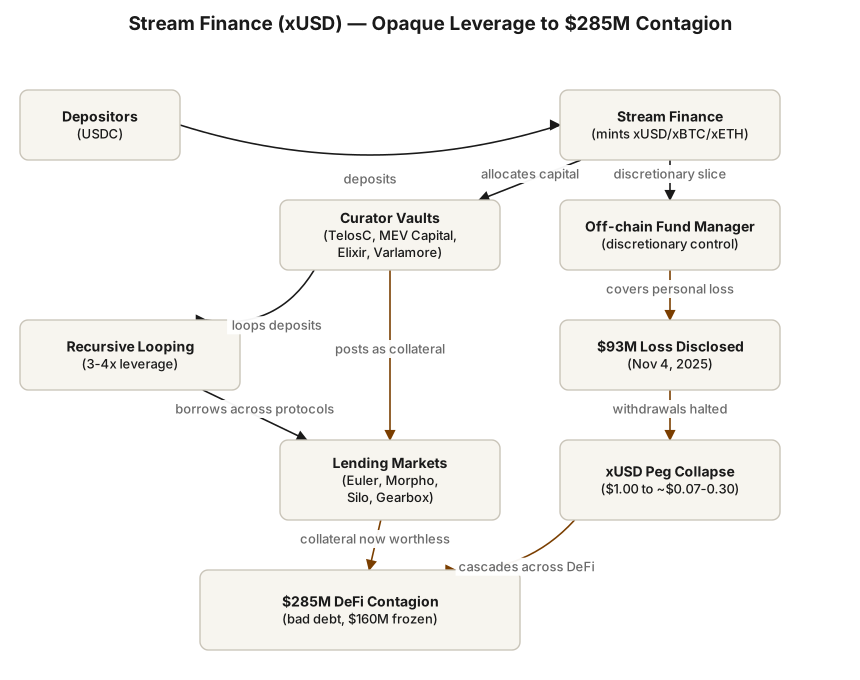
Stream Finance was a DeFi yield protocol that let users deposit stablecoins (primarily USDC) and receive xUSD, marketed as a yield-bearing "synthetic dollar." Behind the scenes, deposits were deployed into a mix of on-chain and off-chain leveraged strategies — lending arbitrage, hedged market making, and recursive looping across lending markets — managed partly by third-party "curators" (TelosC, MEV Capital, Elixir, Varlamore) and partly by an external, largely undisclosed fund manager. On November 4, 2025, Stream halted all deposits and withdrawals after disclosing that an external fund manager had lost approximately $93 million of protocol assets. xUSD's peg collapsed within hours — falling from $1.00 to roughly $0.26–$0.30 and eventually trading as low as $0.07–$0.14 with almost no liquidity. Because xUSD, along with sister tokens xBTC and xETH, had been widely rehypothecated as collateral in third-party lending markets (Euler, Morpho, Silo, Gearbox), the collapse cascaded into an estimated $285 million of interconnected bad debt and roughly $160 million of frozen user funds across DeFi, including a near-total collapse of Elixir's deUSD, which had 65% of its backing lent to Stream through private Morpho vaults.
Design (Mechanism)
Unlike fiat-collateralized stablecoins, xUSD's peg was not backed 1:1 by cash-equivalent reserves held in transparent custody. Instead, Stream's strategy was to accept stablecoin deposits and redeploy them through recursive "looping": a deposit would be posted as collateral to borrow additional funds, which were then redeposited as collateral to borrow again, repeating across multiple lending protocols. Reports estimated this could turn a single $1 million deposit into $3–4 million of deployed capital, amplifying yield (and risk) several times over. A portion of this capital flow was routed through curated vaults run by firms like TelosC and MEV Capital, which earned management fees scaled to assets deployed — an incentive structure that favored growth over caution. Separately, an unnamed external fund manager reportedly had discretionary control over a slice of Stream's assets off-chain, outside of on-chain verifiability. xUSD tokens (and companion xBTC/xETH tokens) were accepted as collateral by major lending markets such as Euler, Morpho, and Silo, meaning Stream's synthetic assets became embedded as collateral throughout the broader DeFi lending stack — a form of rehypothecation that turned a single point of failure into a systemic one.
Outcome
On November 4, 2025, Stream disclosed that the external fund manager had lost about $93 million, reportedly after a margin call on a personal loan led to a liquidated position that was then covered using Stream protocol assets. Stream immediately suspended deposits and withdrawals — removing the very redemption mechanism that could have helped stabilize the peg — which instead triggered a bank run via decentralized exchanges. xUSD's on-chain trading price plunged roughly 70–90% within days. Lending markets that had accepted xUSD/xBTC/xETH as collateral saw utilization spike to 100% with borrow rates as high as 88%, freezing an estimated $160 million in user funds and leaving roughly $285 million of debt across Euler, Silo, Morpho, and Gearbox backed by now-worthless collateral. TelosC alone reported $123.6 million in losses and MEV Capital $25.4 million. As of the last verification date, xUSD remained severely depegged with negligible liquidity and no announced redemption or compensation plan.
Why it worked
- For roughly a year and a half, Stream successfully attracted deposits by advertising high, "institutional-grade" yields, and its curator-vault model let sophisticated allocators (and by extension retail depositors via those vaults) access leveraged DeFi yield without directly managing the looping strategies themselves.
- Integration of xUSD as accepted collateral across major lending protocols (Euler, Morpho, Silo) gave the token an appearance of liquidity and legitimacy, which helped it scale to hundreds of millions in TVL before the collapse.
Where the design broke
- xUSD's peg rested on leveraged, partly off-chain, opaque strategies rather than transparent, liquid reserves — there was no public real-time proof of reserves, so depositors and even integrating protocols could not verify solvency.
- A single external fund manager reportedly had discretionary access to protocol assets outside on-chain controls; when that manager allegedly used protocol funds to cover a personal liquidation, the loss (~$93M) was concentrated and unrecoverable.
- Recursive looping amplified both yield and downside risk, and rehypothecating xUSD as collateral across multiple third-party lending markets meant the failure propagated well beyond Stream itself.
- Suspending withdrawals at the moment of crisis removed the mechanism that could have absorbed selling pressure, effectively converting a solvency problem into an uncontrolled market-driven depeg.
Lessons
- Yield-bearing "stablecoins" backed by active leveraged strategies (rather than transparent, liquid, verifiable reserves) carry fundamentally different risk than fiat-collateralized stablecoins, and should not be treated as cash-equivalent collateral by other protocols.
- Curator/vault-manager fee structures based on assets-under-management, without matching downside accountability, create incentives to prioritize growth and leverage over risk containment.
- Allowing a single actor (whether a smart contract admin key or, as here, an off-chain fund manager) discretionary control over protocol assets reintroduces centralized counterparty risk into an otherwise "decentralized" system.
- Widespread rehypothecation of a single opaque asset as collateral across many independent lending markets creates systemic contagion risk; protocols integrating exotic collateral should cap exposure and require transparent proof-of-reserves.
- Freezing redemptions during a crisis can worsen outcomes by pushing panic into external markets (DEXs) where price discovery is uncontrolled, rather than providing an orderly off-ramp.
Redesign (EDITORIAL)
EDITORIAL / hypothesis, not fact: A safer version of Stream's model might have (1) required real-time, cryptographically verifiable proof-of-reserves for all strategies, on-chain and off-chain, with automatic circuit-breakers if attestations lapsed; (2) capped leverage/looping ratios and published them publicly rather than relying on curator discretion; (3) eliminated single-signer off-chain fund manager control entirely, replacing it with multi-party custody and pre-defined, auditable strategy mandates; and (4) required any protocol accepting xUSD-like tokens as collateral to apply conservative loan-to-value haircuts and exposure caps reflecting the asset's opacity, rather than treating it as equivalent to a fiat-backed stablecoin. None of this was implemented before the collapse, and it remains speculative whether such controls would have been commercially viable given the yields Stream advertised.
Sources
- Stream Finance's xUSD Depeg Explained: What Happened and Why It Matters (news analysis)
- Anatomy of a $285M DeFi Contagion: The Stream Finance xUSD Collapse (news analysis)
- Stream Finance founders sue business partner, allege $93m used to cover personal losses (news / legal)
- Stream Fund Discloses $93M Loss, Temporarily Halts Operations (news)
- Analysts map $285M in potential exposure across DeFi after Stream Finance's $93M loss (news analysis)
- Stream Finance (@StreamDefi) on X — primary (official social)
Related experiments
Last verified: 2026-07-27 · Spot an error? Suggest a correction