Falcon Finance
DWF Labs-incubated 'universal collateralization' protocol that mints an overcollateralized synthetic dollar (USDf) against crypto, stablecoin, and tokenized RWA collateral, then survived a July 2025 depeg scare with a public transparency push.
▶ Run interactive simulation animated mechanism with editable parameters
How it works onchain
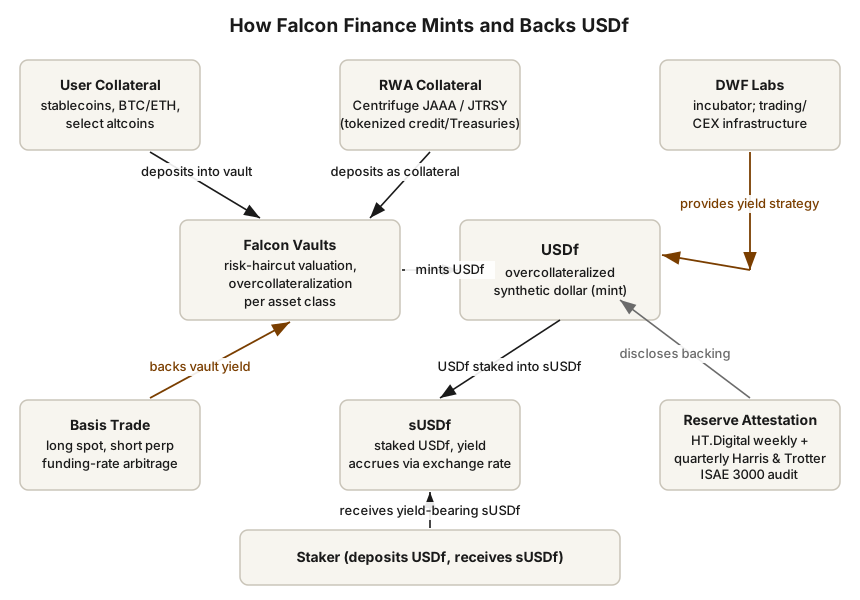 Open full-size diagram
Summary
Falcon Finance is a "universal collateralization" protocol launched April 30, 2025 by Andrei Grachev, managing partner of market-maker DWF Labs, which incubated the project. Users deposit a wide range of collateral — stablecoins, blue-chip crypto (BTC, ETH), select altcoins, and, from November 2025 onward, tokenized real-world assets such as Centrifuge's JAAA (corporate credit) and JTRSY (tokenized Treasuries) — and mint USDf, an overcollateralized synthetic dollar. USDf can be staked for sUSDf, a yield-bearing wrapper whose returns come from a mix of delta-neutral basis-trade arbitrage, market-making, and (increasingly) RWA yield. The protocol markets itself as a diversified alternative to single-strategy synthetic dollars like Ethena's USDe, which depend almost entirely on perpetual funding-rate arbitrage.
Design (Mechanism)
Collateral is deposited into Falcon's vaults and valued with a haircut that varies by asset risk (stablecoins near 1:1, volatile assets overcollateralized more heavily), and USDf is minted against that collateral value. The backing strategies described in Falcon's docs and whitepaper include classic basis/funding-rate arbitrage (long spot, short perp), cross-exchange and OTC market-making (leveraging DWF Labs' trading infrastructure and CEX relationships), and — as of Q4 2025 — direct RWA yield from tokenized credit and Treasury products. sUSDf accrues this yield to stakers via a growing exchange rate against USDf. An FF governance/utility token was also issued. Reserve transparency is handled through weekly attestations by HT.Digital and a quarterly independent assurance report (first published October 2025, performed by Harris & Trotter LLP under ISAE 3000), plus a public dashboard breaking reserves down by asset class.
Outcome
USDf grew quickly after launch, with circulating supply reported above $350M within months and continuing to expand through the RWA collateral push in late 2025. On July 8, 2025, USDf lost its peg by nearly 80 basis points amid market concern that reserves were opaque — critics noted that a large share of backing assets sat off-chain with third-party custodians without granular public disclosure at the time. The peg recovered, and Falcon subsequently accelerated its transparency program (weekly reserve breakdowns, the October 2025 audit, and a public dashboard) in direct response to the episode. As of mid-2026 the protocol is operating, expanding collateral types and chains, and continuing quarterly audits, but it remains dependent on off-chain trading strategies and custodial arrangements that are harder to verify on-chain than fully collateralized or purely crypto-native designs.
Why it worked
- DWF Labs distribution and liquidity: Incubation by an active market-maker gave Falcon immediate access to trading infrastructure, exchange relationships, and liquidity for basis-trade strategies that smaller teams couldn't easily replicate.
- Diversified yield thesis: By combining basis arbitrage, market-making, and RWA yield rather than relying solely on perp funding rates, Falcon reduced (in principle) its exposure to the funding-rate compression that has hurt single-strategy synthetic dollars during low-volatility periods.
- Rapid response to the depeg: Rather than staying quiet, Falcon published weekly attestations and commissioned an independent quarterly audit after the July 2025 scare, which helped rebuild market confidence and differentiate it from more opaque competitors.
- RWA collateral expansion: Adding tokenized Treasuries and corporate credit as collateral broadened the yield base and appealed to institutional-style users seeking more predictable returns than pure crypto basis trades.
Limitations and criticisms
- Opaque reserves at launch: Falcon's initial disclosure was thin — most reserves were reported to be held off-chain with custodians, with no granular per-asset breakdown — which is precisely what triggered the July 2025 depeg once market participants started asking questions.
- Custodial/counterparty risk: Strategies relying on CEX market-making and off-chain custodians reintroduce exactly the kind of trust assumptions DeFi synthetic dollars are supposed to minimize; a custodian or exchange failure is not something on-chain proofs alone can rule out.
- Concentration and governance concerns: As a DWF Labs-incubated and -operated project, Falcon inherits questions about conflicts of interest given DWF Labs' dual role as a major crypto market-maker and token investor across the industry.
- Track record still short: With roughly a year of live operation as of mid-2026, including one public depeg event, Falcon has not yet demonstrated multi-cycle resilience comparable to longer-running stablecoin protocols.
Lessons
- Diversifying yield sources (basis trades + market-making + RWA) can reduce single-point-of-failure risk relative to protocols that depend entirely on perpetual funding rates, but it also multiplies the number of counterparties and off-chain trust assumptions a user must evaluate.
- Transparency has to be proactive, not reactive: Falcon's opaque initial reserve reporting directly caused the depeg it later spent months of PR and audit spend repairing; publishing granular reserve data from day one is cheaper than rebuilding trust after a scare.
- Backing by a market-maker/liquidity provider is a double-edged sword — it accelerates bootstrapping and liquidity, but it concentrates trust in a single entity's trading operations and creates conflict-of-interest questions that pure on-chain designs avoid.
- Quarterly third-party assurance reports (ISAE 3000-style) are becoming a de facto industry standard for overcollateralized synthetic dollars post-Terra/UST and post-various depeg events; protocols that skip this step invite exactly the scrutiny that caused USDf's July 2025 wobble.
Redesign (EDITORIAL)
EDITORIAL — hypothesis, not fact. A more trust-minimized version of Falcon could publish real-time, cryptographically verifiable proof-of-reserves (e.g., via on-chain oracle attestations of custodial balances or zero-knowledge proof-of-solvency) rather than weekly/quarterly manual attestations, closing the gap between "audited last week" and "solvent right now" that made the July 2025 depeg possible. It could also cap the share of collateral routed through any single custodian or counterparty (including DWF Labs-affiliated venues) and publish that concentration ratio alongside reserve data, directly addressing the conflict-of-interest critique. Finally, splitting USDf into explicit risk tranches — a conservative, fully on-chain-verifiable stablecoin-and-RWA-backed tranche versus a higher-yield, higher-risk basis-trade tranche — would let users choose their risk exposure explicitly instead of blending both into one token whose composition shifts over time.
Sources
- Falcon Finance — Official Site — primary (official)
- USDf (Synthetic Dollar) | Falcon Finance Docs — primary (docs)
- Falcon Finance Whitepaper (Andrei Grachev, Sept 2025) — primary (docs)
- Smart Contracts | Falcon Finance Docs — primary (docs)
- Falcon Finance Publishes Independent Quarterly Audit Report Confirming USDf Fully Backed by Reserves — primary (press-release)
- How the USDF depeg unfolded | Exponential DeFi (analysis)
- Falcon USDf Loses Peg, Sparking Stablecoin Crisis Fears (Ainvest) (analysis)
- USDf (Falcon USD) Stablecoin Risk Profile | Pharos (analysis)
- DWF Labs-backed Falcon Finance claims $10 million investment from Trump's World Liberty Financial (The Block) (news)
- Understanding Falcon Finance: A Comprehensive Overview | Messari (analysis)
Related experiments
Last verified: 2026-07-27 · Spot an error? Suggest a correction