0xMonaco
Paradigm CTF 2022's onchain PvP racing game in which players deploy smart contracts as 'cars' that buy acceleration and shells at VRGDA-driven dynamic prices, becoming the first live proving ground for Variable Rate Gradual Dutch Auctions.
▶ Run interactive simulation animated mechanism with editable parameters
How it works onchain
 Open full-size diagram
Summary
0xMonaco was the finale of Paradigm CTF 2022, announced on August 20, 2022 by Paradigm researcher transmissions11 (t11s). Unlike the CTF's other challenges — which had fixed exploit solutions — 0xMonaco was a player-versus-player onchain racing game: each team wrote and deployed an immutable Solidity smart contract, a "car," and three cars at a time raced to a finish line 1,000 units away. Cars spent a fixed budget of in-game coins on two actions, acceleration and shells (projectiles that slow the leader), whose prices were set dynamically by Variable Rate Gradual Dutch Auctions (VRGDAs) — making 0xMonaco the first live, adversarial deployment of the VRGDA mechanism that Paradigm formalized in a paper by transmissions11, Frankie, and Dave White that same month. Teams iterated on their cars around the clock during the competition, climbing an ELO ladder; the OpenSea team (with 0age) finished top-ranked. The format proved so popular it was revived by Matchbox DAO as "0xMonaco: Battle of Titans" on Starknet in January 2023, where a Uniswap developer team beat squads from Polygon, OtterSec, Ledger, Chainlink, NEAR, OKX, and Bybit in a Twitch-streamed final.
Design (Mechanism)
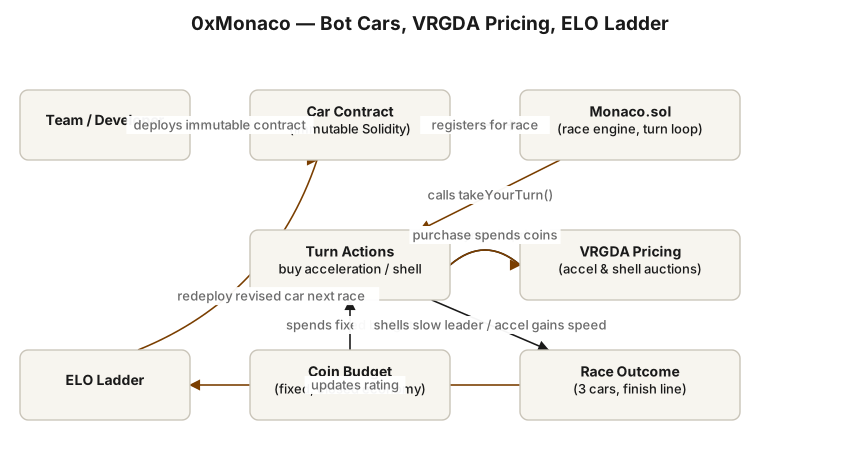
The core loop was deliberately simple and fully deterministic:
- Code as player. Each entrant was an immutable smart contract implementing a
takeYourTurn-style callback. Once deployed, no human input was possible; all strategy had to be encoded in advance. Teams could, however, deploy new cars between races, creating a meta-game of continuous redeployment against an evolving field. - Closed economy. Each car began with a fixed coin balance (15,000 coins in the Battle of Titans configuration) and could never earn more. Every race was therefore a budget-exhaustion problem: spend too early and you are defenseless late; hoard too long and you never build position.
- Two actions, dynamically priced. Acceleration added permanent speed; shells zeroed out or damaged the speed of the car ahead. Both were priced by VRGDAs: prices rise exponentially when purchases outpace the issuance schedule and decay when demand lags. Buying a burst of acceleration made the next units sharply more expensive — for everyone — so aggression created shared scarcity, and patience was rewarded with "cheap speed."
- Three-player game theory. Races were 3-way, not head-to-head. Shelling the leader benefits the third player for free, so the dominant meta (documented in finisher retrospectives) became sitting in second or third, conserving coins, and "slingshotting" past drained leaders near the finish — a kingmaker-laden structure closer to poker than chess.
- ELO ladder. Cars were matched continuously over roughly 24+ hours, with ratings updating after each race, so robustness across many random opponent triples — not one lucky race — determined the winner.
Outcome
0xMonaco was a breakout success by every non-commercial measure. It dominated crypto-Twitter attention during Paradigm CTF 2022, drew teams from major firms (the top-ELO car was fielded by OpenSea engineers, who open-sourced it), and generated an unusually rich body of public retrospectives dissecting strategies — economic pacing models, "kink-distance" spending formulas, rear-view-mirror shell conservation, and race-stage state machines. It validated VRGDAs under genuinely adversarial demand, with Paradigm's own paper citing 0xMonaco as having "created a challenging and highly competitive game loop." The design was successful enough to be forked into an esports format: Matchbox DAO's "0xMonaco: Battle of Titans" (January 29, 2023) on Starknet, streamed on Twitch, with Uniswap defeating Polygon and OtterSec in the final and committing to open-source its winning car. The original game site is now offline; the contracts survive in public repos.
Why it worked
- Perfect audience-mechanism fit. The only way to play was to write a smart contract, so the game selected exactly the players (Solidity engineers, auditors, MEV searchers) who would find bot-vs-bot mechanism design thrilling rather than alienating.
- VRGDA pricing created emergent strategy from two actions. Dynamic pricing turned a trivial action space into a deep economic game: timing purchases against the price curve mattered as much as racing position.
- Immutability plus redeployment. Freezing strategy at deploy time made each race a pure test of foresight, while allowing new deployments between races produced a visible, fast-moving metagame that kept spectators engaged.
- Determinism made it auditable and fair. No oracles, no randomness disputes — every race outcome was reproducible from the contracts alone.
Limitations and criticisms
0xMonaco's design carries real limits worth weighing honestly. It was an ephemeral event, not a persistent protocol: the CTF environment was torn down, there is no canonical mainnet deployment, and its continuation depended entirely on outside organizers staging new tournaments (Paradigm never ran a sequel; Matchbox DAO's Starknet revival was a one-off event series that itself did not repeat). The skill floor — writing gas-efficient adversarial Solidity under time pressure — capped the player base at professional developers, which sharpened competition but forecloses any broader, casual audience. The 3-player race structure also embedded a persistent kingmaker/free-rider dynamic (shelling the leader subsidizes the trailing car for free) that top strategists exploited but that no version of the format has resolved into clean competitive balance.
Lessons
- Adversarial games are the best testnets for economic mechanisms. VRGDAs got a harsher stress test from a weekend of PvP racing than from months of simulation; shipping a new pricing primitive inside a game de-risked it for later production use (e.g., NFT issuance).
- "Code is the player" is a distinct and potent genre. Removing real-time human input turns a game into a mechanism-design essay contest, generating open-source strategy literature as a byproduct — valuable to the whole ecosystem.
- Shared price curves convert individual aggression into a public cost. Pricing actions on a common VRGDA makes every purchase a signal and a tax on imitators — a reusable pattern for any onchain game economy that needs self-balancing without admin tuning.
- Ephemerality is a trade-off, not a flaw — but plan for succession. A time-boxed event maximizes intensity, yet without a standing league or canonical deployment the cultural capital dissipates; 0xMonaco's afterlife depended entirely on a third party (Matchbox DAO) picking it up.
Redesign (EDITORIAL — hypothesis, not fact)
This section is editorial speculation, not historical fact. A persistent 0xMonaco league could run seasons on a cheap L2 with a canonical, immutable Monaco.sol and open registration, staking a small entry fee into a VRGDA-priced prize pool so the economy funds itself. To blunt the kingmaker problem, races could rotate between 2-, 3-, and 4-car formats with ELO computed across formats, making pure free-rider strategies less dominant. A "frozen bytecode" championship tier (no redeployment for a season) would separate foresight from iteration speed, while an open tier preserves the metagame. Finally, commit-reveal car submission with delayed source publication would build the strategy archive deliberately — each season ends with mandatory open-sourcing, turning the league into a compounding public library of adversarial contract engineering.
Sources
- t11s: 'introducing 0xMonaco' (launch announcement) — primary (retrospective)
- Paradigm: Variable Rate GDAs (VRGDA paper; cites 0xMonaco as a live use) — primary (docs)
- Community mirror of the 0xMonaco car contracts (Paradigm CTF 2022) (contract)
- 0age: OpenSea team car source (top-ranked finisher by ELO) — primary (retrospective)
- AbdullaTheDruid: 0xMonaco retrospective (2nd place finisher) — primary (retrospective)
- saucepoint: 0xMonaco strategy retrospective (race-stage meta) — primary (retrospective)
- Matchbox DAO: Introducing 0xMonaco — The Battle of Titans — primary (docs)
- Cointelegraph: MatchboxDAO launches esports experience for Web3 developers (news)
- The Block: Uniswap dev team wins web3 gaming Battle of Titans competition (news)
- Kaiziron: Paradigm CTF 2022 writeup — 0xMonaco (analysis)
Related experiments
Last verified: 2026-07-27 · Spot an error? Suggest a correction