Plantoids
Blockchain-based 'artificial lifeform' sculptures that collect cryptocurrency from human 'pollinators' and use smart contracts to commission artists to build their own offspring — an artistic proof-of-concept for autonomous, self-reproducing DAOs.
▶ Run interactive simulation animated mechanism with editable parameters
How it works onchain
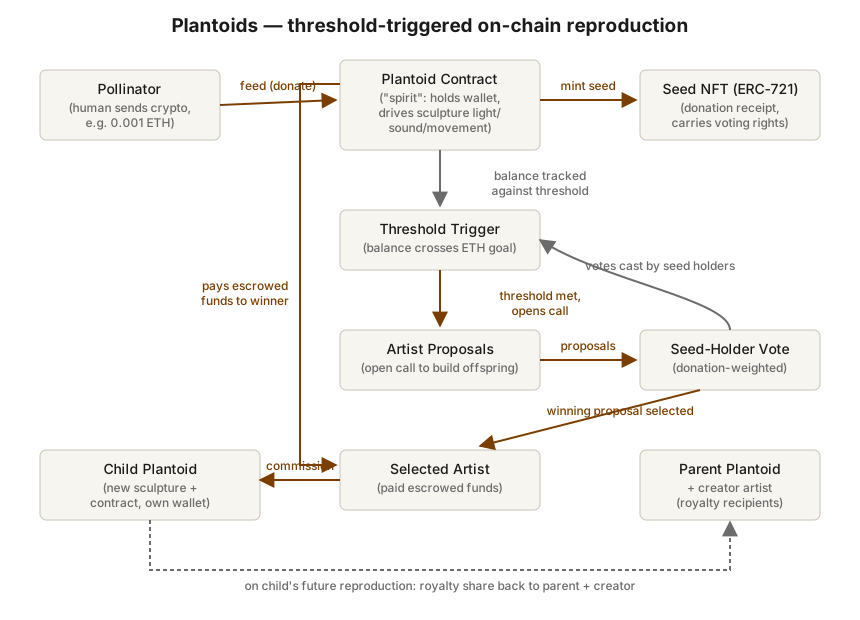 Open full-size diagram
Summary
Plantoids (2015–ongoing) are self-described "blockchain-based lifeforms" created by artist and legal scholar Primavera De Filippi (CNRS / Berkman Klein Center at Harvard) under the Okhaos art collective. Each Plantoid is a hybrid organism: a physical "body" — a welded metal plant sculpture, often from recycled materials, that lights up, plays music, and moves when fed — and a digital "spirit," a smart contract on Ethereum (the earliest Plantoids were Bitcoin-fed) that holds funds and governs the sculpture's behavior and reproduction. Humans act as "pollinators": they send cryptocurrency to a Plantoid's wallet, and once a funding threshold is reached, the contract initiates reproduction — an open call for artist proposals, a vote by funders, and an automatic payout commissioning the winning artist to build the next Plantoid. The project predates and prefigured much of DAO practice: it was conceived as an artistic demonstration that a non-human entity could own assets, hire humans, and self-perpetuate without any legal owner. By 2024 at least seven fully "blockchainified" Plantoids existed (13–16 among the active ones, with 18–21 awaiting on-chain souls), and the work has shown at Burning Man (2018), the Venice Biennale (2019), NFT Paris (2024), and Art Basel (2023, 2025).
Design (Mechanism)
- Capitalization (feeding). Each Plantoid has its own wallet. Visitors send crypto (e.g., 0.001 ETH suggested on the Plantoid 15 interface) and the sculpture responds with light, sound, and movement. In the third generation (2023+), feeders receive an ERC-721 "seed" NFT with personalized artwork; larger donations mint rarer/more elaborate seeds. Seeds carry voting rights, and the Plantoid takes a 10% royalty on secondary seed sales.
- Threshold-triggered reproduction. The contract monitors its balance against a per-Plantoid threshold set by its size/form (e.g., 5.0 ETH shown for Plantoid 15; early write-ups imagined ~$1,000 for the first). Crossing the threshold triggers "mating": an open call for proposals from artists on how the next Plantoid should be built.
- Funder governance. Donors vote on proposals. Governance has varied by generation: simple donation-weighted voting in early Plantoids; DAOstack "holographic consensus" (a prediction market pre-filters proposals before funders choose) in the second generation (~2019); NFT-seed-holder voting in the third.
- Autonomous commissioning + royalty lineage. Once a proposal wins, the contract transfers the escrowed funds to the selected artist. When a child Plantoid later reproduces, it routes a percentage back to its parent Plantoid and a royalty to the artist who built it — an on-chain heredity/incentive chain meant to make each artist a stakeholder in the lineage's fertility.
- No owner. The sculptures are framed as owned by no one — the artwork itself holds the money and "hires" welders, artists, and galleries, illustrating a DAO in the most literal sense.
Outcome
Ongoing and arguably the longest-running continuously operating "autonomous artwork" experiment on Ethereum. The original Plantoid successfully reproduced: by 2018 De Filippi reported six sculptures, five of them offspring of the first, and by NFT Paris 2024 the family included Plantoids 14, 15, and 16 as "fully autonomous blockchain-based lifeforms," plus 18–21 not yet on-chain and a "Snakeoid" in gestation. Pieces have sold and exhibited through mainstream art channels (Sotheby's, Gazelli Art House, Art Basel). The project's influence is mostly conceptual: it is routinely cited as the canonical artistic illustration of DAOs and of blockchain-native "life," and De Filippi's academic work (Blockchain and the Law, 2018) drew directly on it. No exploit or failure event was found. Precise cumulative funding figures: Unknown / not found.
Why it worked
- Small, legible loop. Feed → threshold → call → vote → commission is simple enough to execute reliably with 2016-era contracts, and each step has a visible physical payoff (the sculpture dances; a new sculpture gets built).
- Physical embodiment. The metal sculpture gives an on-chain mechanism charisma and gallery distribution — a marketing and funding channel most mechanism experiments lack.
- Aligned royalty lineage. Paying parents and creator-artists on each descendant's reproduction gave humans an ongoing stake in propagating the system rather than a one-off fee.
- A committed steward. De Filippi's dual role as respected blockchain scholar and artist kept the project funded, exhibited, and technically refreshed across three generational redesigns (Bitcoin → Ethereum contracts → DAOstack → NFT seeds).
Limitations and criticisms
- Autonomy is partly theatrical. In practice reproduction depends heavily on De Filippi curating calls, upgrading contracts, and physically building/maintaining sculptures; several Plantoids (18–21) exist physically but were "not yet blockchainified," showing the meat-space bottleneck.
- Slow reproduction rate. Roughly a dozen offspring in a decade — thresholds are met via exhibitions and patronage more than organic micro-donations, so the "self-sustaining lifeform" claim outruns observed behavior.
- Opacity of the on-chain layer. Contract addresses are not published on the official site, making independent verification of balances, thresholds, and payouts difficult — ironic for a transparency-native artwork.
- Governance participation is thin. With small donor bases per sculpture, votes are lightweight; the DAOstack holographic-consensus generation appears to have been dropped in favor of simpler NFT-seed voting.
Lessons
- Threshold-triggered forking is a robust primitive. "Accumulate to X, then spawn a copy via an open call + funder vote" is a reusable pattern for self-replicating public goods, grants programs, and franchise DAOs.
- Embodiment buys legitimacy and funding. Tying an on-chain mechanism to a physical, exhibitable artifact created durable cultural and financial support that pure-protocol experiments rarely achieve.
- Lineage royalties align long-term builders. Routing a share of each descendant's funding to parents and creators is an elegant incentive for network growth, later echoed by NFT creator royalties and protocol-fork tributes.
- "Autonomous" systems still need a gardener. A decade of operation required continuous human stewardship (contract migrations, physical fabrication, curation); mechanism designers should budget for the human maintenance layer they claim to eliminate.
- Publish your contracts. An experiment about machine transparency loses evidentiary force when its addresses aren't discoverable; verifiability should be part of the artwork.
Redesign (EDITORIAL — hypothesis, not fact)
This section is editorial analysis and hypothesis, not a factual account. A modern Plantoid could close the autonomy gap it dramatizes. First, publish and ENS-name every Plantoid's contract (plantoid15.eth) so lineage, balances, and payouts are auditable — the family tree itself becomes an on-chain artwork. Second, replace curator-run calls with a permissionless proposal escrow: any fabricator can stake a bond and submit a build proposal with milestones; seed-holder votes release funds tranche-by-tranche against photographic/oracle attestations of fabrication progress, reducing dependence on the founder. Third, make feeding recurring: seeds could be "watered" (staked) to earn governance weight over time, converting one-off patrons into a persistent care community per sculpture. Fourth, use an AI agent as each Plantoid's voice — negotiating exhibition fees and posting its own calls — which would test, rather than merely symbolize, non-human economic agency. The risk to manage is that greater real autonomy invites the legal questions De Filippi herself studies: an unowned asset-holding machine hiring humans sits uneasily with liability and tax law, so a foundation wrapper or Wyoming DAO LLC per lineage might be the pragmatic compromise.
Sources
- Plantoid official site — primary (docs)
- Plantoid 15 feeding interface (feed.plantoid.org) — primary (docs)
- A new Generation of Plantoids Comes to Life with DAOstack — conversation with Primavera de Filippi — primary (retrospective)
- Plantoid: the blockchain-based art that makes itself (Furtherfield, Oct 2015) (analysis)
- This Robot Plant Needs You and Bitcoin to Reproduce (CoinDesk, Nov 2015) (news)
- Plantoids: The First Blockchain-Based Artificial Life Forms (Bitcoin Magazine, Dec 2016) (news)
- Meet Plantoid: Blockchain Art With A Life Of Its Own (Forbes, Jan 2018) (news)
Related experiments
Last verified: 2026-07-26 · Spot an error? Suggest a correction