Zeus Network
A Solana-based MPC "guardian" network that lets users mint zBTC — a 1:1 Bitcoin-backed asset — directly from native BTC deposits without a custodian, betting that permissionless threshold-signing validators can replace federated bridge custody.
▶ Run interactive simulation animated mechanism with editable parameters
How it works onchain
 Open full-size diagram
Summary
Zeus Network is a Solana-native protocol that tries to solve a specific version of the bridging problem: getting real, native Bitcoin — not a custodian's IOU on another chain — usable inside Solana DeFi without reintroducing a single trusted custodian. Its flagship product, zBTC, is minted 1:1 when a user sends BTC to a Zeus-generated deposit address; the underlying Bitcoin is then held under the joint control of a permissionless network of "Guardian" validators who co-sign Bitcoin-side transactions using multi-party computation (MPC) rather than any one party holding a private key. The project, led by founder/CEO Justin Wang and backed by Solana co-founder Anatoly Yakovenko and Stacks founder Muneeb Ali, launched its "APOLLO" mainnet v1 on December 30, 2024, positioning itself as one of several competing designs (alongside things like threshold-signature bridges and BitVM-style constructions) for bringing Bitcoin liquidity onto faster, more programmable chains.
Design (Mechanism)
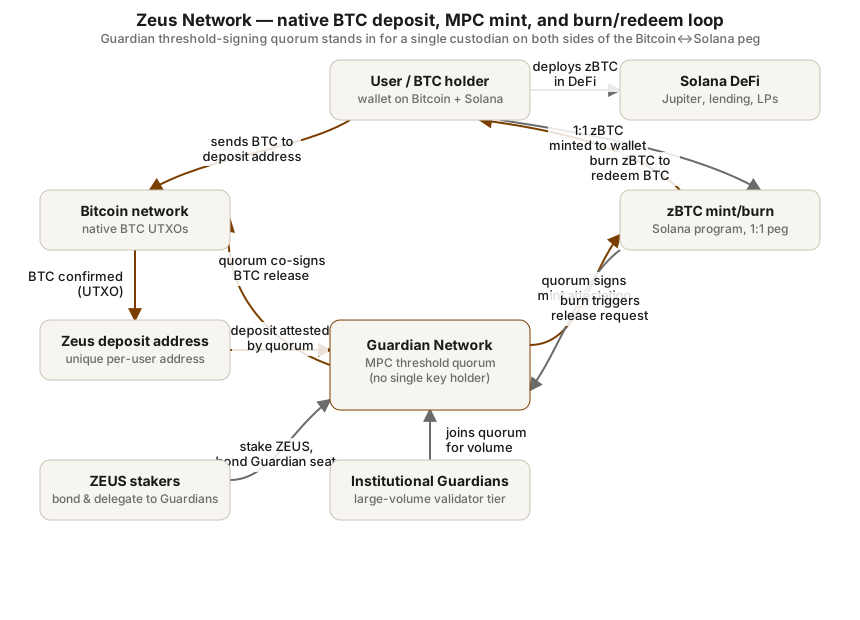
The mechanism has three interlocking pieces. First, the Guardian network: instead of a foundation-run multisig or a single MPC operator, Zeus opens validator slots to two tiers — ordinary Guardians, who stake and delegate the ZEUS token to earn a role in the signing set, and Institutional Guardians, aimed at larger, professionally-operated custodial-grade participants who can handle bigger BTC volumes. Both tiers jointly hold key shares in an MPC threshold-signature scheme, meaning no single Guardian (or even a minority) can move the underlying Bitcoin unilaterally; a quorum of shares must cooperate to sign any Bitcoin-network transaction.
Second, the deposit/mint flow: a user requests a unique Bitcoin address from the protocol, sends native BTC to it, and once confirmed on the Bitcoin chain, the Guardian network attests to the deposit and an equivalent amount of zBTC is minted on Solana. Withdrawal reverses this — zBTC is burned on Solana, and the Guardians cooperatively sign a Bitcoin transaction releasing the corresponding BTC back to the user, without routing through a centralized reserve operator's private key.
Third, the incentive layer: ZEUS token staking is used both to bond Guardians (giving them skin in the game and, implicitly, something to lose if they misbehave or go offline) and to align long-term protocol growth with token holders, who are also exposed to fee/yield flows generated as zBTC circulates through Solana DeFi (lending markets, DEX pools, Jupiter swaps, etc.). The pitch is that this converts Bitcoin from a purely custodial, walled-off store of value into a "programmable" asset without requiring users to trust a single bridge operator — replacing single-party custodial risk with a distributed, economically-bonded quorum.
Outcome
zBTC shipped on schedule relative to its stated targets: a testnet in mid-2024 (reportedly connecting some 15,000 wallets within 72 hours of its final testnet phase) followed by APOLLO mainnet v1 on December 30, 2024. By mid-2025 the project reported having processed over $250 million in cumulative transaction volume and zBTC had become the third-largest wrapped/synthetic Bitcoin representation on Solana, behind Coinbase's cbBTC and the long-standing wBTC. Zeus also raised an $8 million token round at a roughly $100 million valuation from investors including Mechanism Capital, OKX Ventures, and Animoca Ventures. In April 2026 Zeus Network was acquired by Astarter, a DeFi platform, with stated plans to extend zBTC beyond Solana into Cardano — though as of the acquisition announcement no on-chain treasury moves, token migrations, or contract-ownership changes had yet been observed, and no Cardano-side zBTC contracts had been deployed. zBTC itself has continued operating on Solana with TVL reported in the tens of millions of dollars.
Why it worked
Zeus's core insight — that Bitcoin holders want DeFi yield without giving up on Bitcoin's "no counterparty" ethos — targeted real, sizable demand: Bitcoin is by far the largest crypto asset by market cap, yet the vast majority of it sits idle rather than participating in onchain lending, trading, or liquidity provision. By emphasizing permissionless Guardian participation and MPC-based custody instead of a small closed multisig, Zeus differentiated itself from earlier wrapped-BTC models (like wBTC's centralized custodian, BitGo) at a moment when the market had grown more sensitive to custodial bridge risk following years of bridge exploits industry-wide. Backing and endorsement from well-known ecosystem figures (Yakovenko, Ali) plus a functioning testnet-to-mainnet cadence gave it credibility and liquidity to bootstrap early adoption, and Solana's cheap, fast execution environment made zBTC immediately useful as DeFi collateral rather than a dormant wrapped token.
Limitations and criticisms
The MPC Guardian model shifts trust rather than eliminating it: security still depends on a threshold of Guardians behaving honestly and remaining online, on the correctness of the MPC implementation itself, and on the game-theoretic assumption that ZEUS-token bonding is large enough relative to the BTC actually secured to deter collusion — a ratio that can drift unfavorably as zBTC's TVL grows faster than Guardian stake value. The two-tier Guardian/Institutional Guardian structure also reintroduces a soft form of centralization, since Institutional Guardians handling "significant volumes of BTC" concentrate more of the security budget among fewer, larger participants, resembling a permissioned federation more than the fully permissionless framing implies. Independent, plain-language security audits of the Guardian MPC implementation and Bitcoin transaction-signing logic were not identified in this research pass, and no smart-contract program IDs could be independently verified, limiting the ability to assess the true attack surface. Finally, the 2026 acquisition by Astarter — while framed as expansion into Cardano — introduces governance and roadmap uncertainty for a protocol whose entire value proposition rests on users trusting its custody design over long time horizons.
Lessons
- Replacing a single custodian with a distributed MPC quorum reduces single-point-of-failure risk but does not remove trust from the system; it relocates trust to "will a threshold of Guardians behave honestly," which still needs independently verifiable security proofs and audits to be credible.
- Tiering validators (Guardians vs. Institutional Guardians) to bootstrap capacity for large BTC volumes is a pragmatic scaling choice, but it creates a legibility gap between a protocol's "permissionless" marketing and its actual concentration of custody among a few large participants.
- Bitcoin-DeFi bridge designs are judged less by the elegance of their cryptography and more by their track record: surviving multiple years without an incident, publishing audits, and maintaining liquidity depth matter more to adoption than protocol launch announcements.
- Ownership changes (acquisitions, protocol pivots) are a real tail risk for infrastructure whose entire value proposition is long-horizon custodial trust — even when no immediate on-chain change occurs, uncertainty about future governance can matter to users holding bridged assets.
Redesign (EDITORIAL — hypothesis, not fact)
If re-architected, a stronger version of Zeus's model would publish, as a first-class product feature rather than a marketing claim, a continuously updated "collateralization health" dashboard: the ratio of ZEUS (or other bonded value) securing the network versus the current dollar value of BTC held in custody, with automatic mint-pausing if that ratio falls below a hard-coded safety threshold. It would also formally cap the fraction of custodied BTC that can sit with Institutional Guardians relative to the broader permissionless Guardian set, preventing the "permissionless" framing from quietly becoming a de facto federation as volume scales. Finally, a redesign might separate the yield-bearing DeFi layer from the base custody layer entirely — letting zBTC holders opt into a base "plain custody" wrapped token with minimal validator count and maximal auditability, versus a separate higher-yield-but-higher-risk derivative for users who explicitly want to underwrite Institutional Guardian counterparty exposure — so that the risk users take is a legible choice rather than a bundled default.
Sources
- Zeus Network — zBTC product page (official site) — primary (docs)
- Zeus Network docs — ZeusNode Guardian architecture — primary (docs)
- CoinGape — Solana-to-Bitcoin bridge Zeus Network targets Q3 2024 debut (news)
- CoinGape — Zeus Network launches zBTC on Solana, unlocking Bitcoin yield potential (news)
- Solana Compass — Turning BTC into a programmable asset on Solana, w/ Justin Wang, Zeus Network — primary (retrospective)
- Zeus Network (X) — official acquisition announcement by Astarter — primary (announcement)
- ourcryptotalk — Zeus Network acquired by Astarter for Cardano push (news)
Related experiments
Last verified: 2026-07-28 · Spot an error? Suggest a correction