ConstitutionDAO
A viral, week-long crowdfund that pooled ~$47M in ETH from ~17,000 people via Juicebox to bid on a first-edition U.S. Constitution at Sotheby's, and lost.
▶ Run interactive simulation animated mechanism with editable parameters
How it works onchain
 Open full-size diagram
Summary
ConstitutionDAO was a single-purpose, viral crowdfunding DAO created in November 2021 with one goal: buy one of the 13 surviving first-edition printed copies of the U.S. Constitution being auctioned at Sotheby's. Initiated after Graham Novak spotted the auction, and organized with Austin Cain, Julian Weisser, and a self-described "liquid super team" of ~30 core contributors from crypto and startup circles, the effort assembled its treasury, token, brand, and legal structure in roughly a week. Using the Juicebox crowdfunding protocol on Ethereum, it raised roughly $47M worth of ETH (11,500 ETH) from about 17,000 contributors — one of the fastest and broadest crypto crowdfunds to that point. Despite the war chest, the DAO lost the November 18, 2021 auction to hedge-fund billionaire Ken Griffin (Citadel), whose winning bid was $43,173,000. The project disbanded almost immediately, opened refunds, and became a canonical case study in both the promise and the operational limits of ad-hoc DAOs.
Design (Mechanism)
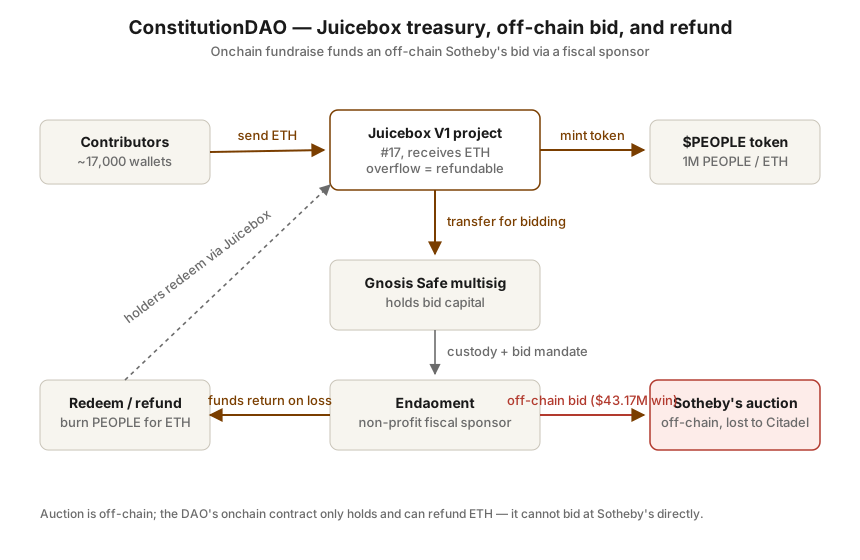
The core financial primitive was a Juicebox V1 treasury (project id #17) rather than a bespoke contract — the team deliberately avoided writing custom Solidity, relying on Juicebox's already-audited protocol to move fast. Contributors sent ETH to the Juicebox project and received a governance/receipt token, $PEOPLE (ERC-20, 0x7a58c0be72be218b41c608b7fe7c5bb630736c71), minted at a fixed rate of 1,000,000 PEOPLE per 1 ETH.
Juicebox was chosen over Mirror and Syndicate specifically for its overflow mechanism: contributions above the funding target sit as "overflow," and token holders can redeem/burn their tokens against the treasury — the property that made refunds technically possible if the bid failed. This mattered because the auction itself was off-chain: an on-chain DAO cannot bid at Sotheby's directly. The DAO therefore used a fiscal sponsor / custodian — the non-profit Endaoment — plus a Gnosis Safe multisig to hold funds and physically bid on the DAO's behalf, with plans for a museum-custody and fractional-governance arrangement had they won. $PEOPLE was framed as governance over the artifact (where to display it, etc.), with specifics to be decided post-auction. Because everything was public and on-chain, the treasury total was fully transparent in real time — a design property that later proved to be a strategic liability at auction.
Outcome
Status: failed (as to the stated goal). The DAO did not acquire the Constitution. Griffin outbid it at $43.17M. A widely cited factor: the DAO's treasury was publicly visible, so competing bidders could see almost exactly how much it could bid, and the team also had to reserve funds for insurance, storage, and transaction costs rather than committing the entire balance to the hammer price.
After the loss the organizers wound down and offered refunds of contributions (redeem $PEOPLE for ETH via Juicebox), which most observers praised as the ethical choice. Refunds were messy: at the November 2021 gas prices, small contributors faced punishing fees — reports of a contributor paying $70 in gas to donate ~$200 and another ~$70 to get it refunded — so redeeming was uneconomic for many small donors. Weeks later a large share of funds remained unclaimed. Separately, $PEOPLE took on a life of its own as a memecoin/collectible, trading on secondary markets and at times reaching a multi-hundred-million-dollar notional market cap, so many holders kept the token rather than redeeming. A successor, ConstitutionDAO2 ("We The People"), formed in 2022 but raised far less ($300K publicly) before Sotheby's postponed that auction.
Why it worked
- Narrative and speed: a simple, patriotic, meme-ready mission ("let's buy the Constitution") plus a ~1-week sprint created enormous viral momentum and mainstream press.
- Composability over custom code: reusing audited primitives (Juicebox, Gnosis Safe, a non-profit fiscal sponsor) let a volunteer team stand up a multi-million-dollar treasury in days without shipping unaudited contracts.
- Low barrier, broad base: ~17,000 contributors with a median donation around $200 demonstrated genuinely permissionless, global small-dollar coordination.
Where the design broke
- Radical transparency at an adversarial auction: an on-chain, public treasury told rival bidders the ceiling; a well-capitalized individual could simply outbid it.
- No post-win plan and reserved costs: the team could not deploy the full balance (needed reserves for storage, insurance, and fees), and governance/custody of the physical object was under-specified.
- Gas-fee UX at redemption: high L1 fees made refunds uneconomic for the very small contributors the campaign celebrated, creating friction and lingering unclaimed funds.
- Receipt token ≠ designed governance token: $PEOPLE was issued fast as a receipt and became a speculative memecoin, decoupling it from any real governance purpose.
Lessons
- Transparency is a double-edged sword in competitive settings. Fully public treasuries are great for trust but can be strategically fatal when bidding against private actors; sealed or discretionary bidding capacity should be designed in when the "opponent" is off-chain.
- Plan the endgame before the fundraise. Custody, governance, insurance, and "what if we win / what if we lose" mechanics (including refund UX and costs) should be specified up front, not improvised post-outcome.
- Reuse audited primitives to move fast — and honor refunds. Building on Juicebox/Gnosis/Endaoment let a volunteer team scale safely; committing to and executing full refunds set a reputational standard, even if execution (gas costs) was imperfect.
- A receipt token will be treated as an asset. If you mint a transferable token to contributors, expect secondary-market speculation and design (or disclaim) governance and value accordingly.
Redesign (EDITORIAL — hypothesis, not fact)
The following is the researcher's editorial hypothesis, not established fact.
A modern redesign would separate bidding capacity from treasury transparency. Rather than exposing the exact hammer-ceiling on-chain, the DAO could commit funds to a fiscal sponsor / escrow with a private, pre-authorized bid ceiling, publishing only that "sufficient funds are escrowed" via a proof (e.g., attestation or ZK proof of a balance threshold) — preserving trust without handing rivals the number. The fundraise could use a binding, time-boxed commitment (funds locked until auction resolution) with an automatic, gas-abstracted refund path: batch redemptions, sponsor gas, or deploy the treasury on an L2 so small contributors are not priced out of getting their money back.
Governance and the token deserve intentional design: issue a non-transferable "contribution credit" for auction governance (to avoid the memecoin decoupling), and only mint a liquid token if long-term stewardship (a museum-owned artifact with fractional governance) is the explicit plan. Finally, the win-condition operations — legal ownership vehicle, insured custody, display agreements, and a clear dissolution-and-refund playbook for a loss — should be ratified and audited before the campaign opens, so the outcome (win or lose) executes deterministically rather than through a post-hoc scramble.
Sources
- ConstitutionDAO and how a group of friends raised over $40M to buy the U.S. Constitution (Juicebox Docs) — primary (docs)
- ConstitutionDAO GitHub (coordination repo, token/mechanism notes) — primary (contract)
- $PEOPLE token on Etherscan / Ethplorer — primary (contract)
- Let's Buy the US Constitution (Not Boring, Packy McCormick — core contributor) — primary (retrospective)
- ConstitutionDAO co-founder Graham Novak reflects (Coinage) — primary (retrospective)
- How internet friends raised millions in crypto to bid on the Constitution (CNBC) (news)
- ConstitutionDAO (Wikipedia) (analysis)
- ConstitutionDAO's bold crypto bid falls short (TechCrunch) (news)
Related experiments
Last verified: 2026-07-26 · Spot an error? Suggest a correction