PleasrDAO
A collector DAO that crowdfunds and fractionalizes culturally significant digital and cultural artifacts, pioneering NFT fractionalization (the $DOG token) and encrypted-release mechanisms (the Wu-Tang album).
▶ Run interactive simulation animated mechanism with editable parameters
How it works onchain
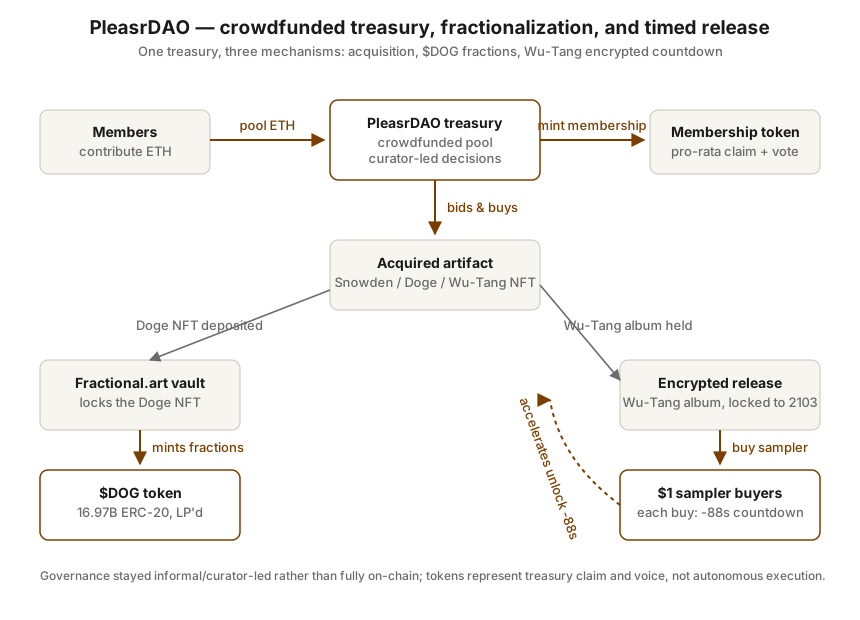 Open full-size diagram
Summary
PleasrDAO is a collector-oriented decentralized autonomous organization formed on Twitter in March 2021, initially to crowdfund the purchase of a single NFT: pplpleasr's "x*y=k" tribute artwork created for the Uniswap V3 launch. The DAO's name is a portmanteau of the artist "pplpleasr" and "DAO." What began as an ad hoc pool of DeFi and NFT insiders rapidly became one of the most recognized digital-art collectors of the 2021 cycle, acquiring Edward Snowden's genesis "Stay Free" NFT (2,224 ETH, a Foundation record at the time), the original "Doge" meme NFT ($4M), and — most famously — Wu-Tang Clan's one-of-one album "Once Upon a Time in Shaolin" ($4M, purchased from the U.S. government after its seizure from Martin Shkreli).
PleasrDAO is notable in mechanism-design terms less for a single novel primitive than for chaining together several: crowdfunded collective treasury acquisition, ERC-20 fractionalization of a single high-value NFT ($DOG), token-gated membership/governance, and an encrypted, purchase-accelerated timed-release scheme for the Wu-Tang album. Membership is represented by tokens conferring a claim on the treasury and a say in decisions; founding participants included PoolTogether co-founder Leighton Cusack (credited with initiating the group) and "Chief Pleasing Officer" Jamis Johnson, alongside figures from Nansen, Compound, Gauntlet, and Mechanism Capital.
Design (Mechanism)
Crowdfunded acquisition treasury. PleasrDAO pooled member capital to bid on individual works. Its debut acquisition, pplpleasr's Uniswap "x*y=k" video NFT, was won for 310 ETH after a bidding war. Subsequent buys (Snowden, Doge, Wu-Tang) were funded from the collective treasury, with members holding pro-rata membership tokens.
NFT fractionalization ($DOG). In September 2021, PleasrDAO used Fractional.art to lock the original Doge NFT in a vault and mint 16,969,696,969 fungible ERC-20 "DOG" tokens (contract 0xBAac2B4491727D78D2b78815144570b9f2Fe8899), selling ~20% via auction and distributing the rest to liquidity on Uniswap/SushiSwap while retaining majority control. This turned a single illiquid collectible into a liquid, tradeable, meme-driven asset — briefly valued in aggregate at hundreds of millions of dollars — and later evolved into the "Own the Doge" / DOG token community.
Encrypted, purchase-accelerated timed release (Wu-Tang). The Wu-Tang album carried a contractual bar on commercial exploitation until 2103. PleasrDAO structured a $1 NFT drop (June 2024) in which each purchase (via an "$ALBUM"-linked scheme) unlocked a short sampler and moved the decryption/countdown date forward by 88 seconds — an on-chain mechanism converting fan participation into a measurable acceleration of an otherwise multi-decade lockup.
Governance and membership. Governance is token-based: each membership token represents a fraction of the treasury and a vote in group decisions. The DAO operated with an informal, curator-led culture rather than a fully on-chain autonomous governance system; day-to-day acquisition decisions were driven by a small core of active members.
Outcome
Status: partial_success. PleasrDAO succeeded spectacularly as a cultural and brand phenomenon and as a proof-of-concept for collective, fractional ownership of high-value cultural artifacts. The $DOG fractionalization worked technically and reached enormous peak valuations; the Snowden purchase directed millions to the Freedom of the Press Foundation; and the Wu-Tang acquisition and NFT-accelerated release generated broad mainstream attention.
However, several outcomes underperformed the 2021 hype. Token/asset values fell sharply in the NFT bear market. In mid-2023, PleasrDAO's Twitter/X account (and CPO Jamis's account) were compromised and used to post phishing links, causing roughly $1.2M in losses to followers who interacted. As of mid-2026 PleasrDAO persists as an ongoing collective, but is best characterized as a landmark experiment whose commercial and governance results were mixed.
Why it worked
- Narrative and timing. It captured the 2021 zeitgeist by owning iconic internet/cultural artifacts (Doge, Snowden, Wu-Tang) with strong meme and press value, giving the DAO outsized brand equity.
- Credible insiders. A membership drawn from DeFi and NFT leadership provided capital, technical competence, and distribution.
- Composable primitives. Fractionalization ($DOG) and token-gated ownership let a single expensive asset become a liquid, community-owned instrument, expanding participation far beyond the original buyers.
- Charitable framing. Directing proceeds (e.g., Snowden's NFT to press-freedom causes) built goodwill and differentiated it from purely speculative flippers.
Where the design broke
- Market beta. Values of $DOG and NFT holdings were highly correlated with the broader NFT collapse; paper gains largely evaporated.
- Single-point-of-failure communications. Official announcements ran through a standard social-media account with no multisig/hardware-key protection and no on-chain verification channel; when that account was compromised in 2023, the same trust attendees placed in it was redirected into ~$1.2M of phishing losses.
- Off-chain rights complexity. Owning a physical artifact with real-world IP and contractual constraints (the Wu-Tang album) meant its rights sat partly outside what any on-chain token or governance vote could resolve.
- Governance thinness. Real decision-making concentrated in a small active core, so "DAO" governance was more social than autonomous — limiting resilience and clarity of member rights.
Lessons
- Fractionalizing a single trophy asset into a fungible token creates liquidity and community but also imports full market volatility and speculative dynamics that can overwhelm the "ownership" narrative.
- On-chain mechanisms (the 88-second accelerated release) can elegantly encode participation into a cultural artifact, but the underlying rights still depend on enforceable off-chain contracts — legal risk is not abstracted away by tokenization.
- A collector DAO's most valuable and most vulnerable asset is its brand/social surface; opsec on official accounts is a first-order security concern, not an afterthought (the 2023 phishing loss).
- "DAO" branding without robust on-chain governance defaults to curator-led decision-making; be explicit about where real authority and member rights actually sit.
Redesign (EDITORIAL — hypothesis, not fact)
The following is the researcher's editorial hypothesis, not established fact.
A redesigned PleasrDAO would separate the three roles it blurred: acquisition, custody/rights, and speculation. First, hold each major artifact in a purpose-built, legally-wrapped entity (e.g., a series-LLC or foundation per asset) so that IP, physical-object, and contractual rights are cleanly assigned and enforceable from the outset, reducing the kind of ambiguity that surrounded the Wu-Tang album's rights. Second, decouple "ownership/patronage" from "speculation": issue non-transferable or slowly-vesting membership rights for governance and curation, while any fungible fractional token ($DOG-style) is explicitly framed and disclosed as a speculative liquidity layer, not a claim on control. Third, harden the social layer: multi-sig-controlled, hardware-key-gated official accounts and an on-chain announcement channel (signed messages from a known contract) so followers can verify drops independently of a hijackable Twitter account. Fourth, formalize governance with a documented rights framework — quorum, treasury controls, exit/redemption rights — so members understand what their tokens actually entitle them to. The core insight worth preserving is PleasrDAO's genuine innovation: encoding cultural participation into programmable, time-based release mechanics. That primitive deserves a more durable legal and security chassis than a hype-cycle collective could provide.
Sources
- PleasrDAO official site — Collective Ownership of Digital Culture — primary (docs)
- The Doge NFT (DOG) ERC-20 token contract on Etherscan — primary (contract)
- PleasrDAO — IQ.wiki organization entry (docs)
- Doge NFT to Be Broken Up Into Billions of Pieces for Investors (Decrypt) (news)
- Fans can buy a fraction of original doge meme NFT owned by PleasrDAO (CNBC) (news)
- PleasrDAO's $5.5M purchase of Edward Snowden's genesis NFT (Foundation blog) (retrospective)
- Revealed: The Crypto Fans Who Secretly Paid $4 Million for Pharma Bro's Wu-Tang Album (Rolling Stone) (news)
- Wu-Tang Clan's Rare 'Once Upon a Time in Shaolin' Sold as $1 Sampler (Variety) (news)
- PleasrDAO account compromised, losing over $1.2m (crypto.news) (news)
- Why We're Invested in PleasrDAO (Mechanism Capital thesis) (analysis)
Related experiments
Last verified: 2026-07-26 · Spot an error? Suggest a correction