Yearn
The archetypal DeFi yield aggregator whose automated vaults auto-compound and rebalance capital across lending and Curve strategies, and whose zero-premine YFI 'fair launch' set the template for community-owned governance tokens.
▶ Run interactive simulation animated mechanism with editable parameters
How it works onchain
 Open full-size diagram
Summary
Yearn (originally "iearn," then yEarn / yearn.finance) is a DeFi yield-aggregation protocol launched on Ethereum in February 2020 by South African developer Andre Cronje. Its core idea is to automate the tedious, gas-heavy work of chasing yield: instead of a user manually moving stablecoins between Aave, Compound, and Curve as rates change, Yearn's smart contracts do it for them, socializing gas and auto-compounding returns. Yearn is best remembered for two things: pioneering the tokenized "vault" (an ERC-20 share representing a pooled, strategy-managed position) and for the July 2020 "fair launch" of its governance token YFI, in which all 30,000 initial tokens were distributed to liquidity providers with zero allocation to Cronje or investors. YFI became a cultural touchstone for community-owned tokens and briefly traded above the price of a single BTC. The protocol scaled to multi-billion-dollar TVL at the 2021 peak before contracting sharply.
Design (Mechanism)
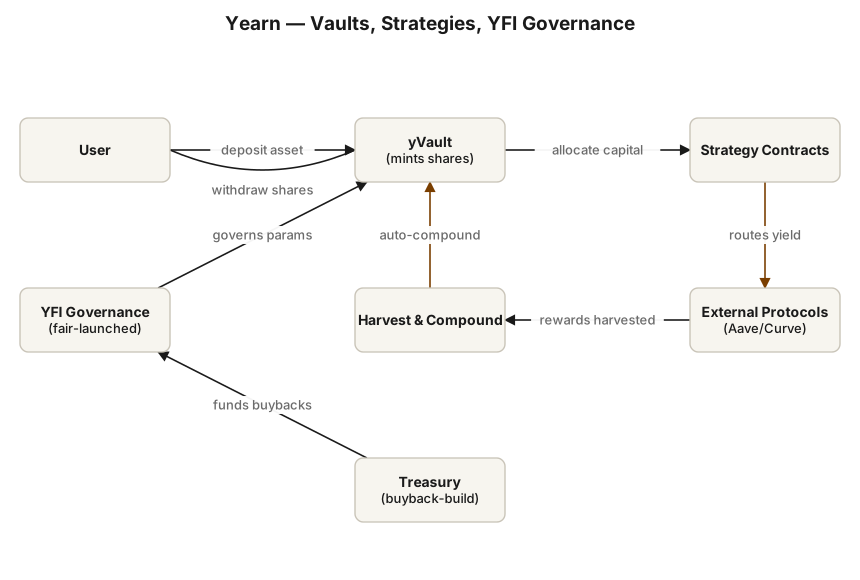
Yearn's central primitive is the yVault. A depositor sends an asset (e.g., DAI, USDC, ETH, or an LP token) and receives a yield-bearing vault share token. Behind each vault sit one or more strategies — modular smart contracts that route capital into external protocols (lending markets like Aave/Compound, and especially Curve pools plus CRV rewards) and harvest, sell, and re-deposit rewards. Key design features:
- Socialized gas & automation: harvesting and rebalancing costs are amortized across all vault depositors, making sophisticated yield farming economical for small holders.
- Strategy abstraction (V2): V2 vaults (early 2021) allowed multiple strategies per vault with capital allocation and debt limits, letting the DAO diversify risk and swap strategies without moving user funds.
- yLockers / veToken meta-layer: Yearn built products (yCRV, later yPRISMA) that aggregate governance tokens using Curve-style vote-escrow mechanics to boost vault yields.
- YFI governance token: contract
0x0bc529c00C6401aEF6D220BE8C6Ea1667F6Ad93e. Initial supply of 30,000 was distributed over roughly a week to LPs staking in a Curve yPool, a YFI/DAI Balancer pool, and a YFI/yPool Balancer pool. Governance later approved YIP-57 to mint 6,666 more (to 36,666), one-third vesting to contributors and two-thirds to the treasury. YIP-56 ("BABY: Buyback and Build") replaced staking emissions with treasury-funded buybacks. Governance has since iterated through veYFI and stYFI staking models.
Outcome
Status: partial_success. Yearn was a category-defining, technically durable protocol that survived multiple exploits and its founder's departure, but its commercial fortunes are cyclical and far below peak. It attracted roughly $800M in its first month and reached a peak TVL around $6–7B in 2021. It suffered a widely studied exploit on 4 Feb 2021 when the v1 yDAI vault was drained for ~$11M (attacker profit ~$2.8M) via a Curve 3pool imbalance created with Aave flash loans; a fast multisig response saved the remaining ~$24M. Another legacy vault exploit occurred in April 2023. Andre Cronje and collaborator Anton Nell announced in March 2022 they were ending contributions to DeFi, but Yearn — DAO-governed with dozens of contributors — continued operating. TVL fell more than 90% from its all-time high; as of 2026 it sits in the hundreds of millions, with a partial 2025 recovery. YFI remains a live, traded governance asset and Yearn continues shipping (V3 vaults).
Why it worked
- Genuine unmet need: early DeFi yields were real but required constant, expensive manual management. Yearn packaged that labor into a one-click deposit, an obvious product-market fit.
- The fair launch as marketing and legitimacy: zero premine aligned incentives, generated enormous goodwill and press, and made YFI a credibly decentralized, community-owned asset — a sharp contrast to VC-heavy launches.
- Composability leverage: Yearn sat on top of Curve, Aave, and Compound, turning other protocols' liquidity and rewards into its own product without needing to bootstrap them.
- Fast, credible security response: the 11-minute multisig reaction in the 2021 exploit limited losses and preserved trust.
Where the design broke
- Yield is reflexive and mercenary: vault APYs depend on external emissions and market conditions; when the 2022 bear market crushed DeFi yields, TVL and revenue collapsed with them.
- Deployment velocity outpaced audit coverage: new strategies and vault configurations were shipped and iterated faster than security review could fully keep pace with, a gap that produced the yDAI exploit; and key-person operational continuity was concentrated enough that a prolific contributor's 2022 departure briefly unsettled markets, even though Yearn itself was DAO-run.
- Smart-contract risk stacked on smart-contract risk: aggregating over other protocols means inheriting all of their attack surfaces plus Yearn's own strategy logic.
- Commoditization: competitors (Convex, Aura, and later curated-vault providers) captured segments of the yield/veToken meta-game, eroding Yearn's first-mover moat.
Lessons
- Distribution design is strategy, not an afterthought: YFI's zero-premine fair launch created durable community ownership and became the reference template for "credibly neutral" token distribution — arguably more influential than the product itself.
- Aggregators inherit compounded risk: building on top of DeFi legos multiplies both yield opportunity and attack surface; slippage/withdrawal-fee misconfigurations (as in Feb 2021) can be catastrophic and must be treated as first-class security parameters.
- DAO resilience can outlast its founder: Yearn's survival after Cronje's exit shows that credible decentralization and a broad contributor base are what let a protocol persist through a founder's departure.
- Reflexive-yield businesses are cyclical: revenue tied to external emissions and market rates will swing violently; treasury policy (buyback-and-build) and diversification matter for surviving the trough.
Redesign (EDITORIAL — hypothesis, not fact)
The following is speculative analysis by the researcher, not established fact.
If rebuilt today, Yearn's biggest structural weakness — reflexive dependence on emissions-driven yield — argues for reframing vaults around risk-adjusted, transparently-rated yield tiers rather than raw APY. A redesign might expose per-strategy risk scores (audited coverage, oracle dependence, protocol counterparty exposure) as on-chain metadata, letting depositors choose an explicit risk budget instead of chasing a headline number that silently embeds tail risk. Second, the 2021 exploit suggests config parameters (slippage bounds, withdrawal fees, earn() permissions) should be governed by enforced invariants and circuit-breakers rather than operator discretion — a formally-verified "safety envelope" that a strategy cannot exceed even if misconfigured. Third, given commoditization by curated-vault marketplaces, a modern Yearn could lean into being a neutral vault standard and risk-scoring layer (an open marketplace where third parties list strategies against Yearn's audited vault framework and shared security response) rather than competing strategy-by-strategy. Finally, distribution: the fair-launch magic is hard to repeat, but tying ongoing governance power to locked, revenue-sharing stake (the stYFI direction) plus retroactive rewards for strategy authors could better align long-term contributors than one-off emissions ever did. These are hypotheses about direction, not claims about Yearn's actual roadmap.
Sources
- Yearn Docs — Getting Started / Products — primary (docs)
- Yearn Docs — YFI Governance Token — primary (docs)
- YFI Token Contract (Etherscan, verified) — primary (contract)
- yearn-security disclosure — 2021-02-04 DAI vault exploit — primary (audit)
- YIP-56: BABY — Buyback and Build Yearn — primary (governance)
- YIP-57: Supply expansion to 36,666 YFI — primary (governance)
- Andre Cronje of Yearn on YFI and the Fair Launch — Unchained (retrospective)
- Andre Cronje: DeFi Expressionist — CoinDesk (news)
- Explained: Inside the Yearn v1 yDAI Hack (Feb 2021) — Halborn (analysis)
- Andre Cronje Leaves Yearn, Fantom and 23 other DeFi apps — The Defiant (news)
- Yearn Finance TVL, Fees & Revenue — DefiLlama (analysis)
Related experiments
Last verified: 2026-07-26 · Spot an error? Suggest a correction