Eden Network
A non-consensus-breaking Ethereum transaction-ordering protocol that let traders and block producers rent guaranteed priority block space by staking a native token, later pivoting to an MEV-Boost relay before winding down in 2025.
▶ Run interactive simulation animated mechanism with editable parameters
How it works onchain
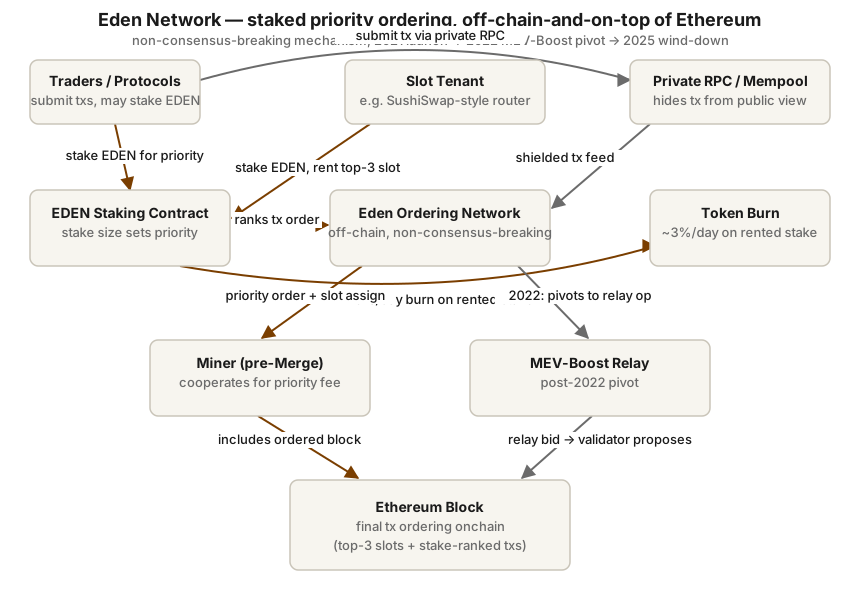 Open full-size diagram
Summary
Eden Network was an optional, opt-in transaction-ordering protocol for Ethereum that let traders and applications pay for guaranteed priority placement inside blocks, without changing Ethereum's consensus rules. It grew directly out of Archer DAO, a group of MEV researchers and tooling builders who had been working on miner-revenue and frontrunning-mitigation tools since 2020. On July 26, 2021 the Archer DAO community voted to rebrand and migrate its ARCH token into a new EDEN token, and the rebranded network went live around the Ethereum London upgrade (block 12,965,000, early August 2021). The pitch was to give miners (and later validators) an additional, MEV-aware revenue stream while giving users and protocols a way to buy predictable, front-of-block execution instead of competing in an open priority-gas-fee bidding war. After Ethereum's Merge to proof-of-stake in September 2022 made miner-side transaction ordering obsolete, Eden pivoted into operating as an MEV-Boost relay and a set of related MEV infrastructure products (private RPC, transaction bundles, mempool data feeds). On August 13, 2025, the team announced it was winding down all of these services, citing an increasingly competitive and low-margin relay/block-building market, and began distributing its roughly 2,000 ETH treasury to EDEN token holders as a retirement payout.
Design (Mechanism)
Eden's core mechanism sat entirely off-chain-and-on-top of Ethereum rather than inside its consensus layer, which is why the project described it as "non-consensus-breaking." It had three interlocking pieces:
- Slot Tenants. The top three positions in each block were auctioned off on a rolling basis to "Slot Tenants" — typically DeFi protocols such as SushiSwap, Uniswap-adjacent routers, or 1inch — who staked EDEN tokens to hold a slot. Holding a slot meant that transactions routed through that tenant's relationship with Eden-participating miners/validators would land first in the block, ahead of the general priority-fee auction.
- Stake-weighted priority ordering. Outside the three reserved slots, transactions submitted through Eden's network were ordered by the size of EDEN staked by the sender rather than by a pure gas-price bidding war, so a trader could get better relative ordering by staking tokens instead of continuously escalating gas tips.
- Token burn and private mempool. Tokens committed to rent priority access were burned at a steady rate (cited at roughly 3% per day on rented slots), creating ongoing deflationary pressure tied to usage, while Eden's private RPC/mempool let transactions bypass the public mempool entirely, denying searchers and bots the visibility needed to sandwich or frontrun them.
The underlying bet was that a market for ordering rights, denominated in a project-native token, would out-compete the public gas-priority auction on both fairness (protection from arbitrary reordering and frontrunning) and efficiency (predictable execution for high-volume traders), while still paying block producers for their cooperation.
Outcome
Eden Network shipped and operated for roughly four years. It attracted real integrations (well-known DeFi front ends and routers used its Slot Tenant program) and raised a $17.4 million token sale, evidence that both users and capital markets took the design seriously in its first phase. The Merge in September 2022 eliminated Eden's original mechanism, since transaction ordering under proof-of-stake moved to the separate MEV-Boost/proposer-builder-separation pipeline; Eden adapted by becoming a relay and MEV-data-infrastructure operator rather than a token-staked priority market. That second act did not durably work: on August 13, 2025 the team announced a full shutdown of Eden RPC, Eden Bundles, Mempool Stream, and Tx Explain, stating that the relay and block-building market had matured into a low-margin niche sustainable only for a small number of large operators. The project closed by burning its treasury-held and unvested EDEN and distributing about 2,000 ETH to remaining EDEN holders at a fixed rate per token, functioning as a wind-down/retirement rather than a technical failure or exploit.
Why it worked
For a period, the model captured real demand: protocols wanted a way to shield their users from sandwich attacks without waiting on a protocol-level fix, and staking-based ordering was legible and easy for integrators to reason about compared to opaque private relationships with individual miners. Token burn on rented slots gave EDEN a usage-linked sink, and the private-mempool option delivered an immediately verifiable benefit (transactions simply weren't visible to public searchers) rather than a probabilistic promise.
Limitations and criticisms
Eden's mechanism was inherently tied to a specific point in Ethereum's history — the pre-Merge era where individual miners could be courted directly for ordering favors. Proof-of-stake's proposer-builder-separation architecture replaced ad hoc miner relationships with a standardized relay/builder market, which made Eden's original staked-priority design structurally obsolete overnight rather than something that could be incrementally patched. Its second act put it in direct, undifferentiated competition with well-capitalized relay operators and builders in a market that compressed margins industry-wide, and a token whose main utility (staking for priority slots) had disappeared was left searching for a new value-accrual story. The project's own closing statement attributed the end to competitive and cost pressure in that market rather than to any single design flaw, but the deeper issue was that the mechanism's core value proposition (pay-to-order via a native token) did not have an equivalent role to play once Ethereum's ordering pipeline was redesigned at the protocol level.
Lessons
- A mechanism that depends on a specific, informal relationship with block producers (rather than a protocol-guaranteed role) is exposed to being obsoleted the moment the underlying protocol formalizes that relationship differently.
- Token-based priority markets can demonstrate genuine short-term product-market fit (real integrations, a real funding round) without that translating into a durable moat once bigger, better-capitalized competitors enter the same niche.
- Pivoting a token's utility after its original mechanism disappears is difficult: EDEN's value had been tied to slot-staking, and no comparably legible utility replaced it once Eden became "just" a relay operator.
- Winding down with a transparent treasury-distribution/token-retirement program is a lower-drama way to end a mechanism-design experiment than letting a token slowly bleed value with no exit path for holders.
Redesign (EDITORIAL — hypothesis, not fact)
If re-approached today, a similar project might avoid coupling its economic model so tightly to a single consensus-layer regime. Instead of a bespoke staked-priority slot auction sitting outside the protocol, the mechanism could be rebuilt as a thin, protocol-agnostic layer on top of PBS/MEV-Boost: sell verifiable inclusion guarantees or ordering preferences as a service priced in ETH (or stablecoins) rather than a project-native token, so the business doesn't need a token-burn narrative to survive a market-structure change. A credibly neutral, non-token-gated version of the private-mempool/frontrunning-protection feature — the part of Eden's stack that delivered clearly measurable user benefit — could plausibly have survived the Merge on its own merits, decoupled from the fate of a governance/staking token whose entire raison d'être vanished with the transition to proof-of-stake.
Sources
- Hello World (Eden Network launch post) — primary (blog)
- FAQ | Eden Network — primary (documentation)
- Ethereum's Priority Transaction Network Eden Raises $17.4M in Token Sale (news)
- MEV protocol Eden Network shuts down operations, plans treasury distribution to token holders (news)
- Eden Network Explained: Making Ethereum Safer for Users (explainer)
- Eden Network (EDEN) Token | Etherscan — primary (data)
Related experiments
Last verified: 2026-07-28 · Spot an error? Suggest a correction