SUAVE
Flashbots' proposed 'Single Unifying Auction for Value Expression' — a dedicated MEVM chain meant to become a shared, decentralized mempool and block-building layer for every blockchain, whose chain-centric vision never reached mainnet before Flashbots redirected the underlying tech into BuilderNet.
▶ Run interactive simulation animated mechanism with editable parameters
How it works onchain
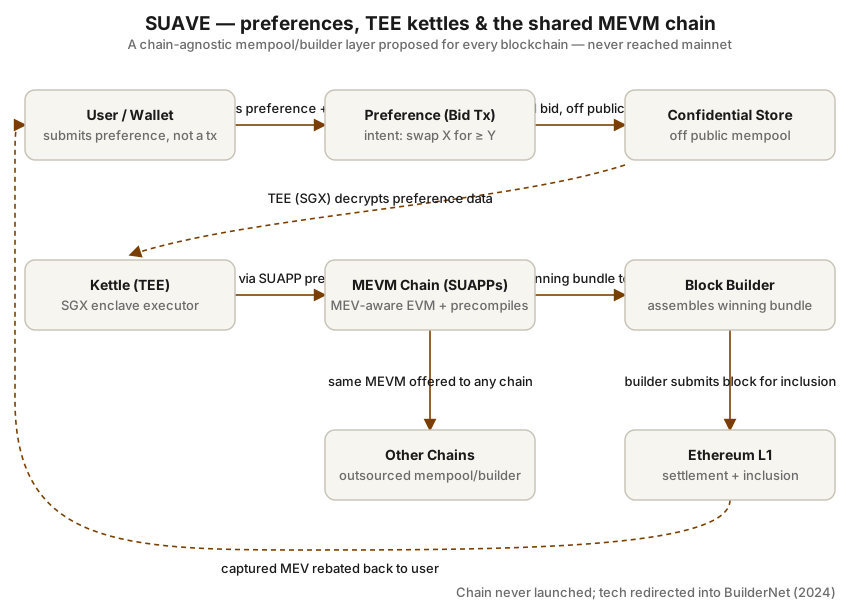 Open full-size diagram
Summary
SUAVE ("Single Unifying Auction for Value Expression") was Flashbots' proposal, published November 23, 2022, to pull MEV extraction out of individual blockchains and into one shared, decentralized coordination layer. Instead of every chain growing its own private mempool, order-flow auction, and block-builder cartel, SUAVE imagined a single MEVM (MEV-aware EVM) chain that any blockchain could plug into as an outsourced mempool and builder network. Users would submit "preferences" — signed statements of intent, from simple swaps to complex cross-domain strategies — and a competitive market of off-chain "executors" and builders would fulfill them, with captured MEV redistributed back to users rather than absorbed by searchers and builders. The project shipped in stages (mev-share as a privacy-aware order-flow auction, the Centauri devnet, the Toliman public testnet, TEE-secured "kettles" in the Andromeda phase) but never reached an independent SUAVE mainnet; by late 2024 Flashbots redirected its production block-building effort into BuilderNet, a differently-shaped multi-party TEE network, rather than the dedicated SUAVE chain originally envisioned.
Design (Mechanism)
SUAVE's architecture separated a chain's job into pieces that could be centralized elsewhere. A user (or their wallet) would submit a "preference" — an intent describing a desired outcome (e.g., "swap X for at least Y") rather than a fully-formed transaction — along with a bid. These preferences, and any sensitive order-flow data attached to them, were held in a confidential data store rather than a public mempool, specifically to prevent front-running before execution. Off-chain "executors" (later called kettles) would compete to satisfy preferences optimally, running arbitrary computation — including cross-chain and cross-domain logic — outside the constraints of any single L1's EVM.
The chain layer itself ran a modified EVM, the MEVM, adding precompiles so that MEV-related logic (auction mechanics, order matching, builder payment splitting) could be written as ordinary Solidity smart contracts ("SUAPPs") instead of living in closed-source, off-chain infrastructure operated by a handful of sophisticated searchers and builders. A new "bid" transaction type carried the confidential preference data on-chain in encrypted form, decryptable only inside authorized execution environments.
Trust in the executors was the hardest problem, and SUAVE's roadmap staged it explicitly: Centauri (targeted Q4 2023) ran execution nodes under centralized operator trust to prove out the devnet; the following Andromeda phase moved execution into SGX-based trusted execution environments (TEEs) to reduce reliance on any single centralized kettle operator; the stated long-run goal was to replace TEEs with pure cryptographic techniques (e.g., MPC/FHE-style approaches) so that no single machine ever saw preference data in the clear. The public Toliman testnet let developers deploy SUAPPs and exercise the preference/bid flow before any mainnet commitment.
Outcome
mev-share, an early and more limited piece of the SUAVE vision (a privacy-preserving order-flow auction for Ethereum searchers), shipped and saw real usage as a beta product ahead of the full chain. The Centauri devnet and the Toliman public testnet both launched on schedule, and Flashbots open-sourced the client (suave-geth) and specifications (suave-specs) for community experimentation, including hackathon activity (ETHGlobal London, the Crucible hackathon) built on the testnet. However, an independent, economically live SUAVE mainnet — the "one chain that unifies MEV for every blockchain" — was never launched. In November–December 2024, Flashbots instead launched BuilderNet, a multi-operator TEE-based block-building network, and migrated Ethereum order flow and builder operations there, formally shutting down its own centralized Ethereum block builder in December 2024. BuilderNet reuses some of SUAVE's underlying ideas (TEE-secured, collaborative block building) but is architecturally simpler — a network of cooperating builders rather than a dedicated MEVM settlement chain with preferences and a cross-chain executor market.
Why it worked
The parts of SUAVE that shipped succeeded because they were narrowly scoped and solved an already-acute pain point. mev-share gave searchers a way to share partial transaction data with builders without fully exposing order flow, directly improving on the all-or-nothing privacy of the existing private mempool ecosystem, and it required no new chain or token. The Toliman/Centauri testnets similarly succeeded as developer-facing artifacts: they were self-contained, low-stakes environments where the MEVM precompile model and preference/bid transaction type could be exercised and iterated on without needing real economic buy-in from any external chain or validator set.
Limitations and criticisms
The full SUAVE vision required convincing many independent blockchains to outsource their sequencing and block-building to a new, unproven chain — a coordination problem far larger than any single technical component. Bootstrapping trust in off-chain executors before TEEs (and long before any cryptographic replacement) meant the earliest, most economically meaningful version of the system depended on centralized operators, undermining the "decentralized MEV" pitch during exactly the phase when real value would have started flowing through it. TEE-based confidentiality (the Andromeda-era design) also inherits the well-known limitations of hardware trusted execution — side-channel and supply-chain risk, and reliance on a small number of chip vendors — rather than eliminating trust assumptions outright. And because SUAVE's value proposition depended on aggregating order flow from many chains simultaneously, no single chain had a strong unilateral incentive to be first; the chicken-and-egg problem of shared sequencing layers likely slowed adoption relative to point solutions (like per-chain order-flow auctions or, later, BuilderNet) that a single ecosystem could adopt on its own.
Lessons
- A cross-chain coordination layer needs credible neutrality and near-term economic value for adopters, not just a compelling architecture diagram; "everyone plugs into one shared MEV chain" is a multi-sided bootstrapping problem, not a protocol design problem.
- Staging trust incrementally (centralized operators to TEEs to cryptography) is honest engineering, but it means the riskiest trust assumptions are live exactly when the system is trying to attract its first real economic activity.
- Shipping the narrowly-scoped, immediately useful piece of a grand vision (mev-share) can outlive and outperform the grand vision itself; teams should track whether the "minimum viable component" is quietly becoming the actual product.
- Infrastructure research programs can succeed by changing the ecosystem's direction (TEE-based collaborative block building becoming mainstream via BuilderNet) even when the original named project (a dedicated SUAVE chain) does not reach mainnet — the artifact and the thesis are not the same thing.
Redesign (EDITORIAL)
EDITORIAL / hypothesis, not fact: SUAVE's core bottleneck may have been sequencing its own rollout backwards — trying to build the neutral, chain-agnostic settlement layer before any single chain had strong reason to rely on it. A path more likely to reach production faster might have started as an Ethereum-only, opt-in order-flow and builder service (closer to what mev-share and later BuilderNet actually became), proven the preference/executor market economically on one chain with real fee revenue, and only then generalized the MEVM and cross-chain preference format outward to other chains once there was a working reference deployment other ecosystems could point to and copy. In this hypothesis, the "shared chain for everyone" framing was the right long-term thesis but the wrong first milestone — a single successful client is more persuasive to a second chain than a specification is, and BuilderNet's faster real-world traction after SUAVE is circumstantial evidence for that ordering.
Sources
- The Future of MEV is SUAVE — primary (founder retrospective / project announcement)
- The MEVM, SUAVE Centauri, and Beyond — primary (project blog)
- suave-specs: SUAVE Alpha Protocol Specifications (GitHub) — primary (protocol spec)
- Suave Chain — SUAVE Docs (Rigil) — primary (documentation)
- suave-geth (GitHub) — primary (source code)
- Introducing BuilderNet (project blog)
- Migrating to BuilderNet (project blog)
Related experiments
Last verified: 2026-07-28 · Spot an error? Suggest a correction