UniswapX
Uniswap Labs' intent-based, auction-driven swap protocol where users sign off-chain Dutch orders and a competitive network of fillers settles them on-chain, offering gas-free swaps and MEV protection.
▶ Run interactive simulation animated mechanism with editable parameters
How it works onchain
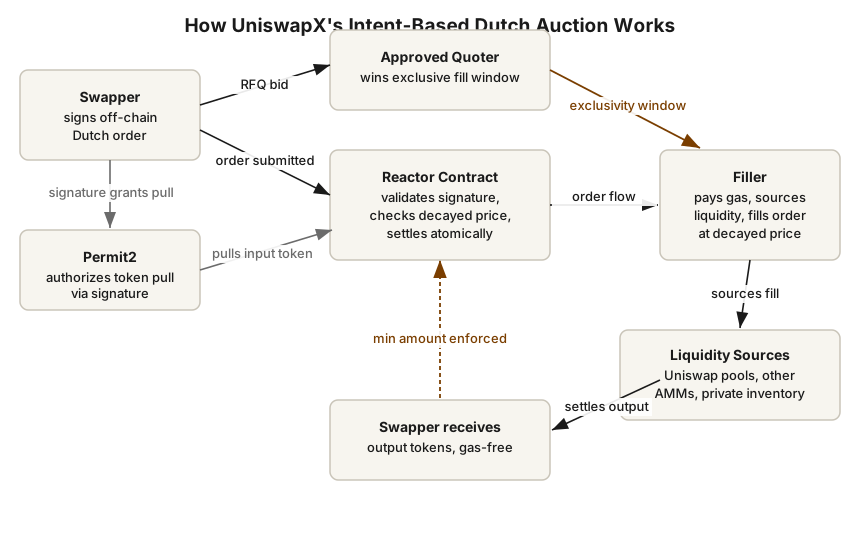 Open full-size diagram
Summary
UniswapX is Uniswap Labs' answer to a structural problem the AMM itself created: by 2023, most retail swaps were being routed, re-routed, and MEV-taxed by intermediaries outside Uniswap's control. Announced in July 2023 with a whitepaper authored by Hayden Adams, Noah Zinsmeister, Mark Toda, Dan Robinson and a large Uniswap Labs team, UniswapX abandons the "user sends a transaction to a pool" model. Instead, users sign an off-chain intent — an order specifying what they want to receive — and a permissionless set of "fillers" competes to settle it on-chain via open-source "reactor" contracts, using any liquidity they like: Uniswap pools, other AMMs, aggregators, or private inventory. The swapper pays no gas, cannot be sandwiched via the public mempool, and pays nothing for failed transactions. The design fused the RFQ model of 0x/1inch-style systems with a decaying-price Dutch auction fallback, and became one of the most-copied templates in the "intents" wave of 2023–2025.
Design (Mechanism)
The core object is a Dutch order: a signed message (authorized via Permit2, 0x000000000022D473030F116dDEE9F6B43aC78BA3) whose output amount starts slightly better than the estimated market price for the swapper's counterparty and decays over time toward a worst-case minimum. Fillers watch the order flow; as the price decays, filling becomes profitable for whichever filler can source liquidity most cheaply, so competition pushes execution close to the start of the decay curve. Settlement runs through reactor contracts — e.g., the V1 ExclusiveDutchOrderReactor at 0x6000da47483062A0D734Ba3dc7576Ce6A0B645C4 on Ethereum — which validate the signature and decay math, pull the swapper's input tokens, invoke the filler's execution logic, and enforce that the swapper receives at least the current decayed amount. The filler pays gas and internalizes revert risk.
Layered on top is an exclusivity mechanism: in the interface's RFQ stage, quoters approved by Uniswap Labs bid off-chain, and the winner receives a brief exclusive filling window; if it fails to fill, the order opens to all fillers via Dutch decay. Later iterations adapted the auction to chain characteristics: V2 orders on mainnet, a DutchV3OrderReactor on Arbitrum tuned for its sequencer timing, and a PriorityOrderReactor on Base (0x000000001Ec5656dcdB24D90DFa42742738De729) that uses priority-fee bidding — fillers compete through the priority gas auction itself rather than a time decay. The whitepaper also specified a cross-chain variant of the protocol. OpenZeppelin audited the contracts before launch.
Outcome
Ongoing and structurally significant. UniswapX launched on Ethereum mainnet in beta in July 2023, then expanded to Arbitrum, Base, Unichain and other chains, and has processed billions of dollars in volume as one of the largest intent-based systems in production, running alongside (not replacing) classic AMM routing in the Uniswap interface. Uniswap's own research (Bachu & Wan, "Quantifying Price Improvement in Order Flow Auctions") argued the auction delivers measurable price improvement versus routed AMM execution, while independent academic work on solver-based DEXes ("Execution Welfare Across Solver-based DEXes") found execution quality varies with order size and competition. The design's most persistent criticisms have been about decentralization in practice: the RFQ quoter set was permissioned at launch, and fill volume concentrated among a small number of professional fillers — a pattern observers (e.g., Anoma's research team) flagged early. The cross-chain version described in the whitepaper has not shipped as a widely used product on the original timeline. No major exploit of the reactor contracts is known as of mid-2026.
Why it worked
- It priced execution as a competition, not a path. Moving from "best route through pools" to "best bid from anyone with any liquidity" let private market makers subsidize swaps with off-chain inventory, which routing algorithms can never see.
- Dutch decay is a self-executing auctioneer. No trusted auction operator is needed for the fallback: the order's own price curve arbitrates between filler profit and swapper welfare, and competition compresses filler margin toward zero.
- It shifted MEV and gas risk to sophisticated parties. Swappers got gas-free, revert-free, sandwich-resistant UX; fillers — who are equipped to manage mempool risk — absorbed it, and the exclusivity window converted would-be MEV into quoted price improvement.
- Distribution. Being embedded in the default Uniswap interface gave the mechanism instant order flow that standalone intent protocols had to beg for.
Limitations and criticisms
UniswapX underdelivered on its decentralization narrative. The permissioned quoter list and empirical filler concentration mean execution quality depends on a small oligopoly's competitiveness, and the promised permissionless RFQ/reputation system remained "under exploration" long after launch. Off-chain order distribution also moved a critical piece of market structure onto Uniswap Labs' infrastructure, trading the AMM's credible neutrality for better prices. The cross-chain design — arguably the whitepaper's boldest claim — lagged well behind the single-chain product.
Lessons
- Intents convert MEV from a tax into a bid. Any value an intermediary could extract from an order can, with an auction in front, be competed back to the user instead — but only in proportion to how many bidders actually show up.
- Auction mechanisms must be chain-specific. UniswapX shipped different reactors per chain (time-decay on mainnet, priority-fee auctions on Base, a tuned V3 reactor on Arbitrum) because block time, sequencing, and fee markets change what "competitive bidding" physically means.
- Permissionless settlement plus permissioned quoting is a stable but uncomfortable equilibrium. Open filler sets prevent hard capture, yet the off-chain RFQ layer is where power concentrates; whoever controls order distribution controls the market.
- Gasless, revert-free UX is a mechanism-design output, not a wallet feature. By making fillers pay gas and bear revert risk, the protocol bought consumer-grade UX with market structure rather than subsidies.
Redesign (EDITORIAL — hypothesis, not fact)
This section is editorial speculation. Three changes seem worth testing. First, replace the permissioned quoter list with an on-chain, stake-and-slash reputation registry: fillers bond collateral, exclusivity windows are auctioned continuously, and failure-to-fill slashes the bond — turning today's social permissioning into priced permissionlessness. Second, publish the order flow through a neutral, replicated mempool (or commit orders to a data-availability layer) so the distribution layer cannot silently favor incumbent fillers; the Dutch decay already tolerates latency, so neutrality costs little. Third, make the decay curve adaptive: start prices and decay rates set by an on-chain estimator of recent fill-time distributions per pair, so thin pairs decay faster and deep pairs extract more filler margin for users. The open question is whether retail order flow auctions can stay competitive at all once filler consolidation matures — if not, the long-run design may need to route a share of filler profit back to swappers protocol-level, e.g., via rebates funded by an exclusivity-window auction.
Sources
- UniswapX Whitepaper (July 2023) — primary (docs)
- UniswapX overview — Uniswap developer docs — primary (docs)
- UniswapX deployment addresses — Uniswap developer docs — primary (docs)
- UniswapX source code (Uniswap/UniswapX) — primary (contract)
- V1 ExclusiveDutchOrderReactor on Etherscan — primary (contract)
- How Dutch Auctions Deliver Better Swaps — Uniswap blog — primary (docs)
- Quantifying Price Improvement in Order Flow Auctions (Bachu, Wan) — primary (analysis)
- OpenZeppelin UniswapX audit — primary (audit)
- Intent-based protocols pt1: unfolding UniswapX — Anoma research (analysis)
- Execution Welfare Across Solver-based DEXes (arXiv 2503.00738) (analysis)
- UniswapX — A Deep Dive (Xangle) (analysis)
Related experiments
Last verified: 2026-07-27 · Spot an error? Suggest a correction