Factom
An early (2014-15) Bitcoin-anchored data-integrity protocol that used a dual-token model — tradable Factoids (FCT) and USD-stable Entry Credits (EC) — to shield enterprise users from crypto volatility; the operating company went bankrupt in 2020 and the protocol was migrated into Accumulate Network in 2022.
▶ Run interactive simulation animated mechanism with editable parameters
How it works onchain
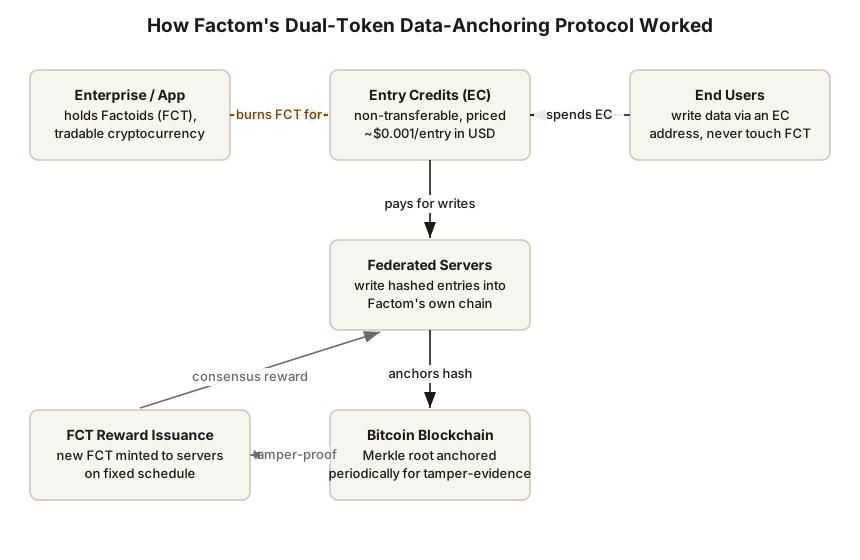 Open full-size diagram
Summary
Factom was one of the earliest "blockchain beyond currency" projects, founded in Austin, Texas in 2014 by Paul Snow, David Johnston, and Peter Kirby. It positioned itself as a decentralized data-integrity and record-keeping layer: instead of storing raw data on-chain, Factom let users hash and timestamp arbitrary entries (documents, audit logs, land records, IoT data) into its own federated chain, then periodically anchored a Merkle root of that chain into the Bitcoin blockchain for tamper-evidence. It ran a 45-day token crowdsale from March 31 to May 15, 2015 — one of the first token sales in crypto history — raising funds in Bitcoin. The protocol's defining design choice was a dual-token model: a tradable, speculative token (Factoids/FCT) and a non-tradable, USD-pegged utility token (Entry Credits/EC) that users actually spent to write data.
Design (Mechanism)
Factom's architecture split "the token people speculate on" from "the token people use," an explicit attempt to insulate enterprise customers from crypto price volatility:
- Factoids (FCT): the freely tradable cryptocurrency, issued at a fixed schedule to the federated servers ("Factom nodes") that ran the protocol's consensus, similar to a mining/staking reward.
- Entry Credits (EC): a non-transferable, non-tradable credit priced to track roughly $0.001 per entry in USD terms, not in FCT terms. To use the network, a party converted (burned) FCT into EC via an on-chain conversion transaction; EC was then spent, one entry at a time, to write hashed data into the Factom chain.
- Burn-to-convert flow: because EC could not be resold or re-converted back into FCT, the conversion was one-directional and deflationary for FCT supply — every entry written permanently retired some FCT from circulation.
- Bitcoin anchoring: Factom's own chain was run by a rotating set of federated servers, and periodically a summary hash of recent activity was written into a Bitcoin transaction, borrowing Bitcoin's proof-of-work security to make Factom's history externally auditable and tamper-evident without needing Bitcoin-level throughput itself.
- Enterprise-facing abstraction: third parties (e.g., an app or a government integrator) could hold FCT, convert it to EC, and let end users interact only via an "Entry Credit address," meaning end users never had to touch a volatile cryptocurrency directly — the explicit design goal of the dual-token split.
Outcome
Factom secured real-world pilots and partnerships that many 2015-era projects only claimed: work explored with the U.S. Department of Homeland Security on border-sensor data integrity, a Bill & Melinda Gates Foundation-linked medical records pilot, work with the Republic of Honduras on land title records (later stalled locally), and a later grant-funded initiative (via spinout TFA Labs) exploring use of Factom's open-sourced blockchain for power-grid data security. Despite this, Factom Inc., the company built around the protocol, burned through Series-A-style funding and reported annual losses of roughly $2.6M (2016), $4.3M (2017), $5.0M (2018), and $4.8M (2019). In early 2020 its largest backer, FastForward Innovations, refused further funding, pushing the company toward dissolution; Factom Inc. filed for Chapter 11 bankruptcy on June 18, 2020. The open-source protocol itself continued to be run by the community/Factom Council, and in 2021-2022 it was formally relaunched as Accumulate Network, with FCT holders able to swap into Accumulate's ACME token at a 1:5 ratio. As of this writing, the original FCT token trades at effectively $0 with negligible volume.
Why it worked
- The dual-token split was a genuinely novel and prescient piece of mechanism design: separating a volatile speculative asset from a stable-cost utility credit anticipated problems (gas-fee volatility, user custody of crypto) that later "account abstraction" and fee-sponsorship systems in Ethereum tried to solve years afterward.
- Anchoring to Bitcoin for tamper-evidence rather than trying to replicate Bitcoin's security from scratch was a pragmatic, capital-efficient design that let Factom scale entry throughput independently of Bitcoin block space.
- The protocol attracted credible institutional pilots (DHS, Gates Foundation-linked work, Honduras land registry, Department of Energy-linked grid security research) at a time (2015-2017) when few blockchain projects could point to any non-speculative government or NGO engagement.
Why it failed or underperformed
- The core business model — selling enterprises on paying for "blockchain data integrity" — never generated recurring revenue anywhere close to the company's burn rate; multi-year losses of $4-5M/year with no comparable revenue stream made the company structurally unsustainable.
- High-profile pilots (Honduras land titles, DHS work) largely did not convert into long-term paying production deployments, a common pattern for enterprise-blockchain pilots of that era that never reached procurement/regulatory maturity.
- The dual-token EC/FCT design, while elegant, added friction and complexity for developers who mostly wanted a simple pay-per-write API; many potential integrators found simpler cloud/data-integrity alternatives (e.g., traditional notarization services, or later, simpler Merkle-anchoring services) sufficient.
- As a proprietary/independent Layer 1 with its own federated validator set (rather than building on a growing smart-contract ecosystem like Ethereum), Factom missed the network effects, tooling, and developer mindshare that accrued to general-purpose smart-contract platforms after 2017-2018.
- The 2020 COVID-era funding environment made it hard for a struggling infrastructure startup to raise a bridge round, precipitating the FastForward funding refusal and subsequent bankruptcy.
Lessons
- A well-designed token-economics split (volatile asset vs. stable utility credit) can be technically sound and still fail commercially if the underlying product-market fit for the utility itself is weak.
- Government and NGO pilots are a poor leading indicator of sustainable revenue for infrastructure startups; procurement cycles, budget cycles, and regulatory caution mean pilots frequently stall well short of production scale and recurring payment.
- Running your own federated Layer 1 rather than building on a shared smart-contract platform trades away network effects and developer tooling for sovereignty — a trade that became increasingly costly as Ethereum's ecosystem matured through 2017-2020.
- Protocol continuity does not require company continuity: Factom Inc.'s bankruptcy did not kill the protocol, which persisted under community/foundation stewardship and was eventually relaunched (as Accumulate) — a reminder that "project" and "company" outcomes should be tracked separately.
Redesign (EDITORIAL)
EDITORIAL — hypothesis, not fact. Had Factom launched a few years later (post-2017), it likely would have been better served by building its dual-token, pay-per-write data-integrity primitive as a smart-contract layer or rollup on top of Ethereum rather than as an independent federated chain: it could have inherited Ethereum's validator security and developer ecosystem, used an ERC-20 for the speculative token and a simple prepaid-credit contract (analogous to EC) for metered writes, and focused entirely on go-to-market for the data-integrity use case rather than also having to bootstrap consensus infrastructure. A modern equivalent might resemble a rollup-based "proof-of-existence as a service" API business, monetized through a stablecoin-denominated credit system (closely mirroring the original EC idea) rather than a volatility-exposed native token — validating that Factom's core token-design insight was sound even though its infrastructure choices and business model were not.
Sources
- Factom Outlines Record-Keeping Network That Utilises Bitcoin's Blockchain (CoinDesk) (news)
- Factom Announces Launch Date for Token Crowdsale (CoinDesk) (news)
- Factoids: The Tokens that Drive the Factom Protocol (Bitcoinist) (explainer)
- Factom Inc. 'Faces Liquidation' After Investors Refuse Request for More Funding (CoinDesk) (news)
- Blockchain Company Factom Inc. Files for Chapter 11 Bankruptcy (CoinDesk) (news)
- Factom becomes Accumulate (Factom Council, Medium — official announcement) — primary (docs)
- Factom Transition to Accumulate Guide & FAQ (Accumulate Network, official) — primary (docs)
Related experiments
Last verified: 2026-07-27 · Spot an error? Suggest a correction