Reserve Protocol
A permissionless factory for asset-backed 'RToken' currencies whose stability is insured by staked RSR, born from a mission to fight hyperinflation and later pivoted toward onchain index funds (DTFs).
▶ Run interactive simulation animated mechanism with editable parameters
How it works onchain
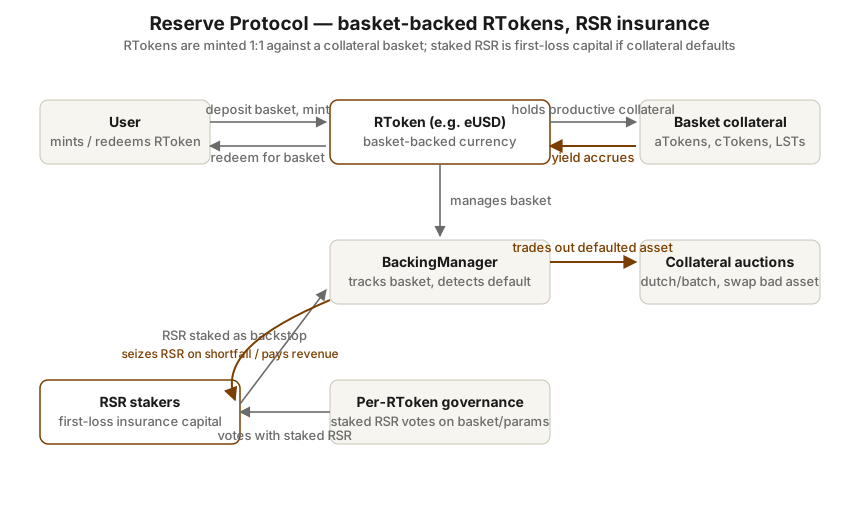 Open full-size diagram
Summary
Reserve Protocol is a permissionless platform on Ethereum (later Base and Arbitrum) for creating fully asset-backed currencies called RTokens — each backed 1:1 by a governable basket of ERC-20 collateral and insured against collateral default by staked RSR (Reserve Rights) tokens. Founded in 2017 by Nevin Freeman (CEO) and Matt Elder (CTO), with early backing reported from investors including Peter Thiel and Sam Altman, Reserve began with an explicitly humanitarian thesis: give people in hyperinflating economies (Venezuela first) a stable currency. The project's arc has three phases: (1) a centralized-basket stablecoin, RSV, plus the RPay consumer app in Latin America (2019–2023); (2) the permissionless RToken factory protocol, live on Ethereum mainnet in October 2022, which produced eUSD and ETH+; and (3) a 2025 pivot to the Reserve Index Protocol, which generalizes RTokens into onchain index funds ("Decentralized Token Folios," DTFs). RSR itself launched via a Huobi Prime IEO in May 2019 and was migrated to a new contract in January 2022.
Design (Mechanism)
The core primitive is the RToken, a currency issued by a deployed instance of Reserve's contract suite:
- Basket backing. Each RToken is defined by a "prime basket" of collateral tokens with target weights (e.g., eUSD: a mix of yield-bearing stablecoin deposits; ETH+: a mix of ETH liquid staking tokens). Anyone can mint an RToken by depositing the basket in proportion, or redeem it for the underlying — issuance and redemption are always at basket value, so peg maintenance relies on arbitrage rather than an active market maker.
- RSR staking as first-loss capital. RSR holders stake on a specific RToken. If a collateral asset defaults (detected by price/status plugins per collateral type), governance-defined "emergency collateral" replaces it: the BackingManager trades out the bad asset via batch or dutch auctions, and any shortfall is covered by seizing staked RSR. Only if staked RSR is insufficient do RToken holders take a haircut. Stakers are compensated with a share of protocol revenue.
- Revenue distribution. Collateral is productive (aTokens, cTokens, LSTs). Yield above the backing requirement is split per RToken configuration between RToken holders (via appreciation or supply increase) and RSR stakers, aligning insurers with the token's growth.
- Per-token governance. Each RToken has its own governance (typically the "Governor Alexios/Anastasius" OpenZeppelin-based setup) in which staked RSR votes on basket composition, revenue splits, and parameters — making each RToken a semi-autonomous currency board rather than one monolithic protocol DAO.
- Security posture. The core protocol went through an unusually heavy audit gauntlet before and after launch — Trail of Bits (Aug 2022), Ackee (Oct 2022), Solidified (Oct 2022), Halborn (Nov 2022), and Code4rena contests (Jan 2023, June 2023 invitational) — plus a bug bounty advertised up to $5M.
The 2025 Reserve Index Protocol reuses the basket/issuance machinery for "Index DTFs": tokenized, rebalanceable portfolios of arbitrary crypto assets, positioned as onchain ETFs on Ethereum and Base.
Outcome
Ongoing, with real but modest traction relative to its "asset-backed world reserve currency" ambition. The RPay app built genuine grassroots usage in Venezuela and five other Latin American countries (a paid "Reserve Rangers" community; the company reported $5.7B in cumulative app volume by early 2023), but in July 2023 RPay suspended local-currency deposits/withdrawals in six countries — Venezuela included — citing US regulatory headwinds, keeping only Mexico rails; the app later refocused internationally. RSV was retired in favor of the decentralized eUSD in March 2023. On the protocol side, RTokens (dominated by eUSD and ETH+) reached a combined market cap on the order of $200M+ by 2025, with no protocol exploit found on the core contracts. Index DTFs launched February 25, 2025 with small initial uptake (~$1.7M across Ethereum and Base at mid-2025 reporting). RSR's market value remains far below its 2021 speculative peak.
Why it worked
- Honest collateral model. Full backing with issuance/redemption at basket value avoided the reflexive death-spiral design of seigniorage stablecoins; eUSD's diversified, governable basket was built to rotate away from a depegging component rather than ride it down.
- Priced-in insurance. RSR staking created an explicit, compensated first-loss tranche — a rare case of a stablecoin quantifying who eats a collateral default and paying them for it.
- Security discipline. Five audit engagements plus contests before/around launch; no core-protocol exploit found to date.
- Real demand discovery. The Venezuela deployment proved product-market fit for inflation-hedging dollars in a way few DeFi projects ever field-tested.
Limitations and criticisms
- Regulatory chokepoints matter more than mechanism design. The fiat on/off-ramps — not the contracts — are the fragile layer; US regulatory pressure led RPay to cut local-currency rails in its core markets in 2023, cutting the protocol off from its flagship user base.
- Permissionless currency creation has found few creators. Years after launch, TVL remains concentrated in two team-adjacent RTokens (eUSD, ETH+); the "Uniswap-for-currencies" long tail has largely not materialized, prompting the pivot to index products.
- Complexity tax. Collateral plugins, per-token governance, auctions, and staking make RTokens far harder to reason about than fiat-backed incumbents (USDC/USDT), which keep winning on distribution and simplicity.
- RSR's value capture is slow. Insurance yield on modest TVL supports limited demand for a 100B-supply token, leaving RSR price driven mostly by narrative cycles.
Lessons
- Fully-backed, redeemable baskets with an explicit paid first-loss tranche is a durable stablecoin architecture; algorithmic peers (Basis — whose team Reserve is often contrasted with — Terra, Iron) died where Reserve's design survived, including through the March 2023 stablecoin depeg turbulence.
- The binding constraint on "money for hyperinflating economies" is fiat ramp regulation and banking access, not smart-contract capability; mechanism designers should treat off-ramp jurisdiction risk as a first-class failure mode.
- Permissionless factories need a demand-side story: infrastructure for creating currencies does not conjure currency creators. Reserve's pivot from "anyone can launch money" to "anyone can launch an index fund" is an admission that the tractable market was portfolio products, not new monies.
- Per-instance governance (each RToken its own DAO of stakers) is a useful pattern for isolating risk: a bad basket decision in one RToken cannot drag down the others.
Redesign (EDITORIAL — hypothesis, not fact)
This section is editorial hypothesis, not established fact. A redesign might invert Reserve's sequencing: instead of building the maximally general currency factory first, ship one flagship RToken with aggressive distribution (wallet and payment-app integrations, LatAm remittance corridors) and only open the factory once the flagship has network effects — the 2025 DTF pivot partially concedes this. Second, the RSR insurance layer could be unbundled: letting stakers underwrite in the RToken's own collateral or in restaked ETH would decouple insurance capacity from the market cap of a single volatile governance token, which currently caps how much default protection the system can credibly sell. Third, given that RPay's rails were the single point of failure, a redesign would pursue jurisdictional redundancy from day one — multiple licensed ramp partners per country and stablecoin-native P2P settlement — so that a regulatory action against one intermediary degrades service rather than severing entire markets.
Sources
- Reserve Protocol core contracts and audit reports (Trail of Bits, Halborn, Ackee, Solidified, Code4rena) — primary (contract)
- RSR mainnet token repository — primary (contract)
- Reserve documentation — primary (docs)
- Introducing the Reserve Index Protocol (Nevin Freeman) — primary (retrospective)
- Update to the Reserve Roadmap (Nevin Freeman) — primary (retrospective)
- Reserve Rights (RSR) contract update scheduled for 01/13/2022 — primary (docs)
- Code4rena — Reserve Protocol invitational audit (June 2023) — primary (audit)
- Etherscan — Reserve: eUSD Token — primary (contract)
- Axios — The rise and pause of stablecoin app RPay (news)
- Rest of World — Reserve created a crypto community in Venezuela (news)
- PRWeb — LATAM payments app RPay with $5.7B in volume adopts eUSD (news)
- DefiLlama — Reserve Protocol TVL (analysis)
- LlamaRisk — Reserve RTokens General Assessment (analysis)
Related experiments
Last verified: 2026-07-26 · Spot an error? Suggest a correction