DigixDAO
Ethereum's first major crowdsale (March 2016) — a DAO meant to govern a gold-tokenization business, which after years of inactivity voted 96.7% to dissolve itself and refund its 380,000 ETH treasury to token holders.
▶ Run interactive simulation animated mechanism with editable parameters
How it works onchain
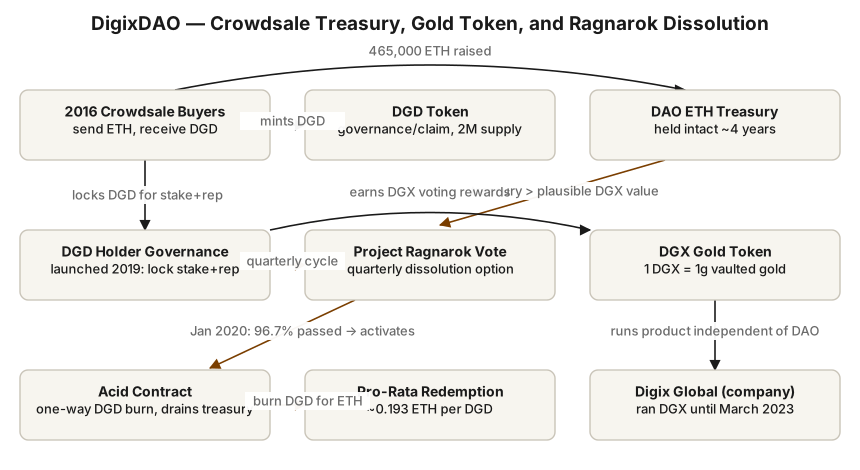 Open full-size diagram
Summary
DigixDAO was the first major crowdsale on Ethereum and one of the first DAOs ever attempted — predating "The DAO" by weeks. Built by Singapore-based Digix Global (founded December 2014 by Kai C. Chng, Anthony Eufemio, and Shaun Djie), it raised roughly $5.5 million in ETH on March 29–30, 2016, hitting its cap in about 12 hours. The DAO's purpose was to govern and fund the growth of Digix's core product: DGX, a gold-backed token where 1 DGX represented 1 gram of audited, vault-stored gold, tracked on-chain via Digix's "Proof of Provenance" documentation pipeline. DGD tokens (2M supply, 1.7M sold) conferred governance rights and a claim on ecosystem rewards. The DAO's governance platform did not actually launch until March 30, 2019 — three years after the raise — by which time the ETH treasury had appreciated enormously and holders wanted out. In January 2020, a founder-proposed dissolution mechanism ("Project Ragnarok") passed with 96.7% support; from March 2020, holders could burn DGD in the "Acid" contract for 0.193 ETH each, unwinding a treasury of roughly 380,000 ETH ($64M at the vote). It remains crypto's most famous voluntary DAO self-liquidation. Digix the company continued operating DGX until ceasing operations in March 2023.
Design (Mechanism)
- Two-token structure. DGX was the product: an ERC-20 gold token redeemable 1:1 for grams of vaulted gold in Singapore, with a demurrage-style annual custody fee and a small transfer fee, backed by Digix's Proof of Provenance protocol (chain-of-custody documents hashed on-chain, third-party audits). DGD was the governance/claim token sold in the 2016 crowdsale; holders were to direct treasury spending on ecosystem growth and earn rewards sourced from DGX fee revenue.
- Crowdsale. March 2016,
465,000 ETH raised ($5.5M then) for 1.7M DGD; 300,000 DGD (15%) retained by the team. The verified DGD token contract (0xE0B7…0E2A) was compiled with Solidity v0.3.0 — a genuine artifact of earliest-era Ethereum. - Governance (launched 2019). DigixDAO ran on quarterly cycles: DGD holders locked tokens to gain "Stake" and accumulated non-transferable Reputation Points by participating; voting weight combined stake and reputation. Moderator roles gatekept proposal quality, and participants earned DGX rewards for voting. Proposals requested treasury ETH in milestone-based tranches.
- Project Ragnarok (dissolution). Proposed by CEO Kai Chng himself, it added a standing quarterly dissolution vote: if holders chose dissolution, the remaining treasury would be placed in a one-way refund contract. The "Acid" contract (0x23Ea…062f, open-sourced by DigixGlobal) let any holder approve and burn DGD to receive a fixed pro-rata ~0.193 ETH per DGD, permanently destroying the tokens. DGX itself was unaffected by the DAO's dissolution.
Outcome
The January 2020 vote passed with 96.7% in favor of dissolution; the DAO dissolved around late March 2020 when Acid went live. Holders redeemed DGD for ETH at ~0.193 ETH/DGD from a treasury of ~380,000 ETH (of ~465,000 raised). Investors who bought at the ICO (implied ~0.27 ETH per DGD, roughly $3.20 at 2016 prices) received a large USD-denominated return purely from ETH appreciation, though a loss in ETH terms. DGX continued as a Digix Global product until the company ceased operations on 21 March 2023, handing gold redemption to an overseas partner (NexusGold FZC). Verdict: the product worked technically (gold really was vaulted, audited, and redeemable; the refund executed flawlessly on-chain), but the DAO never found a commercial purpose for its treasury — hence technically_successful_commercially_unsuccessful.
Why it worked
- Credible asset backing. DGX's Proof of Provenance, named custodians, and audits made it one of the most transparently collateralized RWA tokens of its era — no depeg, no fractional-reserve allegations.
- Treasury custody held for four years. Unlike The DAO (drained in 2016), DigixDAO's ETH survived intact through hacks, forks, and bear markets, making a full refund possible.
- Founder-aligned exit. The team itself proposed dissolution rather than entrenching against holders, and executed it with a simple, auditable one-way burn contract — a rare graceful death.
Where the design broke
- Three-year governance delay. The DAO raised money in 2016 but shipped voting in 2019; by then holders saw DGD purely as a claim on ETH, not on Digix's future.
- Treasury appreciation inverted incentives. With ~380,000 ETH backing 2M DGD, book value per token exceeded any plausible value of DGX fee flows. Rational holders (including activist funds who accumulated DGD below backing value) preferred liquidation to investment — a classic closed-end-fund discount arbitrage.
- Weak demand for the product. DGX volumes and fee revenue never grew enough to justify a $60M+ war chest; the DAO had capital but no compelling proposals to fund.
- Governance friction. Locking DGD, reputation accrual, and quarterly cadence raised participation costs on a token whose holders mostly wanted the ETH back.
Lessons
- A DAO treasury denominated in a volatile appreciating asset can turn into a liquidation target: once redeemable backing exceeds expected enterprise value, token holders rationally vote to unwind (the on-chain version of an activist raid on a closed-end fund).
- Ship governance before the mandate goes stale — a multi-year gap between raise and empowerment converts a community of believers into a community of creditors.
- Exit rights are a feature, not a failure: Ragnarok/Acid became the template for later "rage-quit" and redemption mechanisms (Moloch-style guildkick/ragequit, Aragon court-era discussions, Arca-style treasury activism at other DAOs).
- Transparent collateral and a transparent dissolution preserved the founders' reputations; a project can be commercially unsuccessful without allegations of misconduct.
Redesign (EDITORIAL — hypothesis, not fact)
This section is editorial hypothesis. A modern DigixDAO would (1) escrow the raise with Moloch-style ragequit from day one, letting dissenters exit continuously instead of building a binary dissolution cliff; (2) size the raise to milestones (tranche-vested via on-chain streams) rather than banking 465k ETH up front, so treasury value tracks work delivered; (3) route DGX fee revenue directly to staked DGD via an on-chain fee switch from launch, giving the token cash-flow value independent of treasury book value; and (4) denominate operating reserves in the unit of account of its liabilities (gold or stables), holding ETH only as explicit upside exposure approved by governance. Ironically, the strongest redesign argument is that DigixDAO's actual ending — full pro-rata redemption — is the benchmark every underperforming treasury DAO should be forced to offer.
Sources
- DigixDAO: DGD Token — Etherscan (verified contract) — primary (contract)
- Digix: DGD ETH Refund (Acid) — Etherscan — primary (contract)
- acid-solidity — DigixDAO Refund Contract (DigixGlobal GitHub) — primary (contract)
- Proposal Announcement: Project Ragnarok (Kai Cheng Chng, Digix Official Blog) — primary (governance)
- DigixDAO's Dissolution (Digix Official Blog) — primary (governance)
- Guide To Burning your DGD for ETH (Digix Official Blog) — primary (docs)
- DigixDAO Votes to Liquidate $64M Treasury (CoinDesk) (news)
- DigixDAO Will Be Dissolved — 96.7% of the Vote (CoinCodex) (news)
- What Is DigixDAO Network? Introduction to DGD and DGX Tokens (Crypto Briefing) (analysis)
- Project Ragnarok: Digix Integrates Dissolution Mechanism (Cointelegraph) (news)
Related experiments
Last verified: 2026-07-27 · Spot an error? Suggest a correction