Interlay (iBTC)
A Polkadot parachain that mints iBTC, a trustless, 1:1 Bitcoin-backed asset secured by over-collateralized vault operators rather than a custodian or federation.
▶ Run interactive simulation animated mechanism with editable parameters
How it works onchain
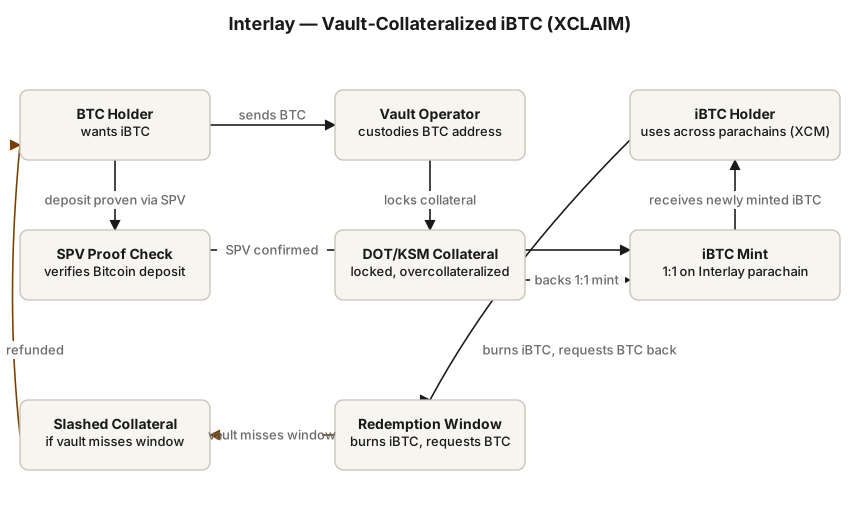 Open full-size diagram
Summary
Interlay is a Polkadot parachain that mints iBTC (formerly "interBTC"), a decentralized, 1:1 Bitcoin-backed token usable across smart-contract chains without relying on a custodian, multisig federation, or trusted bridge operator. The protocol grew out of academic research: co-founders Alexei Zamyatin and Dominik Harz met as PhD researchers at Imperial College London's Centre for Cryptocurrency Research and published XCLAIM (2018), a peer-reviewed protocol design for trustless cross-chain asset issuance. Interlay built the first XCLAIM-based Bitcoin bridge prototype on Ethereum in 2020, then launched its own purpose-built blockchain: first as Kintsugi on Kusama (the "canary" network, live in 2021) and then as Interlay on Polkadot, which won a parachain slot via crowdloan and went live on March 11, 2022.
Design (Mechanism)
Instead of a federation of custodians holding BTC, Interlay uses a permissionless network of "vaults" — operators who lock up collateral (DOT/KSM or other approved assets) worth more than the BTC they custody. To mint iBTC, a user sends real BTC to a vault's Bitcoin address; the deposit is proven on-chain via SPV (simplified payment verification) of the Bitcoin blockchain, and iBTC is minted 1:1 on Interlay. To redeem, a user burns iBTC and the vault must release the underlying BTC within a time window; if the vault fails to do so, its over-collateralized stake is slashed and the user is compensated in the collateral asset instead — the "collateral insurance" model borrowed from XCLAIM's game-theoretic design. This removes the need to trust any single custodian: security instead rests on collateralization ratios, price oracles, and the economic cost of vault misbehavior. Interlay runs as its own parachain (rather than a smart contract on an existing chain) to get native Polkadot shared security and cross-chain messaging (XCM), and uses INTR as its governance/fee token, with Kintsugi on Kusama serving as an unaudited, faster-moving testbed for new features before they roll out to the Polkadot mainnet.
Outcome
Interlay shipped and has operated continuously since March 2022, making it one of the few academically-designed trustless BTC bridge protocols that reached production rather than remaining a paper design. It raised a $3.2M seed round (2021, IOSG Ventures-led per company announcements) and ran successful DOT/KSM crowdloans to win parachain slots on both networks. TVL has stayed a small fraction of custodial wrapped-BTC competitors (WBTC, cbBTC): Interlay's own March 2024 update cited an all-time-high TVL near $21.7M, versus WBTC's tens of billions. iBTC/INTR remain live and traded, and the project continues shipping ecosystem integrations (money markets, vDOT collateral, etc.) as of mid-2025 reporting, but it has not achieved mainstream DeFi liquidity or adoption comparable to custodial wrapped-Bitcoin incumbents.
Why it worked
- The core trustless-bridge mechanism (XCLAIM/vault-collateral-slashing) has functioned as designed since 2022 without a known loss-of-funds exploit, validating the peer-reviewed academic design in production.
- Building as a dedicated parachain gave Interlay native interoperability (XCM) across the growing Polkadot/Kusama ecosystem rather than being confined to a single host chain.
- The Kintsugi/Interlay two-network structure let the team battle-test features on a lower-stakes canary network before deploying to the higher-value Polkadot chain.
Limitations and criticisms
- Trustless, over-collateralized vault bridges face a structural capital-efficiency ceiling that custodial bridges don't: vault operators must lock collateral well above the BTC value they custody, capping supply growth relative to capital-light custodial wrappers like WBTC — a real design cost, not a bug, of removing the custodian.
- Interlay's addressable market is bounded by Polkadot/Kusama's own relatively modest DeFi activity; as a parachain rather than a contract deployed on Ethereum or a high-liquidity L2, iBTC has less natural distribution than bridges native to bigger DeFi ecosystems.
- Custodial and centralized-exchange-backed wrapped BTC products (WBTC, cbBTC, BitGo-custodied assets) dominate wrapped-Bitcoin market share by a wide margin — most users prioritize liquidity and integrations over trust-minimization, which caps how much of the market a trust-minimized alternative can win even when the mechanism performs exactly as designed.
Lessons
- A cryptographically sound, peer-reviewed protocol design (XCLAIM) does not guarantee market adoption; distribution, liquidity, and ecosystem gravity often matter more than trust-minimization to end users.
- Collateral-based trustless bridges face a capital-efficiency ceiling that custodial bridges don't, structurally limiting how much wrapped-asset supply they can support without heavy incentive subsidies.
- Launching as a standalone chain (parachain) rather than a smart contract on an established DeFi hub trades off deep ecosystem liquidity for infrastructure independence — a real cost if the host ecosystem's own DeFi activity stays small.
Redesign (EDITORIAL)
EDITORIAL / hypothesis, not fact: Interlay's trustless vault design is arguably sound engineering searching for the wrong distribution channel. A redesign might keep the XCLAIM collateral-and-slashing mechanism but deploy it as a set of smart contracts directly on Ethereum and major L2s (rather than a separate parachain), so iBTC could compete for liquidity where Bitcoin-DeFi demand is actually concentrated, and pair it with a "hybrid" mode — a small, insured custodial fast-path for large deposits alongside the trustless vault path for smaller ones — to close the capital-efficiency gap with WBTC/cbBTC while still offering a genuinely trust-minimized option for users who want it.
Sources
- The Interlay Parachain is Coming to Polkadot — primary (primary)
- Trustless Bitcoin Bridge Launched on Kusama Network. Polkadot Next. — primary (primary)
- XCLAIM: Blockchain Interoperability — primary (primary)
- What is the Interlay Network? (docs) — primary (primary)
- Interlay Expanding: Bring Trustless InterBTC to All Blockchains, $3mm Seed Round Led by IOSG Ventures (secondary)
- March 2024 Ecosystem Update — primary (primary)
- interBTC price and info, CoinMarketCap (secondary)
Related experiments
Last verified: 2026-07-27 · Spot an error? Suggest a correction