Bifrost
Polkadot/Kusama-native liquid staking parachain that mints yield-bearing vTokens (vDOT, vKSM, etc.) redeemable across parachains without waiting out native unbonding periods.
▶ Run interactive simulation animated mechanism with editable parameters
How it works onchain
 Open full-size diagram
Summary
Bifrost is a Polkadot- and Kusama-native liquid staking protocol, built as its own parachain, that lets holders of proof-of-stake assets (DOT, KSM, and several parachain tokens) stake without losing liquidity. Depositors receive "vTokens" — vDOT, vKSM, vMOVR, vGLMR, vBNC, vASTR, vMANTA — that represent a claim on the underlying staked asset plus accruing staking rewards, and that can be traded, used as collateral, or supplied to DeFi protocols across the Polkadot ecosystem while the underlying position keeps earning yield. Bifrost predates most Ethereum liquid staking tokens' mainstream popularity: the project began in 2019, first proved its model with a crowdloan-liquidity product (vsToken/SALP) during Kusama and Polkadot's parachain slot auctions, then pivoted its core business to general-purpose liquid staking once slot auctions faded in relevance under Polkadot's move to Agile Coretime.
Design (Mechanism)
Bifrost's architecture has two historically important, related pieces:
Slot Auction Liquidity Protocol (SALP): During 2021-2022, Polkadot and Kusama allocated parachain slots via crowdloan auctions, where users locked DOT/KSM for up to two years to back a project's bid. Locked tokens were normally illiquid for the entire lease. Bifrost's SALP let contributors receive a liquid "vsToken" representing their locked position, which could be traded or used elsewhere while the underlying was locked in the auction. Bifrost used this mechanism on itself too, raising over 140,000 KSM (a top-5 Kusama slot) and roughly 300,000+ DOT in its own crowdloans.
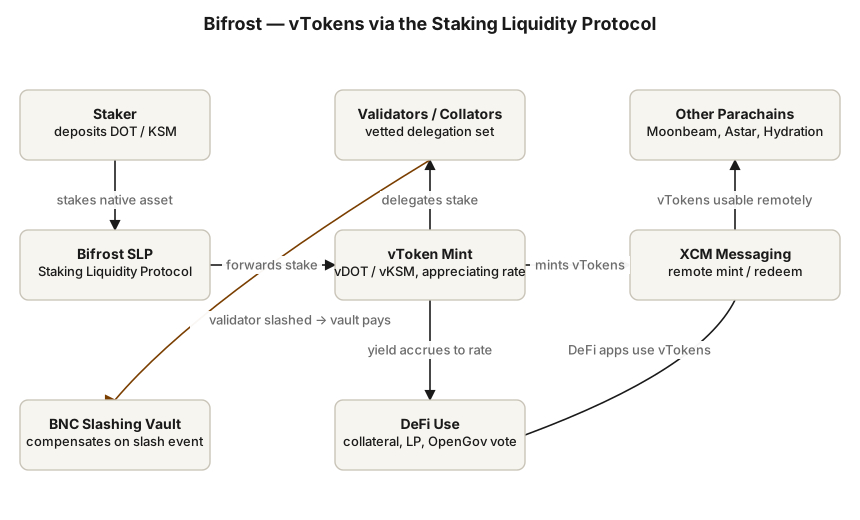
Staking Liquidity Protocol (SLP) / vTokens (the current core product): Users deposit a native PoS asset (e.g., DOT) into Bifrost and receive a corresponding vToken (vDOT) minted at an exchange rate that appreciates over time as staking rewards accrue on the underlying — similar in spirit to Lido's stETH or Rocket Pool's rETH, but built as a purpose-specific parachain rather than a smart contract on a single chain. Bifrost's own validator-delegation logic spreads the underlying stake across vetted validators/collators, with a BNC-token-funded vault intended to compensate users in the event of slashing. Cross-chain messaging (XCM) lets vTokens be minted and redeemed from other parachains (Moonbeam, Astar, Hydration, Manta) without users needing to interact with Bifrost's chain directly, and vToken holders can delegate their voting weight in Polkadot's OpenGov using a "vote-and-earn" style mechanism. Later additions include Loopstake, a leveraged (looping) staking product advertised at up to ~4x exposure to staking yield, and integrations for lending (e.g., via Interlay).
Outcome
Bifrost successfully launched, won parachain slots on both Kusama and Polkadot, and transitioned its business from a slot-auction-liquidity niche (which shrank as Polkadot deprecated traditional slot auctions in favor of Agile Coretime) into becoming, by its own and third-party reporting, the leading liquid-staking protocol within the Polkadot ecosystem, with vDOT and vKSM each reportedly commanding over 60% share of their respective liquid-staking markets and near-total share on several smaller parachains (e.g., vMANTA). Reported TVL has fluctuated with market conditions but has been cited in the hundreds of millions of dollars at points, alongside a broader multi-chain "staking yield layer" strategy. The protocol continues to operate and expand as of the last verification date; no security incident, insolvency, or shutdown was found in available sources, but exact current metrics were not independently re-verified beyond what official/secondary sources reported.
Why it worked
- First-mover status inside Polkadot's own ecosystem: Bifrost built specifically for Polkadot/Kusama's parachain and XCM architecture rather than bolting a liquid-staking wrapper onto a generic smart-contract chain, giving it a structural advantage capturing DOT/KSM stakers.
- Adaptability: when the crowdloan/slot-auction business model it started with became less relevant (Agile Coretime replaced classic slot auctions), the team pivoted the same underlying vToken machinery toward general liquid staking rather than being tied to a shrinking niche.
- Cross-chain composability: XCM-based remote minting/redemption meant vTokens could be used natively in DeFi on other parachains (Moonbeam, Astar, Hydration) without bridging risk, growing utility and demand for the tokens beyond Bifrost's own chain.
Limitations and criticisms
- Bifrost operates in a comparatively small ecosystem (Polkadot/Kusama TVL is a fraction of Ethereum's or Solana's), which caps the addressable market and overall dollar-denominated significance of even a dominant liquid-staking share within it.
- Dependence on Polkadot's own parachain/XCM infrastructure and governance roadmap (e.g., the shift to Agile Coretime) means Bifrost's product surface has had to be reworked more than once as the base layer evolved, adding execution risk and slowing feature velocity relative to single-chain competitors.
- Public, primary-sourced detail on team composition, exact contract addresses, audits, and precise historical metrics is sparser than for larger liquid-staking players (e.g., Lido), making independent verification of specific claims (team, TVL history) harder from open sources.
Lessons
- Liquid-staking derivatives generalize well: a protocol built first for a narrow purpose (unlocking crowdloan liquidity) can pivot its core mechanism (mint a liquid claim token against a locked/staked asset) into a broader, more durable product line.
- Being the dominant player in a smaller ecosystem is a real but bounded win — market-share percentages can look impressive while absolute dollar impact stays modest if the underlying chain's total value is small.
- Tight coupling to a base layer's governance and technical roadmap (Polkadot's slot-auction-to-Coretime transition) is a double-edged sword: it enables native advantages but forces a protocol to keep re-architecting as the base layer changes.
Redesign (EDITORIAL)
EDITORIAL — hypothesis, not fact. If rebuilding Bifrost today, one option worth testing would be decoupling the vToken accounting/rewards layer from any single base chain's roadmap by expressing it as a chain-agnostic, audited "liquid staking standard" (akin to an ERC-4626-style vault interface) that could be deployed consistently across Polkadot parachains, Kusama, and even non-Polkadot ecosystems via a common bridge/light-client layer, rather than being implemented as a bespoke parachain runtime tied to Polkadot's own slot/Coretime economics. This could reduce the engineering cost of adapting to protocol-level changes (like the Coretime migration) and let the vToken liquidity/DeFi network effects Bifrost has built compound across more ecosystems rather than being capped by the size of the Polkadot/Kusama TVL pool. The trade-off is added smart-contract and bridge-security surface area, which is precisely the kind of risk a purpose-built parachain was originally meant to avoid.
Sources
- Bifrost — The Staking Yield Layer For Digital Assets (official site) — primary (official)
- What is Bifrost | Bifrost Docs — primary (official docs)
- How Bifrost Grew to Be The Largest Liquid Staking Platform on Polkadot — primary (official blog)
- Bifrost: The Polkadot Liquid Staking Rollup (Polkadot support) (ecosystem documentation)
- Bifrost reaches its crowdloan soft cap of 300,000 DOT ahead of the Polkadot parachain auction (news)
- Bifrost's Co-Founder and CEO Lurpis Speaks Exclusively with CryptoNewsZ (interview)
Related experiments
Last verified: 2026-07-27 · Spot an error? Suggest a correction