Kujira Orca
Kujira's queue-based liquidation marketplace where bidders compete on discount rate rather than speed, replacing bot-dominated first-come-first-served liquidations.
▶ Run interactive simulation animated mechanism with editable parameters
How it works onchain
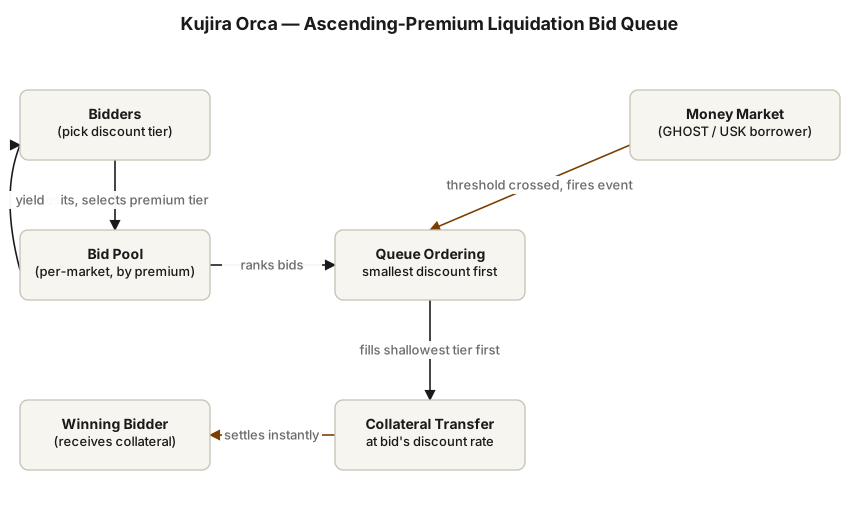 Open full-size diagram
Summary
ORCA is Kujira's public liquidation marketplace, billed as "the world's first public marketplace for bidding on liquidated collateral." Instead of letting the fastest bot claim seized collateral the instant a loan crosses its liquidation threshold — the norm on most lending markets — ORCA runs liquidations through a bid queue where users pre-commit capital to a chosen discount ("premium") level between 0% and roughly 30%. When a liquidation event fires, the queue fills from the smallest requested discount upward, so the bidder willing to accept the thinnest margin gets served first. It launched in October 2021 as the first product built by the pseudonymous "Team Kujira," originally as a companion tool for Anchor Protocol borrowers on Terra, and was later rebuilt as core liquidation infrastructure for Kujira's own money-market and stablecoin products (GHOST and USK) after Kujira launched its own Cosmos SDK app-chain in mid-2022.
Design (Mechanism)
Each liquidatable market on ORCA (e.g., a collateral asset in a lending protocol) has its own bid pool. Users deposit the debt/quote asset and select a premium tier representing the discount they're willing to accept below oracle price for the collateral they'll receive. Bids are queued and, critically, filled in ascending order of requested discount: the shallowest bids execute first, and only if a liquidation is large enough does the queue cascade into deeper-discount tiers. This inverts the typical MEV/bot dynamic — instead of racing to be fastest, participants compete to offer the protocol (and the liquidated borrower) the best price, since demanding too large a discount pushes a bidder to the back of the queue and risks not being filled at all.
The design explicitly targets two failure modes of naive liquidation systems: (1) capital- and infrastructure-advantaged actors (bots, MEV searchers) capturing nearly all liquidation profit via speed, and (2) borrowers being liquidated at needlessly steep discounts because there's no price competition. Kujira also added anti-bot/anti-sniping measures to the queue mechanics, near-instant settlement once a liquidation triggers, on-chain liquidation-prediction analytics so bidders can gauge which positions are near threshold, and a staking gate (reported at 5,000 KUJI or LP tokens) unlocking an advanced bidding dashboard. Idle capital sitting in the queue earns yield while waiting to be matched, reducing the opportunity cost of parking funds for liquidation events that may not occur immediately.
Outcome
ORCA shipped in October 2021 as Team Kujira's debut product, initially serving as a liquidation-bidding front end tied to Anchor Protocol collateral on Terra. After Terra's UST/LUNA collapse in May 2022 wiped out Anchor and most of the Terra ecosystem, Kujira pivoted to launch its own sovereign Cosmos SDK chain (mid-2022), and ORCA was rebuilt as native liquidation infrastructure underpinning Kujira's own lending market (GHOST) and overcollateralized stablecoin (USK). It remains listed in Kujira's official app docs as an active, audited component of the ecosystem. Independent, up-to-date usage statistics (total liquidation volume, number of active bid pools, TVL in queues) were not found in the sources reviewed; Kujira's own dashboards reportedly expose basic per-market liquidation analytics, but no third-party aggregator figures were located.
Why it worked
- Reframes competition from speed to price. By filling the smallest-discount bids first, ORCA turns liquidation bidding into a price-discovery auction rather than a latency race, which is a genuinely novel mechanism relative to the bot-dominated liquidation markets on Ethereum-style money markets.
- Aligns incentives across three sides. Borrowers being liquidated get closer-to-market pricing (less value destroyed), bidders get a transparent, capital-efficient way to earn liquidation yield without running bot infrastructure, and the protocol gets reliable, fast collateral clearing — a genuine three-sided win when it functions as designed.
- Became load-bearing infrastructure, not a side feature. Rather than remaining a standalone product, ORCA was integrated as the liquidation backend for Kujira's own stablecoin (USK) and money market (GHOST), giving it a durable reason to keep operating beyond its original Terra/Anchor use case.
Limitations and criticisms
- Its original context disappeared. ORCA's first use case (Anchor Protocol liquidations on Terra) was wiped out by the Terra/LUNA collapse in May 2022, forcing a full pivot to Kujira's own chain — a discontinuity most liquidation infrastructure never has to absorb.
- Thin, fragmented bid pools in practice. Queue-based fair-price mechanisms depend on enough competing bidders at each discount tier; on a smaller-cap chain like Kujira, liquidation events for any given market can be infrequent and pool depth uneven, which can leave large liquidations only partially filled at the best tiers and spilling into steeper discounts anyway.
- Opacity of adoption metrics. No independently verifiable liquidation-volume or usage figures were found, making it hard to assess from outside how much of Kujira's actual liquidation flow clears through ORCA's fair-ordering queue versus reverting to simpler mechanisms during stress events.
Lessons
- A liquidation mechanism's cleverness (fair-price queues, anti-bot ordering) is only as good as the depth and diversity of the bidder base competing inside it; thin liquidity undermines the "best discount wins" property just as thin liquidity undermines any auction.
- Building core financial infrastructure (like a liquidation engine) as a product first, chain-agnostic layer second let Team Kujira redeploy the same design when its original host chain (Terra) collapsed — a useful pattern for protocol teams betting on infrastructure that may outlive any single settlement layer.
- Tying a liquidation engine to in-house money-market and stablecoin products (GHOST, USK) gives it a captive, recurring source of liquidation flow, which is more sustainable than depending on integrations with third-party protocols outside the team's control.
Redesign (EDITORIAL)
EDITORIAL — hypothesis, not fact. One plausible failure mode for ascending-premium liquidation queues is that they can go empty at exactly the moment they're needed most: during a market-wide crash, everyone wants to be a discount-bidder, not a forced seller, and the queue can be overwhelmed by simultaneous liquidations chasing too few competitive bids, causing exactly the price-blowout the design was meant to prevent. A hardened version might layer a backstop mechanism on top — e.g., a protocol-owned liquidity reserve or insurance fund that only activates when the bid queue's fill rate at low-discount tiers drops below a threshold, automatically absorbing the excess at a fixed, pre-disclosed discount rather than letting the queue cascade to 30%+ during a crisis. Combining this with cross-chain bid-pool sharing (letting bidders on other Cosmos IBC-connected chains post liquidity into Kujira's ORCA pools without bridging assets first) could also deepen the bidder base beyond Kujira's own relatively small user base, addressing the thin-liquidity risk directly.
Sources
- ORCA (Liquidations) | Kujira Docs — primary (official docs)
- ORCA: How to bid on liquidations | Team Kujira (Medium) — primary (official blog)
- Meet Team Kujira | Kujira Docs — primary (official docs)
- Spotlight: ORCA by Kujira — Crypto Chemistry (third-party analysis)
- $USK Minting & ORCA Liquidation Bids | Team Kujira — primary (official blog)
Related experiments
Last verified: 2026-07-27 · Spot an error? Suggest a correction