VRGDA (Gradual Dutch Auctions)
A Paradigm-designed token/NFT issuance primitive that sells assets on a predefined schedule by algorithmically raising prices when sales run ahead of schedule and lowering them when sales lag.
▶ Run interactive simulation animated mechanism with editable parameters
How it works onchain
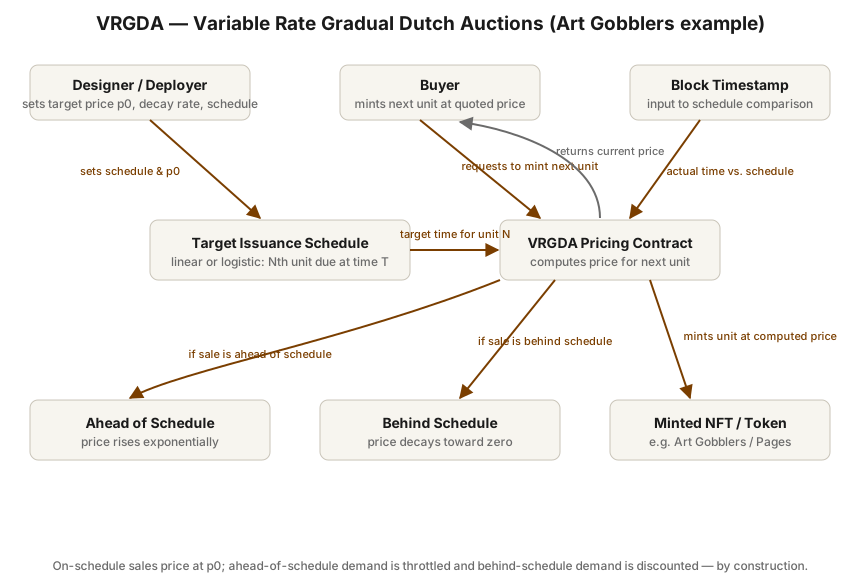 Open full-size diagram
Summary
Gradual Dutch Auctions (GDAs) and their better-known extension, Variable Rate GDAs (VRGDAs), are auction/issuance primitives published by Paradigm's research team in 2022. The GDA paper (Dave White, April 2022) proposed breaking a large sale into a sequence of continuously price-decaying Dutch auctions so illiquid assets (NFTs or fungible tokens) can be sold over time without market makers. The VRGDA paper (August 24, 2022, by transmissions11, FrankieIsLost, and Dave White) generalized this into a schedule-targeting mechanism: pick any target issuance schedule — linear, logistic S-curve, or custom — and the contract exponentially raises price when sales run ahead of that schedule and decays price when sales fall behind. VRGDA is not a company or token; it is an open-source mechanism (MIT-licensed Solidity reference implementation at transmissions11/VRGDAs) that debuted in production with Paradigm's Art Gobblers NFT project (October 31, 2022) and the 0xMonaco onchain racing game, and has since been reused and forked by community experiments (e.g., Robo Nouns) and analyzed academically.
Design (Mechanism)
- GDA (base primitive): A sale is decomposed into many virtual Dutch auctions, each starting at a high price that decays exponentially with time. Discrete GDAs suit NFTs (buy N auctions in one gas-efficient transaction); continuous GDAs suit fungible-token emissions. No counterparty liquidity is needed — the mechanism solves a similar problem to TWAMM without LPs.
- VRGDA (schedule targeting): The designer specifies a target price
p0(the price when sales are exactly on schedule), a per-unit-time decay constant, and an issuance schedule function that maps "the Nth token" to "the time it should be sold." The actual price for the next unit isp0scaled exponentially by how far ahead of (or behind) schedule the sale is. On schedule → price ≈p0; ahead → price rises steeply, throttling demand; behind → price decays toward zero, guaranteeing eventual clearing. - Schedule variants in the reference repo:
LinearVRGDA(constant units/day, equivalent to a standard GDA),LogisticVRGDA(fast early issuance tapering asymptotically toward a supply cap without infinite inflation), and composites likeLogisticToLinearVRGDA. - Production example: Art Gobblers used a logistic VRGDA for Gobbler NFTs (paid in the GOO token) and a logistic-to-linear VRGDA for Pages (targeting ~69/day early, decaying toward a constant 10/day), so mint pricing floats purely on demand versus schedule rather than gas-war first-come-first-served mints.
Outcome
The mechanism worked as engineered. Art Gobblers' launch (October 31, 2022) was one of the largest NFT launches of the bear market — roughly 7,000 ETH of OpenSea volume in the first 12 hours and over $50M in secondary sales within days — and its VRGDAs priced continuous issuance without gas wars or a mint crash, exactly as intended. 0xMonaco used a VRGDA to price in-game purchases in a competitive game loop. The primitive itself became a widely cited piece of the mechanism-design canon: it is a standard reference in NFT-issuance discussions, spawned forks and variants (e.g., martingale-corrected MVRGDA, Robo Nouns' VRGDA minting experiment for the Nouns ecosystem), and drew formal academic analysis (the "Loss-Versus-Fair" AFT 2024 paper on Dutch-auction efficiency). However, Art Gobblers itself faded — GOO was extremely volatile post-launch (single-day swings of ~70%) and the project's cultural momentum did not persist — and VRGDA adoption, while real, remained a niche pattern rather than an industry-default mint standard. Hence: partial_success — an intellectually successful, production-proven primitive whose flagship application underperformed and whose adoption stayed modest.
Why it worked
- It solved a real, well-scoped problem: first-come-first-served fixed-price mints create gas wars and MEV; one-shot auctions can't handle continuous issuance. VRGDA gives a closed-form, gas-cheap price for "the next unit right now" for any schedule.
- Exceptional distribution of the idea: a clear Paradigm paper, a highly optimized MIT reference implementation, and an immediate high-profile production deployment (Art Gobblers, open-sourced pre-launch) made it trivially adoptable and credible.
- Self-correcting economics: the exponential ahead-of-schedule penalty and behind-schedule decay make both runaway pricing and permanent unsold overhang impossible by construction — the sale always converges back to schedule.
Why it failed or underperformed
- Fate tied to its flagship: VRGDA's visibility rode on Art Gobblers, and when GOO/Gobbler prices collapsed with the project's hype cycle, enthusiasm for the surrounding stack cooled, even though the auction mechanism itself performed correctly.
- Schedule-setting is the hard part: VRGDA guarantees you hit a schedule, not that the schedule is right. Designers must still guess demand elasticity (
p0, decay rate, curve shape) upfront; a bad guess produces prices that feel punitive or giveaway-cheap. - Narrow demand window: after the 2022–23 NFT contraction, far fewer projects needed sophisticated continuous-issuance pricing at all; simple allowlist or fixed-price mints sufficed for smaller drops, capping the mechanism's addressable use cases.
- Behind-schedule decay is exploitable in thin markets: if organic demand disappears, price decays toward zero, so a committed schedule keeps emitting cheap supply into a falling market — pro-cyclical for the asset's floor price.
Lessons
- Mechanisms outlive their flagship apps. A well-specified, open-source primitive (paper + audited-quality reference code) keeps compounding as public infrastructure even when the launch project fades — design for reuse, not just for your own drop.
- Schedule-targeting beats price-targeting for issuance. Fixing quantity-over-time and letting price float eliminates gas wars and mint sniping in a way fixed-price mints structurally cannot; the price chart becomes the demand signal.
- Algorithmic pricing moves the design risk upstream. VRGDA doesn't remove the pricing problem; it relocates it into parameter selection (target price, decay constant, curve). Teams should treat parameterization as the core economic decision and simulate demand scenarios before deploying.
- A guaranteed-clearing sale is pro-cyclical on the downside. Any mechanism that decays price until units sell will keep issuing into weak demand; pairing it with a reserve price, pause governance, or utility sinks mitigates the death-spiral aesthetic.
Redesign (EDITORIAL — hypothesis, not fact)
This section is editorial analysis — a hypothesis, not established fact. A modern VRGDA v2 could address the two structural weak points: static schedules and downside pro-cyclicality. First, make the schedule itself adaptive within governance-set bounds — e.g., an EMA of realized demand slowly re-parameterizes the target rate, so the designer's launch-day elasticity guess is corrected onchain rather than locked in forever (the community MVRGDA fork's martingale price correction gestures at this). Second, add an optional protocol-owned reserve: below a floor price, unsold scheduled units are diverted to a treasury/burn instead of being dumped at decaying prices, converting the "guaranteed clearing" property into "guaranteed schedule resolution." Third, the most promising near-term application is probably not NFT art at all but continuous sales of protocol resources — blockspace derivatives, sequencer slots, ad slots, or DAO treasury diversification (as the Nouns-ecosystem experiments hinted) — where a credible, manipulation-resistant schedule matters more than mint-day spectacle. Deployed there, VRGDA's core insight (fix quantity, float price, penalize being ahead of schedule exponentially) could become boring, load-bearing infrastructure rather than a bull-market curiosity.
Sources
- Variable Rate GDAs (Paradigm research paper) — primary (docs)
- Gradual Dutch Auctions (Paradigm research paper) — primary (docs)
- transmissions11/VRGDAs reference implementation (MIT, Solidity) — primary (contract)
- Art Gobblers contract (GOBBLER) on Etherscan — primary (contract)
- Open Sourcing the Art Gobblers Smart Contracts (Paradigm) — primary (docs)
- Understanding Art Gobblers: the Mechanics Unpacked (Crypto Briefing) (news)
- What is VRGDA? (Delphi Digital explainer) (analysis)
- Loss-Versus-Fair: Efficiency of Dutch Auctions on Blockchains (AFT 2024) (analysis)
- Robo Nouns — VRGDA minting experiment for Nouns (contract)
Related experiments
Last verified: 2026-07-26 · Spot an error? Suggest a correction