Injective Burn Auction
Injective's weekly winner-take-all auction that sold off 60% of pooled exchange fees for INJ and destroyed the winning bid, making INJ deflationary before the mechanism was superseded by a monthly Community BuyBack program in late 2025.
▶ Run interactive simulation animated mechanism with editable parameters
How it works onchain
 Open full-size diagram
Summary
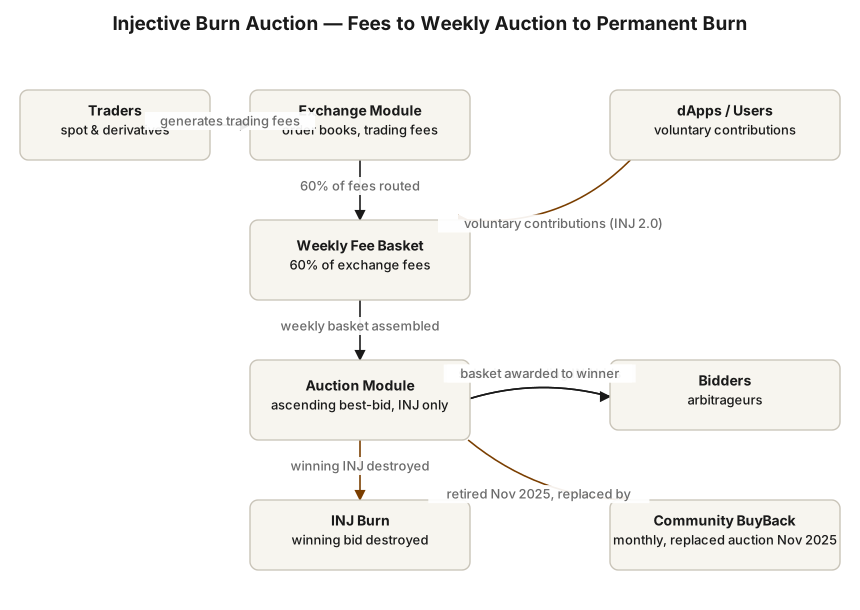
The Injective Burn Auction was a native, protocol-level auction module launched on December 10, 2021 (first burn executed December 15, 2021) that automatically routed 60% of all exchange trading fees collected across the Injective chain into a weekly basket, then auctioned that basket off to the highest bidder — payable exclusively in INJ, Injective's native token. The winning bid's INJ was immediately and permanently burned, tying the chain's own commercial activity directly to a continuous reduction in INJ's circulating supply. It was one of the earliest and most aggressive "revenue-to-burn" designs in DeFi, later expanded (INJ 2.0 in 2023, and a further upgrade in April 2024) to let any application — and eventually individual users — contribute assets into the auction basket, not just the exchange module.
Design (Mechanism)
Each week, Injective's on-chain auction module (a native Cosmos SDK module, not a smart contract) accumulates a basket of assets: 60% of exchange fees generated by spot and derivatives trading on the protocol, plus, after later upgrades, voluntary contributions from third-party dApps and users. The basket is auctioned using an ascending best-bid mechanism over a roughly one-week window. Bidders submit INJ; each new bid must exceed the prior one, and only the final, highest bid is honored when the round closes. When the auction ends, the winning bidder receives the entire basket of pooled assets (potentially discounted relative to market value, creating an arbitrage incentive to bid), and the INJ they paid is destroyed on-chain — verifiably reducing total INJ supply. A new auction round begins immediately after the previous one settles, making the burn cadence continuous and automatic rather than requiring governance action each time. The module is fully permissionless and requires no off-chain coordinator: anyone can view the current basket and submit a bid directly against the chain.
Outcome
The mechanism ran essentially continuously for roughly four years, burning meaningful and growing amounts of INJ, especially as Injective's DeFi and derivatives ecosystem (dYdX-style perpetuals, spot markets, and later RWA/prediction-market apps) grew and generated more fee volume. Reporting over the years cites individual weekly burns ranging from thousands to over 12,000 INJ, and single-week burns exceeding $300,000 in value at various points, alongside cumulative supply reductions reported in the low single-digit millions of INJ. By late 2025, Injective's own materials describe the burn auction as having removed on the order of 6.78 million INJ from circulation (roughly 7% of total supply, valued at approximately $32 million at the time) over its lifetime. In November 2025, Injective retired the winner-take-all weekly auction model in favor of a new "Community BuyBack" program — a monthly mechanism where community participants commit INJ in exchange for a share of ecosystem revenue, with the committed tokens ultimately burned. As of this writing the Community BuyBack is the active mechanism; the original Burn Auction is no longer running in its original form.
Why it worked
- Direct, automatic linkage between protocol usage and token scarcity. Every trade on Injective mechanically fed the auction basket, so growth in exchange activity translated into a visible, verifiable, on-chain burn — a concrete, checkable "buyback-and-burn" story rather than a discretionary treasury decision.
- Market-priced arbitrage incentive kept the auction liquid. Because winning bidders received a basket of assets (often at a discount to spot value), sophisticated bidders were financially incentivized to participate every week, ensuring the auction reliably cleared rather than going unbid.
- Progressive expansion widened the flywheel. The INJ 2.0 (2023) and April 2024 upgrades let any application and eventually individual users route value into the auction basket, not just the native exchange module, which broadened the mechanism beyond Injective Labs' own order book product as the ecosystem diversified.
Where the design broke
- Winner-take-all structure concentrated benefit. Only one bidder per week actually captured the discounted basket; the deflationary "story" was broadly shared but the arbitrage upside accrued narrowly to whichever sophisticated trader/bot won that round, limiting the sense of broad community participation.
- Burn size was capped by real trading volume. Because the basket was funded by actual exchange fees, the deflationary impact scaled only with genuine usage — during quieter trading periods the burns were comparatively small relative to INJ's overall supply and market cap, muting the "ultrasound money" narrative during down markets.
- Eventually judged insufficiently aligned with long-term holders, per Injective's own framing: the team replaced it with the Community BuyBack specifically to let more participants commit tokens and earn ecosystem revenue share rather than have value flow to a single weekly auction winner, implying the original design was seen as leaving value on the table for the broader community.
Lessons
- Routing protocol revenue into a transparent, automatic, on-chain burn mechanism is a credible way to make "deflationary tokenomics" verifiable rather than promotional — but the burn's magnitude is still bounded by real usage, not by marketing.
- Winner-take-all auction formats are simple and reliably clear (arbitrageurs keep them liquid), but they concentrate the auction's economic upside in a small set of sophisticated participants rather than the wider token-holder base.
- Tokenomics mechanisms are not static: even a multi-year, widely cited flagship mechanism (the burn auction was one of Injective's signature features) can be redesigned or retired once the team judges a newer structure (here, the Community BuyBack's revenue-share model) better serves participation and alignment goals.
Redesign (EDITORIAL)
Hypothesis, not fact. A blended design could preserve the burn auction's simplicity while spreading its benefit more broadly: instead of a single weekly winner-take-all round, split the fee basket into several smaller parallel lots (e.g., 5–10 baskets) auctioned simultaneously, so multiple bidders can win a share each week rather than one party capturing the whole pool. Combine this with a pro-rata "second-price" settlement (all winners pay the same clearing rate, akin to a batch auction) to reduce the incentive for bid-sniping late in the round and make outcomes fairer across participants of different sophistication levels. This would retain the core verifiable-burn property that made the original mechanism credible while addressing the concentration critique that apparently motivated Injective's actual move to the Community BuyBack model.
Sources
- Injective Burn Auction Launch (official blog) — primary (docs)
- Injective Auction module documentation — primary (docs)
- 2026 Injective Community BuyBack Guide (official blog) — primary (docs)
- Injective (@injective) explainer thread on the burn auction — primary (other)
- Understanding Injective (INJ) Burn Auction and Its Mechanism — Bittime (analysis)
- INJ 2.0: The Injective Token Burn Upgrade — Medium (analysis)
Related experiments
Last verified: 2026-07-27 · Spot an error? Suggest a correction