Lighter
A custom zero-knowledge rollup on Ethereum built solely to run a fully onchain, zk-proven central limit order book for perpetual futures, offering zero fees to retail traders.
▶ Run interactive simulation animated mechanism with editable parameters
How it works onchain
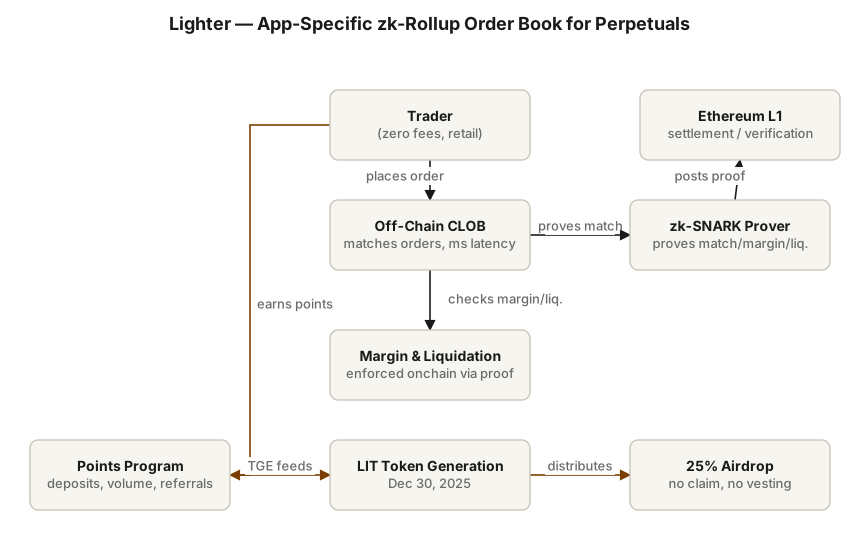 Open full-size diagram
Summary
Lighter is a decentralized perpetual futures exchange built as its own application-specific zero-knowledge rollup on Ethereum. Rather than deploying a perps protocol on top of a general-purpose chain, Lighter built a custom L2 whose only job is running a central limit order book (CLOB) for perpetuals, with every order match, margin check, and liquidation accompanied by a zk-SNARK proof posted back to Ethereum. Founded by Vladimir Novakovski (previously co-founder/CEO of Lunchclub, and earlier Head of Machine Learning at Quora and VP Engineering at Addepar), Lighter ran an eight-month private beta before opening a public mainnet on October 2, 2025. It raised $68 million in a round led by Founders Fund and Ribbit Capital (with Haun Ventures and Robinhood also participating) at a reported ~$1.5 billion valuation, and launched its LIT token on December 30, 2025, distributing 25% of supply via airdrop to points-program participants.
Design (Mechanism)
Lighter's core bet is that a perp exchange should be an appchain, not a smart contract. The rollup runs a fully onchain CLOB (rather than the AMM or vAMM designs used by many earlier onchain derivatives protocols), matching orders off-chain at high frequency — reportedly tens of thousands of orders and cancellations per second with millisecond latency — while cryptographically proving the correctness of every match, margin check, and liquidation via zk-SNARK proofs settled to Ethereum L1. This is meant to combine centralized-exchange-grade performance (speed, tight spreads, an order book rather than a pool) with the verifiability and self-custody properties of a rollup: traders don't have to trust an operator's internal ledger because the state transitions are proven, not merely asserted.
The fee model was structured to court retail flow specifically: zero fees for ordinary retail traders, with tiered/competitive fees applied to high-frequency and market-making participants who generate the bulk of volume. This is a deliberate wedge against incumbents (notably Hyperliquid) that charge fees more uniformly. Growth was bootstrapped through a multi-season points program (funded deposits, trading volume, and referrals earned points), which fed directly into the LIT token generation event and airdrop rather than running as a separate, disconnected incentive scheme.
Outcome
Lighter scaled quickly. By the time of its public mainnet launch and through the following months, reporting cited roughly $487 million in TVL, ~$39 billion in 30-day perp volume, and $1.63 trillion in cumulative trading volume since inception, with the user base reported around 188,000 accounts. In September 2025, Lighter's trading volume reportedly briefly surpassed Hyperliquid's, a notable milestone given Hyperliquid's dominant position in onchain perps at the time; that same month, industry-wide perp DEX volume crossed $1 trillion for the first time, with Lighter, Hyperliquid, and Aster all posting over $100 billion in 30-day volume. The LIT token launched December 30, 2025, with 25% of supply airdropped at TGE with no claim process or vesting, and the remaining supply split evenly between team/investors (with a one-year cliff) and the ecosystem. As of this research pass, Lighter is an actively operating, well-capitalized protocol; it is too early to call the token's long-term price performance or the venue's durability against Hyperliquid, Aster, and other perp-DEX competitors a settled outcome, so this entry is marked "ongoing."
Why it worked
- Performance-first architecture: building a dedicated app-specific rollup for one purpose (a perps order book) let Lighter chase CEX-like latency and throughput instead of inheriting the constraints of a general-purpose L2 or L1, directly targeting the UX gap that has historically pushed derivatives traders to centralized venues.
- Verifiable trust without full decentralization theater: zk-proving matches and liquidations gave users cryptographic assurance of fair execution without requiring a fully decentralized sequencer/validator set from day one — a pragmatic middle ground that let the team ship and scale fast.
- Fee design aimed at the right growth lever: zero fees for retail removed the main friction for casual traders switching from CEXs, while still monetizing the professional/HFT flow that provides liquidity and generates most volume.
- Credible capital and timing: a $68M raise from Founders Fund/Ribbit Capital (plus Haun and Robinhood) gave Lighter runway and legitimacy during a period when onchain perps overall were seeing explosive volume growth, letting it capture share of a rapidly expanding pie rather than fight for a shrinking one.
Limitations and criticisms
- Reliance on a nascent, custom zk-rollup stack. Execution and proving bugs, and sequencer-centralization concerns, are risks inherent to any new application-specific appchain in its early years, and Lighter's stack has not yet been tested by a long track record.
- Intense competitive pressure. Hyperliquid, Aster, and other perp DEXs are racing on the same latency, throughput, and fee dimensions Lighter is built around, so its edge is not structurally defensible against fast followers.
- Incentive-driven volume is unproven as durable demand. Points-program and airdrop-driven volume commonly proves partly mercenary and contracts once token incentives taper off, a pattern seen in many DeFi "vampire growth" launches; whether Lighter's volume holds up post-incentives has not yet been settled one way or the other.
Lessons
- A CLOB-based, application-specific rollup can meaningfully close the UX gap between onchain and centralized derivatives venues if the team is willing to build custom infrastructure rather than reuse general-purpose L2/L1 rails.
- Zero fees for retail combined with fees on professional flow is an effective wedge strategy against incumbents that price all users similarly — it targets the segment most sensitive to switching costs.
- Tying a points program directly to a token generation event (rather than running loosely-coupled "farm now, hope for airdrop later" incentives) can convert early liquidity-mining behavior into a clean, well-telegraphed token launch.
- Surpassing an established leader's volume in a single month is a meaningful signal but not proof of durable product-market fit; sustained volume after incentive/airdrop effects fade is the real test, and that test had not yet fully played out as of this write-up.
Redesign (EDITORIAL — hypothesis, not fact)
If starting from scratch, a redesign might try to reduce the trust and centralization risk still implicit in "app-specific rollup with zk-proofs of correctness" by shipping a fully decentralized, permissionless sequencer/prover set from launch rather than as a later-stage roadmap item — several perp-DEX competitors have been criticized for keeping matching or sequencing centralized even while marketing "onchain" trading, and Lighter's long-term differentiation may depend on closing that gap before rivals do. A second hypothesis: rather than a single monolithic points-to-airdrop pipeline, a redesign could experiment with continuous, volume-proportional fee rebates paid in LIT (instead of front-loaded season-based points), which would smooth incentive-driven volume spikes and give a cleaner read on organic retention once the initial airdrop excitement fades.
Sources
- Lighter official site — primary (official)
- Lighter CEO on 'democratizing finance' with a zero-fee, ZK perp DEX (The Block) — primary (news)
- Exclusive: DeFi founder who graduated Harvard at 18 raises $68 million for crypto trading protocol Lighter (Yahoo Finance / Fortune) — primary (news)
- Lighter Launches Public Mainnet With ZK-Powered Perp DEX on Ethereum L2 (Yahoo Finance) (news)
- Lighter Launches LIT Token With 25% Supply Distributed via Airdrop (news)
- What Is Lighter (LIGHT): zk-Rollup Perpetuals DEX With Secure Liquidations (Bitget Academy) (explainer)
Related experiments
Last verified: 2026-07-27 · Spot an error? Suggest a correction