Aztec Network
Privacy-first Ethereum zk-rollup that shipped and then deliberately killed two centralized privacy products (zk.money, Aztec Connect) before relaunching in November 2025 as Ignition Chain, a decentralized-from-day-one L2 with client-side proving and the Noir language.
▶ Run interactive simulation animated mechanism with editable parameters
How it works onchain
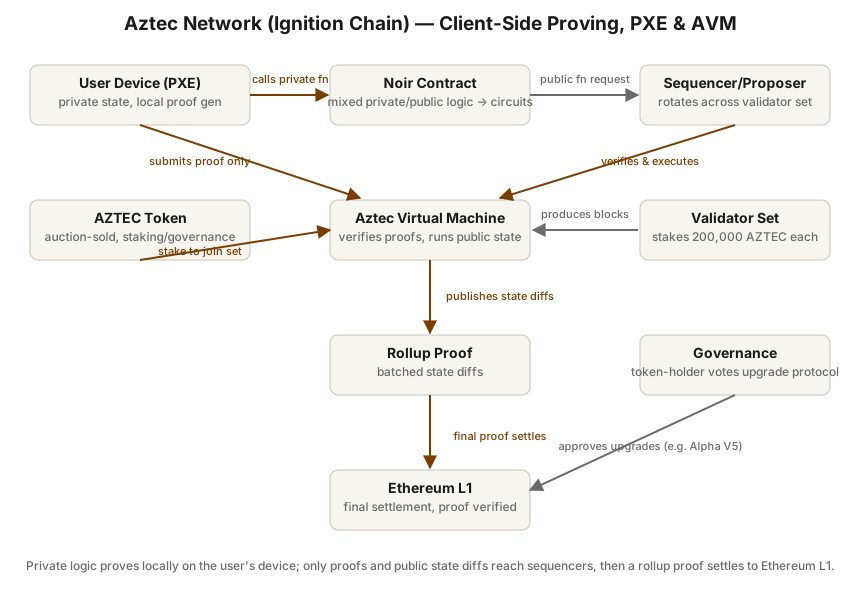 Open full-size diagram
Summary
Aztec is the longest-running attempt to build programmable privacy on Ethereum. Founded in 2017 by Zac Williamson, Joe Andrews, Tom Pocock, and Arnaud Schenk (originally as CreditMint, a private corporate-debt platform), the team invented the PLONK proving system in 2019 — one of the most influential zk-SNARK constructions in the industry — and shipped two production privacy products: zk.money (March 2021, private payments) and Aztec Connect (July 2022, a "DeFi privacy bridge" rollup that let users interact with Lido, Element, and other protocols anonymously). In March 2023, despite raising a $100M Series B led by a16z just months earlier (December 2022), the team announced it was sunsetting both products, stating that they could not be fully decentralized without massive architectural changes. The team publicly denied that regulatory pressure (this was post-Tornado Cash sanctions) forced the decision. After a two-and-a-half-year rebuild around the Noir language and client-side proving, Aztec launched its public testnet in May 2025 and its "Ignition Chain" mainnet on November 19, 2025 — claimed as the first Ethereum L2 to launch with a decentralized sequencer/validator set from day one, with block production triggered when the validator queue reached 500. As of mid-2026 the network is in Alpha (V5), with upgrades passed by token-holder governance.
Design (Mechanism)
The current network's core mechanism is hybrid private/public execution with client-side proving:
- Private Execution Environment (PXE): private smart-contract functions execute on the user's own device. The PXE manages private state and accounts, generates a zk-proof of correct execution locally, and submits only the proof (plus any public-function requests) to the network. Private inputs never leave the client.
- Aztec Virtual Machine (AVM): public functions execute network-side, processed by sequencers who verify the private proofs, execute public state transitions, and publish state diffs and a final rollup proof to Ethereum L1.
- Noir: a Rust-like domain-specific language (originally developed by Kevaundray Wedderburn's team) that compiles contracts into SNARK circuits, letting developers mix private and public logic in one contract without writing raw circuits.
- Decentralized sequencing: validators stake 200,000 AZTEC to join the validator set; sequencer/proposer duties rotate across this permissionless set rather than a company-run sequencer. Mainnet block production was gated on a minimum of 500 registered validators.
- Token distribution: Aztec deliberately rejected the airdrop meta, running a public auction sale instead (registration raised ~$2.5M from 1,925 bidders; auction opened December 2, 2025). AZTEC is used for staking, governance, and block rewards, and protocol upgrades (e.g., Alpha V5) pass through token-holder governance.
- Predecessor mechanism (Aztec Connect): a company-operated rollup (processor contract
0xFF1F2B4ADb9dF6FC8eAFecDcbF96A2B351680455) that batched users' private DeFi interactions through "bridge" contracts, amortizing gas and hiding individual identity within the batch. On sunset, deposits were disabled, ownership of the rollup contract was irrevocably renounced, and a community-maintained "Ejector" allows permissionless withdrawals forever.
Outcome
Ongoing. The first-generation products worked technically and found real users, but were shut down by their own team: zk.money (2021) and Aztec Connect (2022) were sunset in March 2023 (deposits off March 23, 2023; infrastructure fully off March 31, 2024) because the operator was a single point of failure — an uncomfortable property for a privacy system in the post-Tornado-Cash environment, though the founders explicitly denied direct regulatory pressure. The rebuilt network hit public testnet in May 2025 and mainnet (Ignition Chain) on November 19, 2025 with 500+ validators from day one. As of July 2026 it runs in Alpha V5 (a governance-passed upgrade that roughly doubled private proving speed and halved transaction costs). Whether it achieves durable adoption as a "private world computer" is not yet decided; its cryptographic contribution (PLONK, Noir) is already an unambiguous industry-wide success.
Why it worked
- World-class cryptography as a moat: PLONK became a foundational proving system across the ZK industry, giving Aztec credibility, talent gravity, and $119M+ in funding (Paradigm-led Series A; $100M a16z-led Series B).
- Real demand for privacy: zk.money and Aztec Connect demonstrated that users would route DeFi activity through a privacy layer when UX and gas costs were tolerable.
- Willingness to kill their own product: sunsetting Connect — with renounced contract ownership and a permanent escape-hatch withdrawal path — preserved user funds and reputation, and freed the team to rebuild correctly.
- Decentralization as launch criterion, not roadmap item: gating mainnet on 500 independent validators inverted the standard L2 playbook ("training wheels first") and neutralized the operator-liability problem that killed Connect.
Limitations and criticisms
- Generation 1 was architecturally centralized: the company ran the sequencer and infrastructure for zk.money and Connect, making the team a chokepoint for a censorship-resistance product — untenable after the 2022 Tornado Cash sanctions raised operator risk, whatever the proximate motive for the sunset.
- Extremely long rebuild: ~2.5 years between the Connect sunset announcement and mainnet is an eternity in crypto; competitors and the broader privacy narrative moved during the gap, and Aztec now launches into a crowded L2 field where even non-private rollups struggle for organic activity.
- Client-side proving costs UX: generating proofs on user devices is fundamentally heavier than a normal wallet transaction; performance work (Alpha V5's 2x proving improvement) shows this remains a live constraint rather than a solved problem.
- Adoption unproven: as of mid-2026 there is no public evidence of significant TVL or application traction on the new network — too early to judge, but the commercial question is genuinely open.
Lessons
- A privacy system inherits the trust profile of its most centralized component. Perfect cryptography behind a company-run sequencer still leaves an entity that can be pressured, sanctioned, or subpoenaed; Aztec concluded the only fix was architectural, not operational.
- Shutting down gracefully is a mechanism design act. Renouncing contract ownership and shipping a permissionless withdrawal path turned a product failure into a reputation asset — contrast with projects that sunset by rugging user exit paths.
- Research spillovers can outvalue the product. PLONK and Noir arguably created more ecosystem value than zk.money ever transacted; deep-tech crypto teams should plan for their primitives, not just their apps, being the durable output.
- "Decentralized from day one" is a launch-gating choice, not a property that emerges later. Using a validator-count threshold as the mainnet trigger converts decentralization from a promise into a verifiable precondition.
- Rebuilds have a clock. Doing it right cost Aztec the 2021–2024 privacy demand window; a team without $100M+ in the bank could not have survived the same decision.
Redesign (EDITORIAL — hypothesis, not fact)
This section is editorial analysis — a hypothesis, not established fact. If redesigning from 2021 knowledge: (1) ship Aztec Connect with a credible-neutrality exit from the start — a permissionless sequencer fallback or forced-inclusion path via L1 — so the product need not be killed to escape operator liability; this might have preserved the user base through the rebuild. (2) Decouple the privacy layer from the "own L2" bet: licensing PXE-style client-side proving as an embeddable privacy kernel for existing high-liquidity L2s would meet users where activity already is, rather than asking DeFi to migrate to a new chain for privacy. (3) Keep the no-airdrop auction (it filters mercenary capital) but pair it with protocol-level fee routing to application developers, since a privacy chain's cold-start problem is application supply, not validator supply. (4) Treat proving latency as the primary product metric from day one; a privacy transaction that takes an order of magnitude longer than a public one will lose all but the most privacy-motivated users, so the 2x-per-upgrade performance cadence of Alpha V5 should be the core roadmap, not a follow-on optimization.
Sources
- History of Aztec: Pioneering Privacy in Web3 (official) — primary (docs)
- Aztec Network official site (Alpha status, social links) — primary (docs)
- Sunsetting Aztec Connect (Aztec Labs) — primary (retrospective)
- Aztec Documentation — PXE / architecture — primary (docs)
- Zk.Money v2 (Aztec Connect) — L2BEAT (contract address, archived status) (analysis)
- Aztec launches privacy-focused L2 Ignition Chain on mainnet following token sale — The Block (news)
- Privacy-Focused Aztec Network's Ignition Chain Lights Up on Ethereum — CoinDesk (news)
- Regulatory Pressure Did Not Shut Down Privacy Tool, Aztec Founders Say — CoinDesk (news)
- Aztec Network takes on encrypted blockchains with $100M round led by a16z — TechCrunch (news)
- Aztec Network launches public testnet for privacy-focused Ethereum L2 — The Block (news)
Related experiments
Last verified: 2026-07-26 · Spot an error? Suggest a correction