Hyperliquid
Self-funded, VC-free perpetuals exchange that built its own L1 (fully onchain order book, HyperBFT consensus), then executed the largest community-first token genesis in DeFi history and routed ~97-99% of fees into HYPE buybacks.
▶ Run interactive simulation animated mechanism with editable parameters
How it works onchain
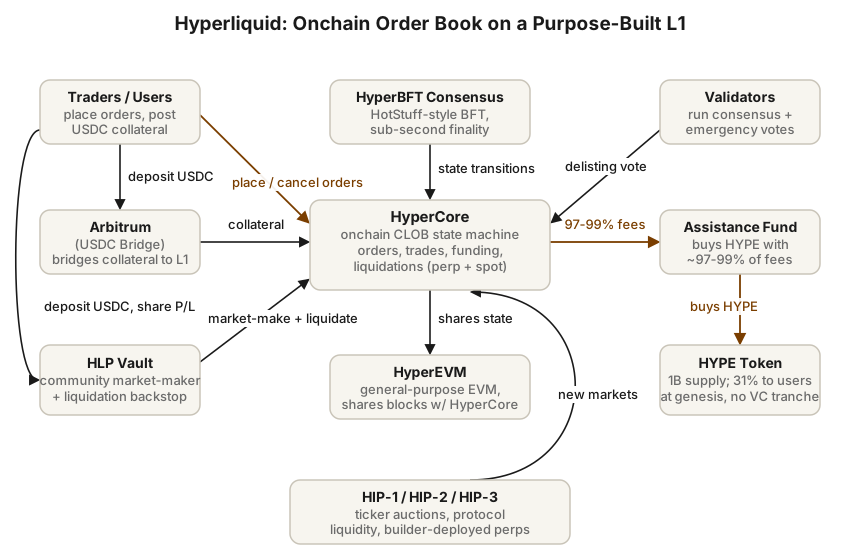 Open full-size diagram
Summary
Hyperliquid is a perpetual-futures (and later spot) exchange that runs as its own purpose-built Layer 1 rather than as a smart-contract app on someone else's chain. Founded by Jeff Yan — a Harvard math/CS graduate and former Hudson River Trading quant who had run the market-making firm Chameleon Trading — together with a pseudonymous co-founder ("iliensinc"), the project launched its closed alpha in February 2023 in direct response to the FTX collapse: the thesis was that traders should get centralized-exchange performance with self-custody and a fully transparent, onchain order book. The team was radically unconventional for its scale: roughly ten people, entirely self-funded from Yan's trading profits, with zero venture capital, no marketing department, and no external token allocations. In November 2024 it converted two years of points-tracked usage into the HYPE genesis event — ~310 million tokens (31% of supply) distributed to ~94,000 users with no VC or CEX allocations — which is now the canonical reference for "community-first" token launches. By 2025–2026 Hyperliquid dominated decentralized perps volume, generated more fee revenue in many weeks than Ethereum or Solana, and had routed over $1.16B–$1.3B of fees into HYPE buybacks via its Assistance Fund.
Design (Mechanism)
App-specific L1 with an onchain CLOB. Hyperliquid's core bet was that an order-book exchange cannot be competitive as a contract on a general-purpose chain. The team built a custom chain around HyperBFT, a HotStuff-inspired proof-of-stake BFT consensus, delivering sub-second finality and capacity on the order of 200k operations/second. HyperCore is the native state machine: every order, cancellation, trade, funding payment, and liquidation for perp and spot books is a consensus-level state transition — no offchain matching engine, no sequencer trust. Collateral is USDC bridged from Arbitrum. In February 2025 the chain added HyperEVM, a general-purpose EVM that shares HyperBFT consensus and blocks with HyperCore, so smart contracts can read HyperCore state (prices, positions) without a bridge.
HLP: a community-owned market maker. The Hyperliquidity Provider (HLP) vault democratizes the market-maker/liquidator role: anyone can deposit USDC and share in the P&L of the protocol's own market-making and liquidation-backstop strategies — the profit stream that on centralized exchanges accrues to insiders.
Distribution and value routing. Usage from 2023–2024 accrued points; at genesis (Nov 29, 2024), 31% of the 1B HYPE supply went to users, ~38.8% was reserved for future community rewards, ~23.8% to core contributors (vesting to 2027–2028), and ~6% to the Hyper Foundation — with no investor tranche at all. Post-genesis, roughly 97–99% of protocol fees flow to the Assistance Fund, which continuously buys HYPE on the open market, plus HLP and burns — an unusually direct fee-to-token linkage with no governance vote required per purchase.
Listing mechanisms. HIP-1 auctions spot ticker deployments (Dutch auctions for listing slots, including the notable ~$?-range USDH stablecoin ticker auction of September 2025 won by Native Markets); HIP-2 ("Hyperliquidity") provides protocol-native passive liquidity for new spot assets; HIP-3 (2025) opened permissionless, builder-deployed perp markets backed by staked HYPE. Delistings and emergency actions are handled by validator vote — a mechanism stress-tested by the JELLY incident (below).
Outcome
Ongoing and, to date, one of the most commercially successful onchain experiments ever run. HYPE reached a ~$1.7B market cap on day one of genesis and later became a top-15 crypto asset. Hyperliquid captured a dominant share (commonly estimated in the 60–70%+ range through 2025) of decentralized perp volume, with annualized protocol revenue around $1.3B by mid-2026 and cumulative buybacks exceeding $1.16B (46% of all crypto token-buyback spending in 2025 by one estimate). The airdrop minted a generation of loyal users and reset industry expectations for token launches. Major stress events: a December 2024 scare over DPRK-linked trading activity; the March 26, 2025 JELLY incident, in which a trader engineered a short squeeze against HLP via the JELLY memecoin perp, forcing ~$12–13M of paper losses, whereupon the small validator set voted within minutes to delist JELLY and force-settle at $0.0095 (favorable to HLP), making non-flagged users whole via the Foundation — averting losses but drawing heavy criticism that the "decentralized" exchange had acted like a discretionary CEX; and an October 2025 market-wide crash that triggered mass liquidations. The chain kept operating through all of them, and the team responded to JELLY by moving delisting to onchain validator voting and expanding the validator set.
Why it worked
- Performance parity with CEXes plus verifiability. The app-chain + native CLOB design removed the latency/gas ceiling that had capped every prior perp DEX (dYdX v3 was offchain-matched; GMX-style AMMs had poor pricing), so it could win order flow on product quality, not just ideology.
- No-VC capital structure as a distribution weapon. Because there was no investor overhang, Hyperliquid could give 31% of supply to users and credibly promise fees-to-token value flow; the community treated the token as "theirs," producing evangelism money can't buy.
- Aligned flywheel. Trading fees → Assistance Fund buybacks → token strength → attention and liquidity → more trading. HLP additionally let the community earn the house's P&L.
- Founder-market fit. A profitable HFT operator self-funding meant no pressure to launch a token early or chase mercenary growth; the points program rewarded real usage over Sybil farming.
Limitations and criticisms
Real weaknesses sit alongside the commercial success: the JELLY episode showed that a handful of validators (initially four, all closely tied to the team) could rewrite market outcomes in minutes — trust-me governance beneath a trustless veneer; node software was closed-source binaries for an extended period; the USDC bridge on Arbitrum is a systemic dependency and a repeatedly probed attack surface; HLP socializes tail risk to depositors; and the buyback-centric token model is untested across a prolonged volume drought.
Lessons
- Vertical integration wins order books. If your mechanism needs sub-second, high-throughput matching, building the chain around the application beats deploying the application on a chain.
- Forgoing VC money is itself a mechanism. A clean cap table enabled the 31% community genesis and direct fee-to-token routing, which became Hyperliquid's strongest moat; distribution design can substitute for marketing spend.
- Decentralization is proven in emergencies, not whitepapers. The JELLY vote saved the vault but cost credibility; whatever discretionary power exists in the "break glass" path is the system's true governance.
- Tie revenue to the token mechanically, not rhetorically. Automatic, non-discretionary buybacks (no quarterly votes) made value accrual legible and hard to renege on.
- Points programs work when they track real economic activity over long periods, raising the cost of Sybil farming relative to genuine use.
Redesign (EDITORIAL — hypothesis, not fact)
This section is editorial speculation. A redesign would harden the emergency-governance path exposed by JELLY: pre-commit, in consensus rules, to a formal circuit-breaker regime (position caps that auto-tighten with open-interest/liquidity ratios on thin assets, auto-deleveraging before HLP backstop) so validators never face a discretionary settle-price decision; publish a binding "market intervention constitution" with mandatory time delays except for narrowly defined solvency triggers. Open-source the node from day one and diversify the validator set geographically and organizationally before, not after, TVL scales. Reduce bridge concentration by supporting natively issued collateral (the USDH direction) and multiple canonical bridges with rate limits. Finally, hedge the buyback flywheel's procyclicality: divert a fraction of fees to a counter-cyclical insurance reserve that buys HYPE only in drawdowns and backstops HLP in tail events, decoupling token support from peak-volume conditions.
Sources
- About Hyperliquid — Official Docs (HyperBFT, HyperCore, HyperEVM) — primary (docs)
- Hyperliquid Docs — Support page (official X accounts @HyperliquidX, @HyperFND) — primary (docs)
- Hyperliquid official X statement on JELLY delisting vote — primary (governance)
- Crypto Exchange Hyperliquid Announces Native Asset HYPE, Users to Receive 310M Tokens — CoinDesk (news)
- Hyperliquid's HYPE airdrop breaks the mold — Blockworks (analysis)
- Explained: The Hyperliquid Hack (March 2025) — Halborn (JELLY incident) (analysis)
- Hyperliquid Delists JELLY After Vault Squeezed in $13M Tussle — CoinDesk (news)
- Most Influential: Jeff Yan — CoinDesk (news)
- Hyperliquid Has Used Nearly All Trading Fee Revenue, Over $1.16B, to Buy Back HYPE — MoneyCheck (analysis)
- Hyperliquid Architecture: HyperBFT, HyperCore, HyperEVM — Zealynx Security (analysis)
Related experiments
Last verified: 2026-07-27 · Spot an error? Suggest a correction