Numerai Signals
Numerai's bring-your-own-data stock-signal tournament where quants stake NMR on the originality of their signals, with burns for underperformance, feeding a real hedge fund's meta model.
▶ Run interactive simulation animated mechanism with editable parameters
How it works onchain
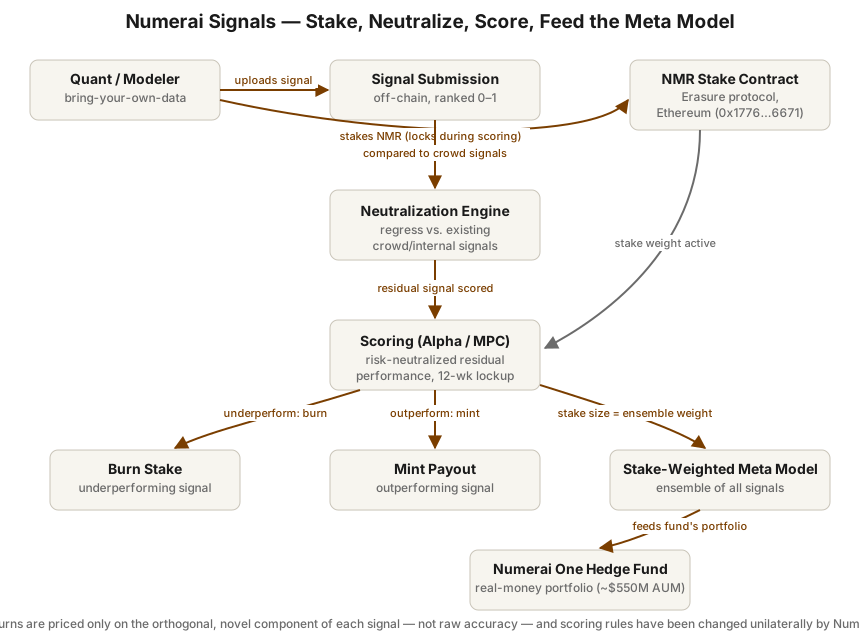 Open full-size diagram
Summary
Numerai Signals, announced by Numerai founder Richard Craib on October 31, 2020, extended Numerai's crowdsourced hedge-fund tournament from "model our encrypted data" to "bring your own data." Anyone can submit ranked stock predictions (a "signal") over Numerai's global equity universe (~5,000 names at launch) and optionally stake NMR, Numerai's Ethereum ERC-20 token, on their signal. Well-performing, original signals earn NMR; underperforming staked signals have a portion of their stake burned. The economic point is not stock-picking per se: each submission is neutralized against the signals Numerai already has, so participants are paid only for the orthogonal, novel component of their signal. Craib framed Signals as a way to vacuum up the world's stranded alpha — quants, alt-data vendors, and hobbyists who could never run a fund — into one meta model, announcing a $50M pool for rewarding signals and pitching it as vastly larger than Kaggle-style prize competitions. Signals remains live in 2026, with its scoring and payout regime repeatedly overhauled (most recently the Alpha/MPC system in September 2025), while the parent fund grew from roughly $60M to $550M AUM and drew a J.P. Morgan Asset Management capacity commitment of up to $500M.
Design (Mechanism)
- Bring-your-own-data tournament. Unlike the classic Numerai Tournament (obfuscated data provided by Numerai), Signals participants build models from any data — fundamentals, technicals, alternative data — and upload predictions in a 0–1 range keyed to tickers in Numerai's universe.
- Originality via neutralization. Submitted signals are regressed against/neutralized to Numerai's existing internal and crowd signals; scoring and payment target only the residual. This directly prices novel information rather than raw predictive accuracy, discouraging the industry-wide redundancy (everyone selling the same momentum factor) Craib criticized at launch.
- Staking with burns (skin in the game). Staking NMR locks tokens during the multi-week scoring period; positive scores mint payouts to the staker, negative scores burn part of the stake. Numerai's docs explicitly frame staking as "a way to validate 'real' signals" — a costly-signaling filter separating confident modelers from noise. The minimum stake was tiny (0.01 NMR, ~$0.30 at launch), keeping entry open. The burn/payout mechanism was originally enforced via the Erasure protocol's Ethereum contracts, with NMR (0x1776e1F26f98b1A5dF9cD347953a26dd3Cb46671) as the non-mintable scarcity token.
- Stake-weighted meta model. Signals are ensembled with stake size as the confidence weight, so the token mechanism doubles as the aggregation weight for the hedge fund's actual portfolio inputs.
- Evolving score targets. Payout criteria shifted repeatedly: correlation-based scores, feature-neutral correlation, Meta Model Contribution (MMC)-only payouts (2023 forum decision), then in September 2025 a new pair — Alpha (risk-neutralized performance) and Meta Portfolio Contribution (MPC) — at 0.3x/0.8x multipliers with 12-week stake lockups; a community Discord vote raised the payout clip from 1.7% to 3.5% effective January 1, 2026.
Outcome
Ongoing and functioning after five-plus years. Signals became one of three live Numerai tournaments (Classic, Signals, Crypto) supplying the meta model behind Numerai One, whose 2024 flagship net return was reported at 25.45%, with AUM growth to ~$550M and a 2025 $30M Series C at a $500M valuation. Staking on Signals continued through 2025–26, and governance of payout parameters partially devolved to community votes. Caveats: the on-chain footprint shrank in significance — the broader Erasure protocol vision (Erasure Bay data marketplace) faded after 2020, and staking economics are set administratively by Numerai, with repeated unilateral scoring/payout regime changes (TC, MMC-only, Alpha/MPC) that periodically frustrated participants and made long-horizon strategy planning hard. NMR burns are real but the token's price has been volatile and well below 2021 highs.
Why it worked
- Real buyer of last resort. Unlike most data DAOs, signals feed an actual hedge fund with growing institutional AUM — the reward pool is backed by fund economics, not token emissions alone.
- Paying for orthogonality is a genuinely novel market design: it prices the marginal information value of data, solving the "everyone sells the same signal" redundancy problem of alt-data markets.
- Burns as honest-signal filter. Staking-with-slashing cheaply screens out overfit or spammy submissions and turns stake size into a usable ensembling weight.
- Low entry cost plus pseudonymity let a global long tail of quants monetize signals without funds, licenses, or data-sales infrastructure.
Limitations and criticisms
- Centralized rule-setting. Scoring targets and payout multipliers have changed frequently and unilaterally (correlation → FNC → TC/MMC → Alpha/MPC), imposing regime risk on stakers that the on-chain mechanism does not protect against; trust ultimately rests on Numerai the company, not the contracts.
- On-chain layer atrophied. The Erasure protocol's ambition of a general decentralized data market did not take off; Signals in practice is a centralized platform that settles stakes in a token, not a trust-minimized marketplace.
- Opaque scoring feedback. Because payment targets are neutralized against undisclosed internal signals, participants cannot fully verify or predict their own scores — an information asymmetry that can suppress participation and staking confidence.
- Token volatility means realized compensation is a joint bet on model skill and NMR price, a real cost for professional data vendors weighing whether to participate.
Lessons
- A crowdsourced data market needs a real, revenue-generating consumer. Numerai's fund gives staked signals actual economic grounding; data markets without a buyer of last resort tend to die (see Erasure Bay).
- Price the orthogonal component, not raw accuracy. Neutralization against existing signals is the key innovation — it aligns rewards with marginal information value and is reusable in any oracle, forecasting, or data-procurement design.
- Slashing screens quality only if rules are stable. Repeated changes to scoring targets convert honest staking into regime-change gambling; mechanism credibility requires commitment devices (or genuine governance) over payout rules.
- Tokens are good for global, pseudonymous skin-in-the-game, but denominating rewards in a volatile token taxes exactly the sophisticated participants you most want.
Redesign (EDITORIAL — hypothesis, not fact)
This section is editorial hypothesis, not a description of Numerai's plans. A redesigned Signals could (1) commit scoring rules on-chain per epoch — publish the neutralization basis as a hash and the scoring function as verifiable code, with changes requiring a timelocked, staker-weighted vote — converting today's administrative regime risk into governed, predictable evolution; (2) offer stake denominated in a stable asset with NMR only as a bonded governance/boost layer, separating model-skill compensation from token beta; (3) provide zk-attested score audits so participants can verify their residual-signal payout without Numerai revealing its internal signals; and (4) generalize the "pay-for-orthogonality" market as a permissionless primitive other funds or oracle networks can plug into, making the meta model a two-sided marketplace rather than a single-buyer monopsony. The open question is whether any fund would accept that loss of discretion; the monopsony may be load-bearing for fund performance.
Sources
- Building The Last Hedge Fund — Introducing Numerai Signals (Richard Craib) — primary (retrospective)
- Numerai Signals Overview — Numerai Docs — primary (docs)
- Numerai Signals site — primary (docs)
- Numerai Docs — Staking — primary (docs)
- Introducing Alpha: A Risk-Aware Scoring System for Signals — primary (docs)
- Numerai December 2025 Update — primary (retrospective)
- NMR token contract (Etherscan) — primary (contract)
- The Erasure Protocol Awakens on Ethereum Mainnet — primary (docs)
- Numerai forum — Changing Scoring & Payouts Again To MMC Only — primary (governance)
- Erasure: Numerai's Open, Blockchain-Enabled Data Market (Gemini Cryptopedia) (analysis)
- Numerai Raises $30M Series C at $500M Valuation (2025) (news)
Related experiments
Last verified: 2026-07-26 · Spot an error? Suggest a correction