Ocean Data Markets
Ocean Protocol's attempt to make datasets tradeable onchain assets by wrapping data access in ERC-20 'datatokens' priced via AMM pools — a design that produced speculation and rug pulls instead of a data economy, and was progressively stripped back to fixed-price sales.
▶ Run interactive simulation animated mechanism with editable parameters
How it works onchain
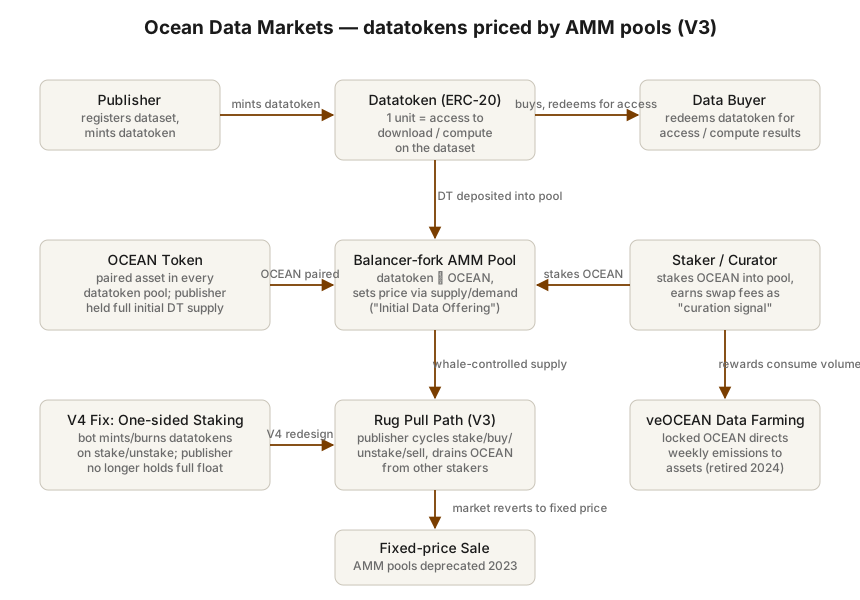 Open full-size diagram
Summary
Ocean Data Markets refers to Ocean Protocol's flagship experiment in making data a first-class onchain asset class: Ocean Market and the V3 "datatokens" architecture, launched on Ethereum on 2020-10-27 by co-founders Bruce Pon and Trent McConaghy (both previously of BigchainDB). Each dataset was wrapped in its own ERC-20 datatoken — holding/spending one token unit granted access to the underlying data — and priced through Balancer-fork AMM pools paired with the OCEAN token, enabling "Initial Data Offerings" (IDOs) where anyone could speculate on, stake toward, and price-discover data assets. It was the most complete attempt to fuse DeFi primitives with data exchange, and its trajectory — AMM speculation, rug pulls, a redesigned V4 with one-sided staking and data NFTs, then full deprecation of dynamic pricing in favor of fixed-price sales — is a canonical case study in what happens when financial mechanism design outruns underlying real demand.
Design (Mechanism)
- Datatokens (V3, Oct 2020): Publishing a dataset minted a bespoke ERC-20. Redeeming 1 datatoken against Ocean's "Provider" infrastructure granted access (download or compute) to the asset. This made data access composable with wallets, DEXes, and DeFi generally.
- AMM price discovery: Instead of the publisher fixing a price, each datatoken could be launched into a Balancer-fork pool against OCEAN. Ocean and Balancer Labs billed it as the first AMM-based data market; supply/demand in the pool set the price.
- Curation-by-staking: Staking OCEAN into a dataset's pool was framed as a curation signal ("this data is valuable") that also earned the staker swap fees — an attempt to make curation economically self-interested.
- Compute-to-Data: Private data could be sold without moving it — buyers sent algorithms to the data, receiving only results, addressing the classic "data can be copied once sold" problem.
- V4 / "OceanONDA" (June 2022): Responding to abuses, V4 introduced data NFTs (ERC-721 for the base IP, ERC-20 datatokens for access licenses against it) and one-sided staking: publishers no longer received the initial datatoken supply; a bot minted/burned datatokens as OCEAN was staked/unstaked, keeping the DT:OCEAN ratio stable so whales could not manipulate price.
- veOCEAN + Data Farming (2022–2024): A Curve-style vote-escrow layer where locked OCEAN directed weekly OCEAN emissions toward data assets, rewarding curators of assets with real consume volume.
Outcome
Technically successful, commercially unsuccessful. The stack shipped and worked as engineered, but the market it was designed to bootstrap never materialized at scale. Datatoken minting peaked almost immediately (analyses report the November 2020 peak, falling to low double-digit monthly mints within months). The V3 pool design enabled rug pulls: publishers held the full initial datatoken supply, so they (or attackers cycling stake/buy/unstake/sell sequences) could drain OCEAN from pools at other stakers' expense. V4 (2022) fixed the rug-pull mechanics, but by mid-2023 Ocean deprecated AMM pools and dynamic pricing entirely — Ocean Market fell back to fixed-price and free assets, and official docs now carry "[deprecated]" pages instructing users to withdraw remaining pool liquidity. veOCEAN and Data Farming were retired on 2024-05-03. In 2024 Ocean folded its token into the Artificial Superintelligence (ASI) Alliance with Fetch.ai and SingularityNET (OCEAN convertible to FET/ASI at 0.433226), pivoting the narrative from data markets to decentralized AI; The Block later reported Ocean's withdrawal from that alliance. OCEAN's old token contract remains live on Ethereum. The core ideas (tokenized data access, compute-to-data) survive in Ocean's tooling, but "data as a tradeable, price-discovered onchain asset" did not.
Why it worked
- Genuinely novel composability: Wrapping access control in a plain ERC-20 meant every existing DeFi primitive (AMMs, wallets, indexers) worked on data with zero modification — an elegant reuse of infrastructure.
- Real problem, credible team: Data silos and the inability to sell data without losing it are real; compute-to-data was a substantive answer, and the BigchainDB pedigree gave the project enterprise reach (e.g., automotive/energy consortia interest).
- Fast, honest iteration: The team publicly diagnosed the rug-pull mechanics and shipped V4's one-sided staking; when even that wasn't enough, they deprecated AMM-based pricing entirely rather than defending it.
Where the design broke
- Speculation displaced utility: AMM pricing needs organic two-sided flow. With few genuine data buyers, pool activity was dominated by token speculation and IDO farming; "curation staking" measured expected token flows, not data quality.
- Rug-pull-by-design in V3: Giving publishers the entire initial datatoken supply plus withdrawable liquidity made the exploit path the rational strategy for anonymous publishers.
- Data is a bad AMM asset: Data value is buyer-specific, private-information-heavy, and non-fungible in practice; continuous public price discovery added volatility and attack surface without helping actual buyers, who simply want a stable posted price.
- Thin real demand: Enterprises with valuable data had compliance reasons not to publish; the crypto-native audience had little need for the datasets on offer. Fee revenue never justified the incentive spend, and emissions programs (Data Farming) were ultimately retired.
Lessons
- Don't bolt price discovery onto assets with no natural trading demand. AMMs amplify whatever flow exists; if the only flow is incentive farming, trading volume decouples from underlying demand and the AMM itself becomes what's being farmed.
- Initial-supply allocation is mechanism design. V3's rug pulls were not a bug in code but in distribution: whoever holds the full float of a thin asset controls its price. V4's mint-on-stake supply control is the general fix pattern.
- Access tokens ≠ investment tokens; conflating them invites both regulatory and incentive problems. Ocean's own retreat to fixed-rate pricing concedes that a license key does not need a floating market.
- Curation staking only works when the reward signal is tied to verified end-use (consume volume), not to circular token flows — and even then it can't conjure buyers who don't exist.
- Utility infrastructure can outlive its financialization layer: datatokens and compute-to-data persisted after pools, IDOs, and veOCEAN were all retired.
Redesign (EDITORIAL — hypothesis, not fact)
This section is editorial analysis and hypothesis, not a factual account. A modern redesign would drop public price discovery entirely and treat data as licensed compute: fixed or negotiated pricing per compute-to-data job, settled in a stable unit, with datatokens reduced to non-transferable (or transfer-restricted) license receipts to kill the speculation surface. Curation would be replaced by verifiable consumption attestations — TEE- or ZK-attested proof that a dataset was actually used in paid jobs — with any incentive emissions streamed retroactively against that proof, not against staking predictions. Publisher reputation would live on the data NFT as slashable stake posted by the publisher (bonding data quality/availability), not by third-party speculators. Finally, bootstrap demand-side first: subsidize a handful of high-value verticals (e.g., model-training corpora with clean licensing) where buyers already pay for data offchain, rather than emissions-farming a long tail of free CSVs. The hypothesis is that Ocean's failure was sequencing — financializing supply before demand existed — not the core idea of tokenized data access.
Sources
- Ocean Protocol launches Datatokens & Ocean Market (V3 press release) — primary (docs)
- Ocean Market: An Open-Source Community Marketplace for Data (Trent McConaghy) — primary (retrospective)
- Ocean Protocol and Balancer Labs Partner for the First AMM-Based Data Market — primary (docs)
- Ocean V4 One-Sided Staking (Trent McConaghy) — primary (retrospective)
- OceanONDA V4 is now live with Data NFTs, solving rug pulls (press release) — primary (docs)
- Liquidity Pools [deprecated] — Ocean Protocol Docs — primary (docs)
- Introducing veOCEAN (Trent McConaghy) — primary (docs)
- Passive & Volume Data Farming Airdrop Has Completed; They Are Now Retired — primary (docs)
- Fetch.ai, Ocean Protocol and SingularityNET Finalize Token Merger Details (ASI Alliance) — primary (governance)
- Ocean v3 Brings Wave of Data Monetization Tools to Ethereum — CoinDesk (news)
- Ocean Protocol withdraws from AI token alliance — The Block (news)
- OCEAN token contract — Etherscan — primary (contract)
Related experiments
Last verified: 2026-07-26 · Spot an error? Suggest a correction