Tellor
A permissionless oracle that began as a proof-of-work data-mining competition on Ethereum (2019), evolved into a staked-reporter/dispute system (Tellor 360), and ultimately into its own Cosmos-SDK oracle chain (Tellor Layer, 2025).
▶ Run interactive simulation animated mechanism with editable parameters
How it works onchain
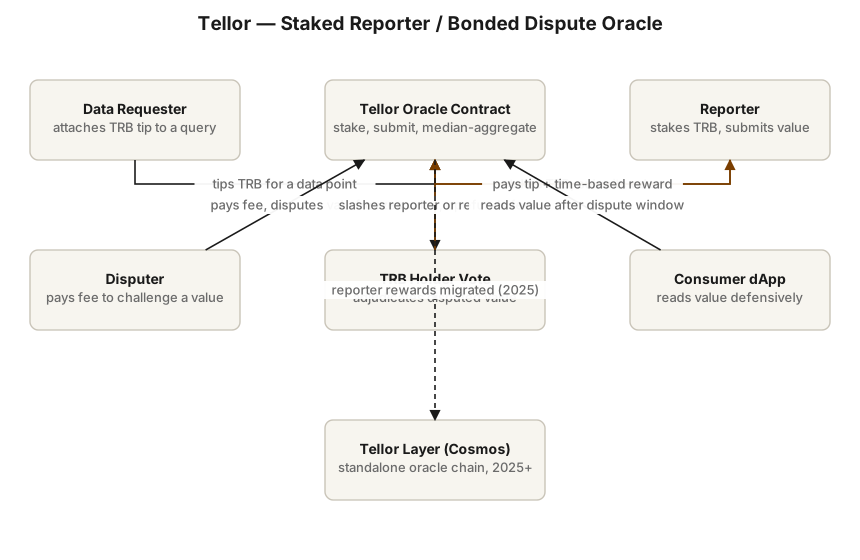 Open full-size diagram
Summary
Tellor is one of the longest-running experiments in permissionless oracle design. Born from an AngelHack DC 2018 hackathon project (a "Proof of Work Oracle" originally intended to feed the team's Daxia derivatives protocol), it launched on Ethereum mainnet on August 1, 2019 as a "mineable oracle": anyone could stake TRB and compete in a PoW race to submit off-chain data (e.g., ETH/USD), with disputes and token-holder votes as the security backstop. The team — Brenda Loya, Nick Fett, and Michael Zemrose — went through Binance Labs' 2019 Berlin cohort and launched with no ICO and no premine; all supply was minted through protocol participation. Tellor's design has since been rewritten twice: Tellor 360 (late 2022) dropped PoW for pure staked reporting on Ethereum, and Tellor Layer (mainnet Q3 2025) moved the oracle onto its own Cosmos-SDK chain. It has survived seven years as a scrappy, censorship-resistant alternative to Chainlink, while repeatedly illustrating the sharp edges of crypto-economic (rather than reputation-based) data security.
Design (Mechanism)
v1 (2019, "mineable oracle"). Users requested a data point and attached a TRB tip; the best-funded query was served next. Miners staked TRB (initially 500, later 1,000) for the right to compete in a PoW puzzle; the first five to solve it submitted the requested value, the median of the five became the official on-chain value, and submitters split tips plus a block reward of newly minted TRB (~every 10 minutes). A 10% "dev share" on minting funded the team in lieu of a premine.
Dispute game. Any TRB holder could pay a dispute fee (scaling with staker count, roughly 500 TRB at times) to challenge a submitted value. The value was frozen/removed while TRB holders voted; a losing reporter's entire stake was slashed to the disputer, while a failed dispute forfeited the fee to the accused. Security is therefore explicitly economic: data is "safe" only if honest capital watching the feed exceeds the profit from a lie surviving the dispute window.
Tellor 360 (2022). The Tellor X redesign removed PoW entirely: reporters simply stake TRB and submit values, with time-based rewards (an initial schedule of 24,000 TRB over two years, ~1,000/month) replacing mining inflation. Feeds became more flexible (arbitrary "query types," not just prices), and the contracts were intended to become effectively immutable after the final upgrade.
Tellor Layer (2025). A standalone Cosmos-SDK L1 where validators/reporters reach consensus on subjective data natively, with data bridged to consumer chains. In 2025–2026 reporter rewards fully migrated from legacy Ethereum Tellor 360 to Layer.
Consumers are expected to read Tellor defensively: use time-delayed values (so disputes can catch lies first), check dispute status, and sanity-check against other sources.
Outcome
Ongoing. Tellor shipped in 2019 with essentially zero supply and built a real, decentralized miner/reporter community; TRB was listed broadly and the protocol became a common fallback oracle (most prominently for Liquity's ETH-USD feed). It never seriously challenged Chainlink's market share, but it never died either — and it kept shipping major redesigns (Tellor X → 360 → Layer) for seven years. The security model was stress-tested repeatedly: in September 2022 Liquity disclosed that its unsafe integration of Tellor as fallback would have let an attacker feed Liquity a fake ETH-USD price at low cost (fixed cooperatively before Tellor 360 froze upgradeability); in February 2023 an attacker staked TRB and reported a ~10x-inflated WALBT price to drain BonqDAO, which read Tellor instantly without dispute-delay protections. In both cases the core Tellor mechanism behaved as designed — the failures were at the integration layer, where the consuming protocols read values before the dispute window had elapsed — but they materially damaged the "budget oracle" value proposition. Tellor Layer's Q3 2025 mainnet reframes the project as an app-chain for arbitrary data consensus; it is too early to judge that pivot, but as an experiment in fair-launch, permissionless oracles, Tellor is a durable partial success within an ongoing story.
Why it worked
- Fair launch bought legitimacy. No ICO, no premine, supply minted by participation — Tellor earned genuine credibility and a decentralized holder base at a time when most oracle tokens were heavily insider-allocated.
- Explicit crypto-economic security. The stake-slash-dispute loop gives an honest, quantifiable answer to "why should I trust this number?" — the cost to lie is on-chain and measurable, unlike committee/reputation oracles.
- Permissionlessness as a moat. Anyone can report any data type without whitelisting, which made Tellor useful for long-tail feeds and as a censorship-resistant fallback that DeFi bluechips like Liquity actually integrated.
- Willingness to rewrite itself. The team killed its own signature mechanism (PoW mining) when it proved wasteful and slow, and later left Ethereum-native design entirely for an app-chain — rare institutional flexibility.
Limitations and criticisms
- Latency and cost. PoW races and dispute windows made Tellor slow and expensive per data point versus push-based competitor feeds; safe usage requires delayed reads, which many DeFi apps can't tolerate.
- Security is only as strong as the integration that reads it. Liquity (2022) and BonqDAO (2023) both consumed Tellor values without respecting the dispute delay; BonqDAO was drained via a trivially cheap TRB stake. Tellor's honest-watchdog assumption exports hard responsibilities to integrators, and the design has no way to enforce that a delayed read is actually used.
- Attack cost tied to a thin token. The cost to corrupt a feed is a function of TRB's price and stake size, not of the value secured by consumers — a structural mismatch when a small-cap token guards large TVL.
- Chainlink's network effects. Business development, not mechanism purity, decided oracle market share; Tellor stayed niche relative to the category leader.
Lessons
- An oracle's security model must be enforced in the consumer path, not the docs. If safe use requires waiting out a dispute window, the oracle should make instant reads hard or impossible, because integrators will default to whatever read path is easiest to wire up.
- Fair launches create resilient communities but underfunded wars. No-premine distribution gave Tellor longevity and legitimacy, yet left it out-resourced against VC-funded rivals; the 10% dev share was a clever partial fix.
- Economic security must scale with value secured. A fixed stake in a small-cap token is an invitation whenever secured TVL exceeds slash cost; corruption cost needs to be priced against downstream exposure.
- Mechanisms can outlive their first implementation. Tellor's core idea (bonded reports + bonded disputes + token vote) survived three architectures; the mechanism, not the deployment, is the experiment.
Redesign (EDITORIAL — hypothesis, not fact)
This section is editorial speculation, not a description of Tellor's actual plans. A redesigned Tellor would make integration safety non-optional: the canonical read function would only ever return values older than the dispute window, with a separate, loudly-named unsafeInstantRead() for consumers who accept manipulation risk. Second, it would scale corruption cost to usage — consumers register and pay fees proportional to the value they secure, with those fees funding a slashable insurance pool and raising required reporter stake on heavily-relied-upon feeds, closing the "small-cap token guards big TVL" gap. Third, it would formalize the watchdog role: protocol-paid dispute bounties and open-source monitoring bots so that the "someone will dispute a lie" assumption is a funded job rather than altruism. Finally, rather than competing head-on as a price-feed vendor, it would lean into what permissionlessness uniquely enables — arbitrary, long-tail, and adversarial data (outcomes, attestations, subjective claims) — essentially the direction Tellor Layer gestures toward, but with dispute-native consumer tooling shipped as the default SDK.
Sources
- Tellor launches to Mainnet! (Tellor Core, Medium) — primary (docs)
- Tellor Whitepaper (Tellor 360, April 2023) — primary (docs)
- About the Tellor Team — primary (docs)
- Tellor360 – The Next Level — primary (docs)
- Tellor Tokenomics 201 — primary (docs)
- TRB token contract (Etherscan) — primary (contract)
- Liquity: Tellor Issue and Fix — primary (audit)
- Liquity advisory: Potential issues with use of Tellor as fallback oracle — primary (audit)
- Tellor Rewards Have Fully Transitioned to Tellor Layer — primary (docs)
- Tellor 2025 Year-In-Review — primary (retrospective)
- Decentralized oracle Tellor launches to Ethereum mainnet (CryptoNinjas, Aug 2019) (news)
- Cyfrin: The Full Guide to Price Oracle Manipulation Attacks (BonqDAO/Tellor incident) (analysis)
- What is Tellor (TRB)? (OKX Learn) (analysis)
Related experiments
Last verified: 2026-07-26 · Spot an error? Suggest a correction