Ostium
Arbitrum perp DEX that brought leveraged trading of real-world assets (FX, commodities, indices, stocks) onchain via a two-tier USDC liquidity layer and a custom RWA oracle — then lost ~$23.75M when an oracle signer key was compromised in July 2026.
▶ Run interactive simulation animated mechanism with editable parameters
How it works onchain
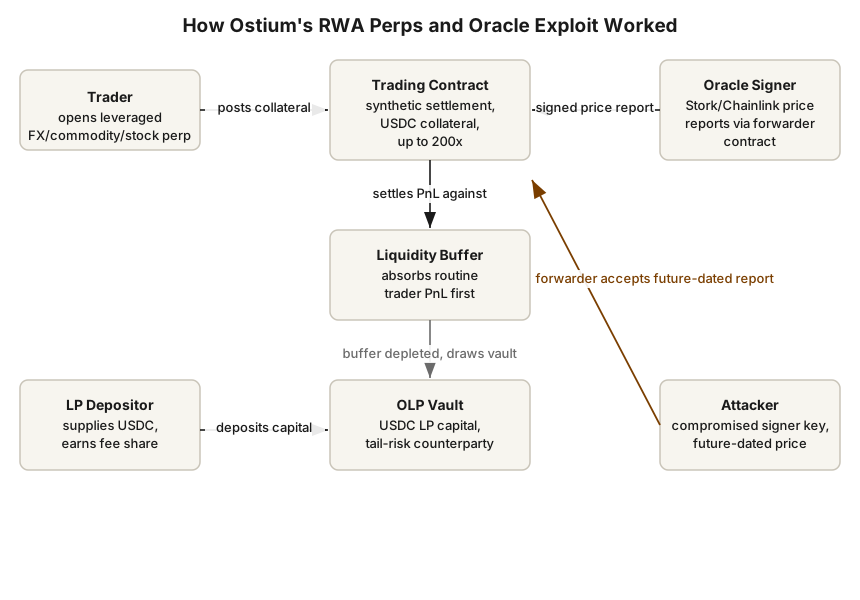 Open full-size diagram
Summary
Ostium is a perpetuals DEX on Arbitrum whose core bet is that the interesting frontier for onchain leverage is not another BTC/ETH venue but real-world assets: forex, commodities (oil, gold), equity indices, single stocks, and ETFs, traded as synthetic perps settled in USDC. Founded in 2022 by Harvard classmates Kaledora Kiernan-Linn and Marco Antonio Ribeiro (both ex-Bridgewater), Ostium Labs raised a $3.5M seed co-led by General Catalyst and LocalGlobe (with SIG and Balaji Srinivasan) in 2023, launched public mainnet in October 2024, and later closed a ~$24M Series A round led by General Catalyst and Jump Crypto. By mid-2026 it advertised 50-75 tradable pairs across six asset classes, tens of billions in cumulative volume, and open interest overwhelmingly concentrated in non-crypto RWA pairs — a genuinely differentiated position among perp DEXs. On July 15, 2026, an attacker who obtained an oracle signer private key pushed a future-dated price report through a legitimate forwarder, fabricated profitable trades, and drained 23,752,746 USDC from the public OLP vault. Trading resumed July 23, 2026 with Ostium Labs and partners contributing balance-sheet capital toward LP recovery.
Design (Mechanism)
Ostium is an oracle-priced synthetic perp exchange in the Gains/gTrade lineage, but reworked for RWAs:
- Synthetic perps on any liquid market. No underlying asset is held; traders take leveraged price exposure (up to 200x on select pairs, positions from $5) against a pooled counterparty. Because settlement is synthetic, listing a market only requires a reliable price feed, letting Ostium offer FX, metals, oil, indices, stocks, and ETFs onchain.
- Two-tier liquidity layer. Trader PnL settles against a layered structure: a Liquidity Buffer absorbs routine wins and losses first, and only when the buffer is depleted does the Market Making Vault (the public OLP, funded by USDC depositors) act as counterparty. In exchange for bearing tail risk, OLP LPs receive a share of protocol fees — 50% of opening fees and 100% of liquidation rewards. The design aims to make LP returns more fee-like and less dependent on traders losing, a known weakness of single-vault (GLP-style) models.
- Custom RWA oracle. Traditional markets lack Chainlink-grade coverage, so Ostium uses in-house feeds operated with Stork for RWA pricing (with Chainlink Data Streams for crypto pairs). Prices are pushed onchain via authorized signed reports through registered "PriceUpKeep" forwarder contracts at trade execution, keeping spreads near underlying-market top-of-book.
- Financing-realistic fees. Instead of crypto-style funding, RWA positions pay rollover fees reflecting real-world financing rates, plus market-hours logic for assets that trade on traditional schedules.
- Institutional hedging layer (2025+). Later architecture added hedging of net directional exposure through institutional partners such as Jump, moving the venue toward a hybrid brokerless-broker model.
Core contracts (Trading, Trading Storage, vaults) are deployed on Arbitrum behind transparent proxies, with USDC as sole collateral.
Outcome
Mixed and still unfolding. Commercially, Ostium was one of the clearest product-market-fit stories of the 2024-2026 perp DEX cycle: it became the leading "brokerless RWA" venue, reportedly crossing $46B cumulative volume with $95M open interest (91% in non-crypto pairs) by May 2026, rode a large points-program wave in 2025, and attracted a Jump Crypto-led Series A. Technically, the July 15, 2026 exploit was severe: an attacker with a compromised oracle signer key authorized a future-dated price report, pushed it through an already-registered forwarder, opened and closed "profitable" positions, and drained ~$23.75M USDC from the OLP vault before laundering proceeds through Tornado Cash. Notably, per Blockaid and Halborn analyses, core contract logic was not broken — the trust root (an off-chain signing key) was. Ostium halted trading for about a week, preserved open positions, resumed July 23, 2026, and committed balance-sheet funds plus partner capital to make LPs whole; full reimbursement mechanics were still being published as of late July 2026.
Why it worked
- Differentiated market selection. While dozens of venues fought over crypto perps, Ostium monetized a mostly empty niche — leveraged onchain FX, commodities, and equities — where synthetic settlement is the only practical way to offer the product.
- Synthetic architecture matched the asset class. Oracle-settled perps need no custody of oil or Nvidia shares, sidestepping the securities-custody problems that killed many tokenized-equity attempts.
- LP economics were more honest. The buffer-plus-vault split and fee-share design reduced the "LPs are the house against toxic flow" problem enough to attract nine-figure liquidity.
- Credible team and backers. Ex-Bridgewater founders and General Catalyst/Jump backing gave TradFi-adjacent legitimacy that pure-crypto perp DEXs lacked.
Where the design broke
- Single point of failure in the oracle trust root. The entire solvency of an oracle-priced synthetic exchange reduces to the integrity of price signers. One compromised key let an attacker mint arbitrary PnL; ~$23.75M left the LP vault in about five minutes.
- Future-dated reports were acceptable. The signing/validation scheme allowed a report timestamped ahead of real time to be treated as authoritative, turning key compromise into unlimited profit fabrication rather than a bounded nuisance.
- Speed of drain vs. speed of controls. No rate limit, payout cap, or anomaly circuit-breaker sized to the vault stopped a five-minute drain of most of the public pool — monitoring (Blockaid) detected it, but detection is not prevention.
- Custom in-house feeds trade decentralization for coverage. The very thing that enabled RWA listings (bespoke, permissioned price infrastructure) concentrated risk far more than a widely-validated oracle network would.
Lessons
- In oracle-settled perps, the oracle key is the vault key. Security budgets, HSM/MPC custody, and signer-set decentralization for price signers should be treated with the same seriousness as protocol admin keys, because compromise is economically equivalent to draining the pool.
- Bound the blast radius of any single price report. Timestamp sanity checks (reject future-dated reports), deviation bounds against secondary feeds, per-block payout caps, and withdrawal delays convert catastrophic key compromise into a recoverable incident.
- Two-tier vault structures work — for market risk, not operational risk. The buffer/vault split successfully smoothed trader-PnL variance for LPs, but no liquidity-layer design protects against fabricated prices; risk tiers must be paired with input-integrity controls.
- RWA perps are a real market. Ostium's volume mix (~90% non-crypto) is strong evidence that onchain demand for leveraged TradFi exposure exists and that synthetic settlement is a viable path to it.
- Fast, funded incident response preserves franchises. Halting within minutes, keeping positions intact, resuming in eight days, and committing founder/partner capital to LP recovery is the difference between an exploit and a death.
Redesign (EDITORIAL — hypothesis, not fact)
This section is editorial hypothesis, not a statement of fact. A redesigned Ostium would keep the two-tier liquidity layer and RWA focus but rebuild the oracle as a threshold-signed committee (e.g., 5-of-9 independent signers across Stork, exchanges, and third-party node operators) so no single key compromise can author a price. Reports would carry strict monotonic-timestamp validation with rejection of any future-dated report beyond a small clock-skew tolerance, plus onchain deviation checks against a slower reference feed (Chainlink or a TWAP of recent committee prices) that force trades into a delayed-settlement queue when feeds disagree. Vault outflows would be governed by a payout governor: per-epoch net-payout caps proportional to buffer size, with excess PnL streamed over hours — giving monitoring (already in place via Blockaid) time to trigger a guardian pause. Finally, a protocol-owned insurance tranche funded by a slice of opening fees would sit senior to the public OLP, so retail LPs are not first-loss capital against operational failures they cannot price.
Sources
- Ostium Docs (current) — primary (docs)
- Ostium Docs (legacy GitBook) — primary (docs)
- Ostium Labs raises $3.5M co-led by General Catalyst and LocalGlobe (Medium) — primary (retrospective)
- Ostium: Trading contract on Arbiscan — primary (contract)
- Ostium Launches Novel Macro Trading Platform (PR Newswire, Oct 2024) (news)
- Ostium Labs raises $3.5 million to bring DEX perpetual swaps to oil and gold (The Block) (news)
- Harvard alumni-founded Ostium lands $24 million to scale onchain perpetuals for RWAs (The Block) (news)
- Ostium Raises $20 Million Series A from General Catalyst & Jump Crypto (Business Wire) (news)
- Explained: The Ostium Hack (July 2026) — Halborn (audit)
- Ostium loses $18 million in oracle attack that gamed its own price-feed infrastructure (CoinDesk) (news)
- Ostium Halts Trading After Oracle Exploit Drains up to $18M from Vault (The Defiant) (news)
- Ostium suspends trading after OLP vault exploit drains up to $23.7M in USDC (Crypto Briefing) (news)
- Ostium to Resume Trading on July 23 After Exploit (The Crypto Times) (news)
- The next Hyperliquid? A look at the RWA-based DEX Ostium (Blockworks) (analysis)
- Ostium: Powering RWA Perps With a Custom Oracle (Stork case study) (analysis)
Related experiments
Last verified: 2026-07-27 · Spot an error? Suggest a correction