Deri Protocol
Cross-chain decentralized derivatives protocol that was the first to implement 'everlasting options' on-chain, pricing perps and options against pooled LP capital via an oracle-fed proactive market maker (DPMM).
▶ Run interactive simulation animated mechanism with editable parameters
How it works onchain
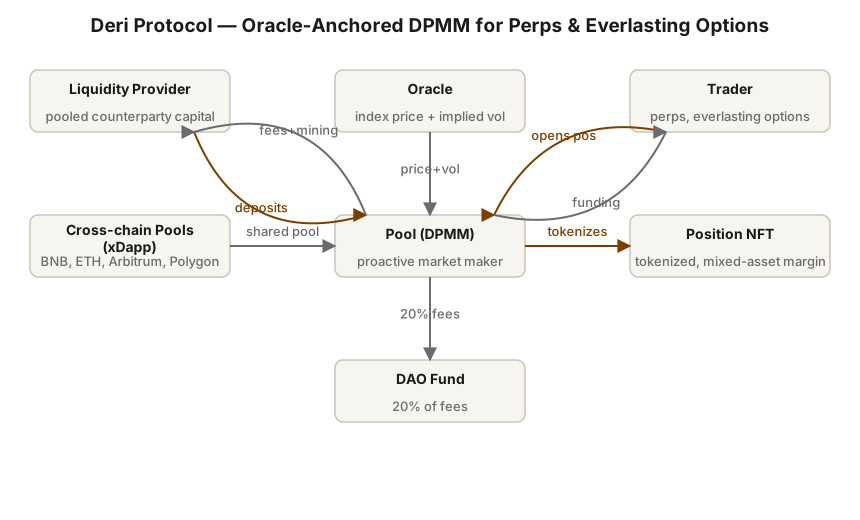 Open full-size diagram
Summary
Deri Protocol is a decentralized derivatives exchange built by Dfactory Ltd. and launched in February 2021, initially running liquidity mining simultaneously on Ethereum, BSC, and HECO, with trading going live on March 4, 2021. Its founding team — pseudonymous CEO "0xAlpha" (physics PhD, Rice University; prior derivatives work at Deutsche Bank, HBK, and Goldman Sachs) and CTO Richard Chen (physics PhD; quantitative trading background) — brought unusually deep TradFi derivatives-pricing expertise to DeFi. Deri's historical claim to fame is being the first protocol to implement "everlasting options" (the expiry-free options design proposed by Dave White and Sam Bankman-Fried in May 2021), launching them in beta on September 1, 2021 with over $50M volume in the first week. Deri pioneered an oracle-anchored proactive market-making model (DPMM) in which pooled LP capital is the counterparty for perpetual futures, everlasting options, power perpetuals, and gamma swaps, with positions tokenized as NFTs. Despite genuine mechanism innovation and repeated re-architecture (V2 through V4's cross-chain "xDapp" design and a V5 "Deri Pro"), it never escaped niche status: TVL peaked around $37M in October 2021 and sits near $0.3M as of mid-2026, with the DERI token down well over 99% from its highs.
Design (Mechanism)
- Pooled-counterparty derivatives. Traders do not match against an order book; they trade against a shared liquidity pool. LPs collectively take the other side of net trader positions and earn transaction fees plus DERI mining rewards.
- DPMM (Deri Proactive Market Making). Trades execute around an oracle-fed index price. At zero net position the mark price equals the oracle price; net long pressure pushes the mark above index and net shorts push it below. The mark/index gap generates a funding fee paid by the majority side, incentivizing arbitrageurs to rebalance the pool back toward neutral — replicating a CEX-style funding mechanism without an order book.
- Everlasting options. For options, DPMM takes both underlying price and volatility from oracles, prices the option off Black-Scholes, and replaces expiry with a perpetual funding flow (holders continuously pay roughly mark-minus-payoff). This concentrates liquidity into one instrument per strike-type instead of fragmenting it across expiries — the core liquidity problem of on-chain options.
- Unified product family. The same funding-fee logic covers perpetual futures, everlasting options, power perpetuals, and gamma swaps, so one LP pool and one mental model serve all products.
- Composability and cross-chain reach. Positions are tokenized as NFTs; margin can be mixed-asset and externally custodied in money-market protocols; V4's "xDapp" architecture pools liquidity across chains (BNB Chain, Arbitrum, Polygon, zkSync Era) behind a single trading surface.
- Token economics. 1B DERI: 60% to liquidity-mining emissions, 36% team/investors, 4% vault. The DAO fund uses 20% of transaction fees for buyback-and-burn. V1 was formally suspended after V2 (June 2021, BSC) took over; V2 was audited by PeckShield and CertiK.
Outcome
Technically successful, commercially unsuccessful. Deri shipped a genuinely novel mechanism stack — the world's first everlasting options, a workable oracle-anchored PMM for both futures and options, and an early unified funding-fee framework — and, notably, was never exploited (no hack found in the record). The everlasting-options launch drew >$50M volume in week one and >$115M in the first month. But it lost the derivatives-DEX race decisively: even in late 2021 its perp volumes trailed GMX, MCDEX, and Cap Finance, and the subsequent cycle was won by GMX, dYdX, and later Hyperliquid. TVL peaked at roughly $37M (Oct 22, 2021, per DefiLlama) and has decayed to ~$309K by July 2026; DERI trades around $0.0026 with a market cap in the low single-digit millions. The team has kept building (V4 open-sourced on GitHub, a V5 "Deri Pro" CLI), so the project is alive but economically marginal — Mint Ventures' 2021 label "a lost pearl of the decentralized derivatives track" proved prophetic in both halves.
Why it worked
- Real derivatives expertise. The founders' quant/derivatives-pricing background produced mechanisms (DPMM, everlasting-option funding) that were mathematically coherent rather than incentive-first hacks; the funding-fee arbitrage loop genuinely kept pools near neutral.
- Right diagnosis of options liquidity. Collapsing all expiries into one perpetual instrument per strike directly attacked the fragmentation that killed most on-chain options books, and first-mover implementation of the White/SBF paper earned real attention and volume at launch.
- Security discipline. Multiple audits and five years of operation across many chains without a known exploit is rare for a derivatives protocol of this era.
Where the design broke
- Wrong home chain, weak distribution. Anchoring on BSC/HECO in 2021 put Deri outside the Arbitrum/Optimism flow where perp-DEX volume concentrated; HECO itself collapsed with Huobi's decline.
- Traders don't pay for elegance. GMX won with a cruder mechanism but stronger incentives (real-yield GLP, trade mining) and better UX; Deri long lacked trade-mining and marketed math to an audience that shops on incentives, depth, and listings.
- Everlasting options never found demand. The instrument is intellectually superior but unfamiliar; continuous funding costs are hard to reason about, and options demand on-chain stayed small overall (even Opyn's Squeeth, the sibling "perpetual derivative," was wound down).
- Emission-heavy token with weak sinks. 60% of supply for liquidity mining against only a 20%-of-fees buyback meant persistent sell pressure once volumes stagnated, and reflexively falling token price gutted the LP subsidy that liquidity depended on.
- Serial re-architecture over compounding liquidity. V1→V2→V3→V4→V5 migrations repeatedly reset liquidity, integrations, and user muscle memory without ever fixing the demand problem.
Lessons
- Mechanism-design superiority is not a moat in trading products; distribution, incentives, and liquidity depth dominate. The best-priced venue with no takers still loses to a cruder venue with flow.
- Novel instruments (everlasting options, power perps) need an education-and-market-making budget at least as large as the engineering budget; without natural buyers, an elegant payoff structure is inventory nobody hedges.
- Chain choice is strategy: deploying where incentives are cheapest (BSC/HECO 2021) rather than where the target trader cohort lives (Arbitrum for perps) can permanently cost the category window.
- Emissions-funded liquidity is a loan against future volume; if organic fees never cover LP risk, the token unwinds and takes the liquidity with it.
- Frequent full-version migrations compound the cold-start problem — each migration is a partial relaunch that resets composability and trust.
Redesign (EDITORIAL — hypothesis, not fact)
This section is editorial hypothesis, not fact. A redesigned Deri would (1) launch everlasting options as a liquidity layer for a venue that already has perp flow (e.g., as a settlement/pricing module for an existing perp DEX or an options vault protocol like Ribbon/Thetanuts, which had structured-product demand but crude pricing), rather than as a standalone exchange competing for traders; (2) replace the volatility oracle — a trust bottleneck and manipulation surface — with an on-chain implied-vol feedback loop where the DPMM's own net option inventory updates the vol input, making vol discovery endogenous; (3) concentrate on one chain and one flagship instrument until it holds category leadership, using a fee-sharing "real yield" LP token from day one instead of heavy DERI emissions; and (4) sell the hedging use case to DAO treasuries and LSD/LRT protocols (covered calls, gamma hedging) as B2B flow, which is stickier than incentive-chasing retail. The bet is that everlasting options fail as a destination product but could succeed as infrastructure priced into other people's flow.
Sources
- Deri Protocol Docs (Getting Started) — primary (docs)
- Deri Docs — Social Links & Media — primary (docs)
- DPMM (Proactive Market Making) — Deri Docs — primary (docs)
- Introducing Deri Protocol's Everlasting Options (official Medium) — primary (docs)
- Everlasting Options Beta Official Launch (official Medium) — primary (docs)
- Announcement on the suspension of Deri Protocol V1 (official Medium) — primary (governance)
- deri-protocol GitHub org (deriprotocol-v4, whitepaper, deri-cli) — primary (contract)
- DERI Token — Etherscan — primary (contract)
- Mint Ventures: Deri Protocol, a lost pearl of the decentralized derivatives track (analysis)
- Messari: Deri Protocol — The Future of Derivatives and On-Chain Market-Making (analysis)
- ChainCatcher: Comprehensive Analysis of Deri Protocol (analysis)
- DefiLlama: Deri Protocol TVL (analysis)
Related experiments
Last verified: 2026-07-26 · Spot an error? Suggest a correction