Aster
CZ/YZi Labs-backed multi-chain perpetuals DEX (Astherus + APX merger) that briefly seized ~70% of perp-DEX volume via a 53.5%-airdrop points war, then pivoted to a privacy-focused L1 amid wash-trading allegations and fading share.
▶ Run interactive simulation animated mechanism with editable parameters
How it works onchain
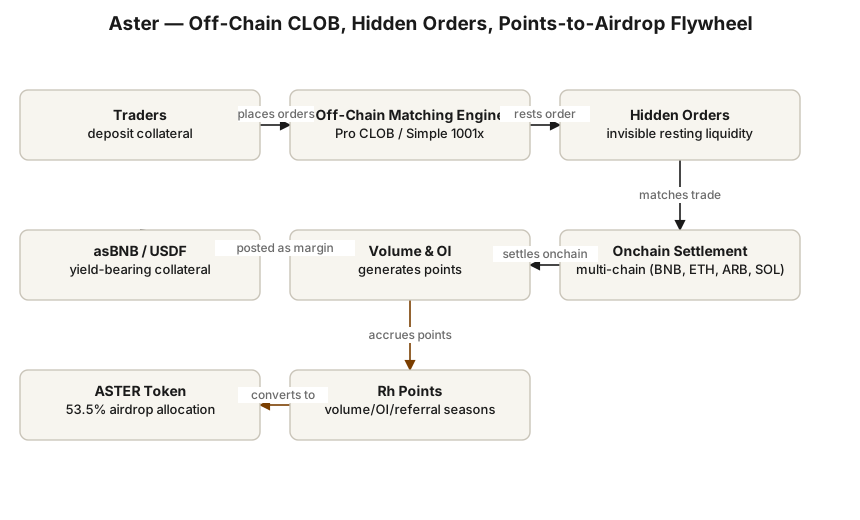 Open full-size diagram
Summary
Aster is a multi-chain perpetual-futures DEX formed by the late-2024 merger of Astherus (a yield protocol issuing the liquid-staked asBNB and the yield-bearing stablecoin USDF) with APX Finance (a perp platform descended from ApolloX), rebranded as Aster in 2025. Backed by YZi Labs and publicly championed by Binance founder Changpeng "CZ" Zhao, its ASTER token launched on September 17, 2025 (8B max supply, BEP-20, contract 0x000Ae314...4f556A) with an unusually community-heavy allocation: 53.5% to airdrops and roughly 30% more to ecosystem incentives. Within a week of TGE, incentive-fueled trading briefly captured a reported ~70% of global perp-DEX volume — hundreds of billions of dollars — pushing Hyperliquid's share to ~10% before the ratio inverted again as points-farming cooled and wash-trading allegations (which led DefiLlama to delist Aster's perp data) dented credibility. The project is led by a pseudonymous CEO known as "Leonard," who describes himself as a former Hong Kong investment-bank HFT technologist and ex-Binance product manager. In March 2026 Aster launched the genesis phase of Aster Chain, a privacy-first L1 with encrypted orders and hidden positions, repositioning from "airdrop-era volume leader" to "private derivatives venue." It remains a live, well-funded, top-tier perp DEX, but with market share well below its September 2025 peak.
Design (Mechanism)
Aster's core is a CEX-style central-limit-order-book perp exchange with off-chain matching and on-chain settlement across BNB Chain, Ethereum, Arbitrum, and Solana — deliberately multi-chain, in contrast to Hyperliquid's single app-chain. It layers several distinct mechanisms:
- Dual trading modes. "Pro" mode is a full order book with advanced order types and grid trading; "Simple"/1001x mode is a one-click, MEV-resistant interface routing against pooled onchain liquidity (an ALP-style counterparty pool inherited from APX/ApolloX), advertising leverage up to 1001x.
- Hidden orders and hidden positions. After CZ publicly called for "dark pool" perpetuals (arguing whale positions being visible onchain invites hunting), Aster shipped hidden limit orders that rest invisibly in the matching engine — no size or presence shown in the public book — while still sharing liquidity with visible orders, an exchange-operator-mediated (i.e., trust-requiring) form of dark liquidity rather than a cryptographic one.
- Yield-bearing collateral. Traders can post productive assets — asBNB (liquid-staked BNB) and USDF (yield-bearing stablecoin) — as margin, so idle collateral earns while positions are open, a carryover of Astherus's "yield + trading in one venue" thesis.
- Token/points flywheel. The 53.5% airdrop allocation funded multi-stage points seasons ("Rh points" and successors) that paid for volume, open interest, and referrals, deliberately weaponizing token emissions to buy market share from incumbents.
- Aster Chain (2026). A proprietary L1 claiming 100k+ TPS and ~50ms latency, with default account privacy, stealth addresses, encrypted order submission, and zero-gas DeFi — moving the privacy guarantees from application policy toward protocol design.
Outcome
Ongoing. The TGE was one of 2025's largest events: reported figures include $544B volume in the first week, 2M+ users, a market cap that touched ~$2.85B, and ASTER spiking toward ~$3. CZ's public support (including a disclosed 2M-token purchase in November 2025) repeatedly moved the price. But volume proved heavily incentive-elastic: DefiLlama's maintainer alleged wash-trading patterns and delisted Aster's perp volume data; Aster delayed its Stage 2 airdrop citing "data inconsistencies"; and by early 2026 Hyperliquid had reclaimed ~70% share ($178B monthly vs. Aster's ~$77B). ASTER fell roughly 86% from its peak to the ~$0.40–0.80 range. Aster Chain's genesis mainnet went live March 17, 2026, with staking and governance slated for Q2 2026. Aster remains a top-three perp DEX by volume with a real product and deep backing — but the "flipped Hyperliquid" moment was transient.
Why it worked
- Distribution muscle: YZi Labs backing plus CZ's endorsement gave instant credibility and reach into the enormous BNB Chain/Binance retail base — the single biggest driver of the September 2025 explosion.
- Paying for liquidity at unprecedented scale: allocating >50% of supply to users made farming Aster the most lucrative game in crypto for weeks; liquidity begets liquidity, and the order books genuinely deepened.
- Real differentiation: hidden orders/positions answered an authentic pain point (onchain position-hunting of whales) that fully transparent venues like Hyperliquid structurally cannot fix.
- Merger synergy: inheriting APX's battle-tested perp engine and Astherus's yield assets let Aster launch as a full-stack venue (trading + collateral yield) rather than a cold-start.
Limitations and criticisms
- Incentive-driven volume is mercenary: once points seasons cooled, volume reverted toward organic levels; the ~70% share peak reflected emissions more than durable retention.
- Integrity questions: wash-trading allegations (alleged, not proven), a DefiLlama delisting of its perp volume data, and a delayed Stage 2 airdrop over "data inconsistencies" have dented trust in the headline metrics used to justify the project's valuation.
- Trust-heavy architecture: off-chain matching and operator-mediated hidden orders require trusting the (pseudonymous-led) operator far more than Hyperliquid's fully attributable onchain book; the privacy claims preceded verifiable infrastructure by months.
- Token overhang: an 8B supply with heavy emission-based distribution creates persistent sell pressure, reflected in ASTER's large drawdown from its post-TGE peak.
Lessons
- Market share bought with token emissions is rented, not owned; the decisive metric is volume retained per dollar of incentives after the campaign ends.
- Volume-weighted airdrop points make wash trading economically rational; any points program that pays for volume must expect it and will be judged by third-party dashboards, not its own.
- A celebrity backer (CZ) is a double-edged flywheel: it compresses years of user acquisition into weeks, but couples your token to one person's statements and portfolio moves.
- "Dark pool" features are only as strong as their trust model — operator-hidden orders solve position-hunting only if you trust the operator; cryptographic privacy (the Aster Chain bet) is the durable version.
- Merging a yield protocol with an exchange (productive collateral) is a genuine structural edge that survives incentive cycles even when hype metrics don't.
Redesign (EDITORIAL — hypothesis, not fact)
This section is editorial hypothesis, not fact. A redesigned Aster would decouple growth incentives from raw volume: pay points on maker uptime, realized-spread improvement, and time-weighted open interest held through funding periods — metrics that are expensive to wash. Airdrop stages would publish reproducible, third-party-auditable eligibility data from day one (a Dune-verifiable points ledger), pre-empting the "data inconsistencies" credibility hit. Hidden orders would launch with a commit-reveal or TEE/ZK attestation that the matching engine cannot preference-order its own flow — turning "trust Leonard" into "verify the engine" — rather than retrofitting privacy via an L1 eighteen months later. Finally, a smaller airdrop tranche (say 20%) vested against retention cohorts, with the remainder held for multi-year maker programs, would trade a spectacular TGE week for a defensible share curve against Hyperliquid.
Sources
- Aster Docs — What is Aster — primary (docs)
- Aster Docs — Hidden Order — primary (docs)
- Aster (@Aster_DEX) — $ASTER tokenomics announcement (8B supply, BEP-20, token address) — primary (docs)
- BscScan — ASTER token contract — primary (contract)
- WuBlockchain — Interview with Aster CEO: CZ's role, differences from Hyperliquid, roadmap — primary (retrospective)
- ChainCatcher — Aster CEO on P2P-lending origins and pivot to perp DEX (retrospective)
- CCN — Behind Aster's rise is its mysterious CEO, known simply as 'Leonard' (news)
- The Defiant — Aster DEX launches Hidden Orders following CZ's call for 'dark pool' perpetuals (news)
- The Block — Weekly Hyperliquid outflows top $430M as Lighter and Aster tighten perp DEX competition (Dune) (analysis)
- CCN — Aster launches first phase of its privacy-focused mainnet (March 2026) (news)
- AMBCrypto — Aster Chain mainnet debuts: can it slow the DEX's falling market share? (analysis)
- Coin Bureau — What is Aster crypto (ASTER)? (analysis)
Related experiments
Last verified: 2026-07-27 · Spot an error? Suggest a correction