Voltz Protocol
A capital-efficient, Uniswap-v3-style virtual AMM that let DeFi users swap floating yields (e.g. Aave, Compound, Lido rates) for fixed rates, before sunsetting in favor of the Reya Network trading L2.
▶ Run interactive simulation animated mechanism with editable parameters
How it works onchain
 Open full-size diagram
Summary
Voltz Protocol was a non-custodial automated market maker for interest rate swaps (IRS), launched on Ethereum Mainnet in June 2022 by Voltz Labs (led by Simon Jones). It let DeFi users convert the floating yield of positions in lending markets and liquid-staking tokens — starting with Aave, Compound, and later Lido's stETH and Rocket Pool's rETH — into a fixed rate, or speculate on where those rates were headed, without needing an offsetting counterparty to show up first. Voltz billed itself as "DeFi's first synthetic, capital-efficient IRS AMM," borrowing Uniswap v3's concentrated-liquidity tick mechanics and repurposing them for rate markets instead of token-pair prices. The protocol grew quickly, reportedly settling over $30 billion in notional volume in its first year and briefly ranking among DeFi's larger derivatives venues by open interest, before Voltz Labs sunset the protocol in late 2023 and redirected its team and token community toward a new venture, the Reya Network trading layer-2.
Design (Mechanism)
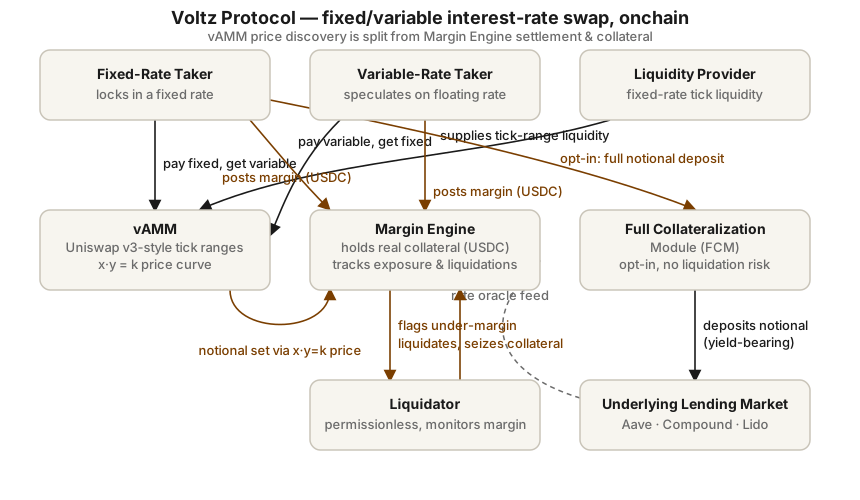
Voltz's core innovation was separating price discovery from settlement. A "virtual AMM" (vAMM) — holding no real assets, only used to determine an exchange rate — let two synthetic tokens (representing fixed-rate and variable-rate cash flows) trade against each other along a constant-product curve (x·y = k), the same math Uniswap uses for spot swaps. Liquidity providers deposited into specific fixed-rate ranges (ticks), rather than across the full curve, so their capital was concentrated where trading activity was expected — mirroring Uniswap v3's capital-efficiency gains, but applied to a rate curve rather than a price curve.
Actual money never sat in the vAMM. A separate "Margin Engine" held real collateral (e.g., USDC or the underlying yield-bearing asset) posted by both fixed-rate takers and liquidity providers, tracked net cash-flow exposure to the underlying variable rate, and enforced margin requirements and liquidations if a position's collateral fell below a maintenance threshold — conceptually similar to how a perpetual futures exchange separates its matching engine from its margin/liquidation logic. A companion "Full Collateralization Module" integrated with Aave v2 so that fixed-rate takers who wanted to avoid margin/liquidation risk entirely could fully collateralize their swap, at the cost of capital efficiency, by depositing the whole notional in yield-bearing form.
The net effect: a lender earning Aave's variable USDC supply rate could sell that floating exposure into Voltz and lock in a fixed rate for a chosen maturity, while a speculator holding the opposite view could take the other side by posting margin, and a liquidity provider could earn swap fees by supplying rate exposure into a chosen tick range — all without a bilateral OTC swap desk or a matched, waiting counterparty on the other side of a specific trade.
Outcome
Voltz v1 launched on Ethereum Mainnet in June 2022 and later expanded to Arbitrum and Avalanche, adding markets tied to Aave, Compound, Lido's stETH, and Rocket Pool's rETH variable rates. The project reported facilitating more than $30 billion in cumulative notional volume within roughly its first year live, and press coverage at the time described it as reaching the largest open-interest position among DeFi derivatives protocols. In 2023 the team published a "Voltz v2" design (a "non-custodial clearinghouse" architecture) and continued iterating, but in the second half of 2023 Voltz Labs announced it was sunsetting the Voltz Protocol brand entirely, directing users to withdraw remaining margin directly via smart contracts and block explorers, and redirected its engineering effort and community (via a badge/token-allocation program) toward a new project, Reya Network, a trading-focused Ethereum layer-2. Voltz Protocol itself is therefore best classified as abandoned rather than exploited or commercially unsuccessful outright — it generated real usage and volume, but the team ultimately judged the IRS-AMM product not worth continuing as a standalone protocol and pivoted the organization to a different design.
Why it worked
Voltz's early traction rested on a genuinely underserved niche: on-chain interest rate markets had no scalable price-discovery mechanism before it, so lenders and stakers had no capital-efficient way to hedge rate exposure without leaving DeFi entirely. By reusing Uniswap v3's concentrated-liquidity design — well understood by both LPs and integrators — Voltz lowered the conceptual and engineering lift for anyone who already knew how to provide Uniswap v3 liquidity. Backing from well-known DeFi-native funds (Framework Ventures led its seed round, alongside Coinbase Ventures, Wintermute, and others) helped it secure integrations with Aave, Compound, Lido, and Rocket Pool markets, giving it credible, high-TVL underlyings to build rate markets on top of rather than needing to bootstrap its own yield source.
Limitations and criticisms
The vAMM/margin-engine split, while elegant, added real complexity: users needed to understand notional exposure, margin requirements, and liquidation mechanics layered on top of the underlying lending market's own risk, a much higher cognitive bar than a simple token swap. Fixed-rate IRS markets are inherently a niche, sophisticated-user product relative to spot trading or even lending itself, and interest-rate volatility in DeFi (where base yields can swing sharply with incentive programs, staking-derivative launches, or protocol changes) made pricing and risk management harder than in traditional fixed-income markets with more stable macro reference rates. The founder's own "Sunsetting Voltz Protocol" retrospective is explicit that the team concluded IRS-AMM demand was not large enough, or not ready soon enough, to sustain a standalone protocol — describing the effort as "too early" for the market it targeted.
Lessons
- Reusing a proven mechanism (Uniswap v3 concentrated liquidity) for an adjacent problem (rate curves instead of price curves) can bootstrap credibility and dev-tooling familiarity quickly, but it does not guarantee the underlying market is as large or as liquid as the one the mechanism was originally built for.
- Splitting price discovery (vAMM) from settlement (margin engine) is a clean architectural pattern worth reusing elsewhere, but it multiplies the number of failure modes and concepts a user must understand before taking a position confidently.
- Real usage and volume metrics (e.g., $30bn+ notional) are not sufficient evidence of product-market fit for sustaining a team and protocol long-term; a founder can judge a technically working, well-used product as strategically not worth continuing.
- Token communities built around one protocol can be migrated to a successor project (Voltz badge holders → Reya Network allocations), showing that "abandoned" protocols can still leave a continuity path for their user base rather than a clean dead end.
Redesign (EDITORIAL)
Hypothesis, not fact. One plausible failure mode was that Voltz asked too much of its users upfront — margin math, liquidation risk, and tick-range LPing — for a fixed-income product whose natural buyers (conservative yield-seekers wanting rate certainty) are typically the least comfortable with derivatives mechanics. A redesign might have offered a "simple mode": a single-click fixed-rate deposit product (functionally a fixed-rate vault) that routed user funds into the same vAMM/margin-engine plumbing under the hood, while hiding notional, margin, and liquidation concepts entirely behind a vault share price — similar to how many users interact with Aave or Compound today without ever thinking about utilization curves. Sophisticated LPs and speculators could still access the raw AMM directly. This could have widened Voltz's addressable market from "DeFi power users comfortable with derivatives" to "any DeFi lender who wants yield certainty," potentially generating the deeper, stickier TVL needed to justify continuing the protocol rather than pivoting away from it.
Sources
- Voltz v2: A Non-Custodial Clearinghouse (whitepaper PDF, Simon Jones) — primary (whitepaper)
- Sunsetting Voltz Protocol — Simon Jones (Mirror post) — primary (founder retrospective)
- Voltz Developer Docs — Protocol Overview — primary (documentation)
- voltz-core (Voltz v1 core smart contracts) — GitHub — primary (code repository)
- Voltz Launches First Synthetic Interest Rate Swap Protocol for DeFi (press release) (press release)
- DeFi Protocol Voltz Opens Door for Passive Traders With Liquidity Optimizer Vault — CoinDesk (news)
- Voltz → Reya: Token Allocation Guide for Badge Holders (project blog)
Related experiments
Last verified: 2026-07-28 · Spot an error? Suggest a correction