Yield Protocol
Paradigm's first incubation brought fixed-rate, fixed-term lending to Ethereum via fyTokens (zero-coupon bonds) and the YieldSpace AMM, worked as designed for three years, then wound down in December 2023 for lack of sustainable demand.
▶ Run interactive simulation animated mechanism with editable parameters
How it works onchain
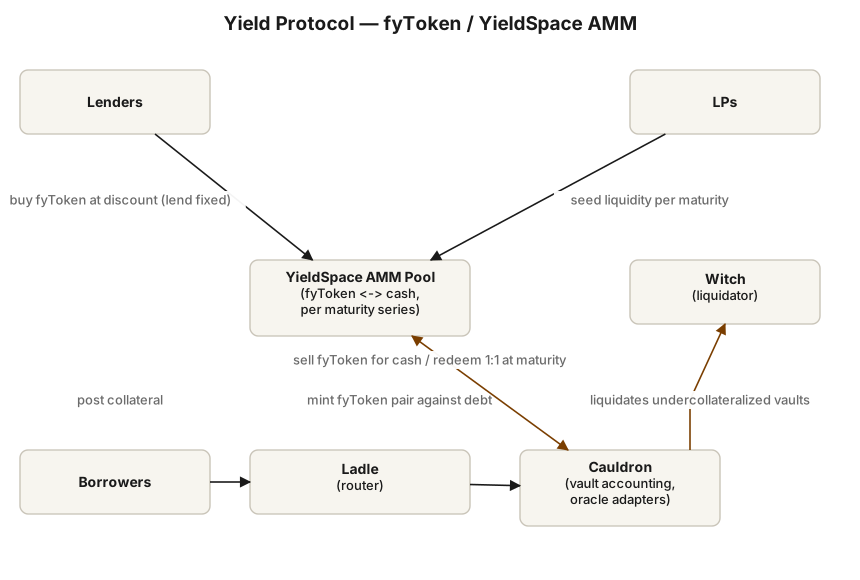 Open full-size diagram
Summary
Yield Protocol was the canonical attempt to bring traditional fixed-income structure — fixed-rate, fixed-term borrowing and lending — to Ethereum. It was Paradigm's first incubation, founded by Allan Niemerg (ex-DRW/Cumberland head of research) with protocol design co-authored by Paradigm's Dan Robinson. Its two intellectual contributions became DeFi standards: the fyToken (a fungible, collateral-backed zero-coupon bond that settles to a target asset at maturity) and YieldSpace, an AMM whose "constant power sum invariant" incorporates time-to-maturity so that liquidity is quoted in interest-rate space rather than price space. The v1 beta (fyDai) launched on Ethereum mainnet on October 19, 2020; a rebuilt v2 (Cauldron/Ladle vault engine) launched in October 2021 and later deployed to Arbitrum One. Despite working essentially as designed and never suffering a major exploit, demand for fixed rates onchain never materialized at scale: TVL peaked around $22M (April 2022) and had fallen to roughly $2M when the team announced an orderly wind-down on October 3, 2023, citing insufficient sustainable demand. The final series matured December 29, 2023.
Design (Mechanism)
- fyTokens as zero-coupon bonds. A fyToken (e.g., fyDai, "fixed yield Dai") is an ERC-20 redeemable 1:1 for the target asset after a fixed maturity date. It trades at a discount before maturity; the discount is the fixed interest rate. Buying fyDai = lending at a fixed rate; minting and selling fyDai against collateral = borrowing at a fixed rate. Series were issued in quarterly maturities.
- Collateralized issuance. In v1, borrowers minted fyDai against ETH at Maker-matching collateralization (150%), or against Chai. In v2, a modular vault engine handled the accounting: the Cauldron tracks vaults (one collateral type against one fyToken series), the Ladle routes all asset movements and integrations, Joins custody assets, and the Witch handles liquidations, with oracle adapters for Chainlink, Compound, Lido, Uniswap, and Yearn.
- YieldSpace AMM. Ordinary constant-product AMMs are poor venues for bonds because a bond's fair price must drift toward par as maturity approaches, forcing LPs into predictable losses. YieldSpace's invariant is written over interest rates rather than prices and takes time-to-maturity as a parameter, so a pool with unchanged reserves quotes a constant rate (with price automatically converging to par at maturity). This made passive LPing in fixed-yield tokens viable and enabled onchain interest-rate discovery.
- Settlement. At maturity fyDai stopped trading and became redeemable; post-maturity balances accrued the Dai Savings Rate (v1) so holders were not penalized for late redemption.
Outcome
Technically the protocol did what it promised for over three years across two major versions and two chains, with audits by Trail of Bits (v1) and a Code4rena contest (2022), and no catastrophic exploit on record. Commercially it never found product-market fit: peak TVL of ~$22M (April 2022, per Blockworks/CoinDesk reporting) was small even by mid-cycle DeFi standards, and had decayed to ~$2M by late 2023. On October 3, 2023 the team announced the wind-down: the planned March 2024 series was cancelled, borrowing/lending was restricted to the December 2023 series, all series matured December 29, 2023, and users were given a supported withdrawal window afterward. The stated reason was no sustainable demand for fixed-rate borrowing at the fees the protocol could charge. Its ideas outlived it — YieldSpace-style curves underpin later fixed-rate protocols (Element, Pendle-lineage designs, Notional's AMM iterations), and the wind-down post itself noted the team's contributions to other fixed-rate protocols.
Why it worked
- Sound financial engineering. The zero-coupon-bond abstraction is the correct primitive for fixed rates: it separates rate discovery (market price of the bond) from credit risk (overcollateralization), and it composes — fyTokens can be traded, LP'd, or used as building blocks.
- AMM designed for the asset. YieldSpace solved the specific failure mode of pricing maturing assets on generic AMMs, a genuine research contribution that the rest of the industry adopted.
- Serious engineering culture. Incubated by Paradigm, audited (Trail of Bits, Code4rena), cleanly modular v2 architecture (Cauldron/Ladle/Witch), and — notably — an orderly, user-protecting shutdown rather than an abandonment or rug.
Where the design broke
- Demand mismatch. DeFi's marginal borrower in 2020–2023 was a leveraged trader who cared about access to liquidity, not rate certainty; DeFi's lender was chasing the highest floating APY. Fixed rates matter to treasurers and institutions, who largely were not onchain yet.
- Fragmented liquidity by construction. Term structure means every maturity is a separate token and a separate pool; a small protocol's TVL split across quarterly series produced thin books and unattractive rates on all of them.
- Competitive squeeze. Floating-rate giants (Aave, Compound) had the liquidity; later fixed-rate/yield-trading entrants (notably Pendle) captured the narrative by monetizing yield speculation rather than yield insurance.
- No sustainable fee model. The team stated plainly that fees at viable levels could not cover the cost of operating and securing the protocol.
Lessons
- A correct primitive is not a business. Fixed-rate lending was intellectually right and technically executed, but the buyer of rate certainty (institutions, treasurers) wasn't onchain yet; mechanism quality cannot substitute for a present-tense customer.
- Term structure fragments liquidity; design must fight that. Any maturity-based product multiplies pools. Protocols that survived this niche either pooled liquidity across terms or attached a speculative wrapper (e.g., yield trading) that recruits volume-seeking traders to subsidize the hedgers.
- Sell the volatile leg, not the boring leg. Pendle's success versus Yield's wind-down suggests the monetizable demand was for speculating on yields, not locking them; the same bond math supports both, but the go-to-market matters.
- AMMs should encode the asset's known dynamics. YieldSpace's time-parameterized invariant (price drifts to par deterministically) is the template: when part of an asset's price path is deterministic, bake it into the curve instead of making LPs bleed it to arbitrageurs.
- How you die is part of the record. A cancelled series, a clear maturity calendar, and a supported withdrawal window preserved user funds and the team's reputation — a model for sunsetting a protocol.
Redesign (EDITORIAL — hypothesis, not fact)
This section is editorial analysis and hypothesis, not historical fact. A revived Yield would keep the fyToken/YieldSpace core but invert the go-to-market. First, unify liquidity: one meta-pool per asset that internally prices all maturities off a fitted yield curve (a true onchain term structure), rather than isolated per-series pools — eliminating the liquidity fragmentation that starved every quarterly series. Second, lead with the speculative product: package the floating/fixed split so rate traders (the demonstrated onchain customer, per Pendle) provide the volume, and market fixed-rate borrowing as the byproduct hedgers can tap. Third, time the market to the arrival of real fixed-income demand: post-2024 tokenized T-bills and RWA treasuries created, for the first time, onchain actors with duration-matching needs; fyTokens collateralized by tokenized bills would let DAOs and fintechs ladder maturities natively. Fourth, address the stated killer — cost of operation — by shipping the protocol as immutable, governance-minimized infrastructure with a fee switch, so it can persist at low TVL without a company obligated to staff it. The hypothesis: Yield failed on timing and distribution, not on mechanism, and the same design launched into a market with tokenized treasuries and rate-trading demand could clear at meaningful size.
Sources
- Winding Down Yield Protocol (official announcement, Oct 3, 2023) — primary (retrospective)
- Introducing fyDai — Allan Niemerg (Aug 6, 2020) — primary (docs)
- Yield Protocol is Live — beta mainnet launch (Oct 2020) — primary (docs)
- YieldSpace: An Automated Liquidity Provider for Fixed Yield Tokens (Niemerg & Robinson) — primary (docs)
- Yield closes $10mm funding round led by Paradigm (Jun 23, 2021) — primary (docs)
- yieldprotocol/vault-v2 — v2 debt vault implementation (Cauldron, Ladle, Witch, Join, FYToken) — primary (contract)
- yieldprotocol/environments-v2 — deployed addresses (mainnet, arb_mainnet) — primary (contract)
- Code4rena audit contest: 2022-07-yield — primary (audit)
- Dan Robinson: Yield is Paradigm's first incubation — primary (archive)
- Fixed rate-focused Yield Protocol is the latest DeFi project to wind down — Blockworks (news)
- DeFi Project Yield Protocol to Wind Down by Year's End — CoinDesk (news)
- A new startup called Yield is trying to bring fixed-rate borrowing and lending to Ethereum — The Block (news)
Related experiments
Last verified: 2026-07-26 · Spot an error? Suggest a correction