APWine
One of the first protocols to split yield-bearing tokens into principal and tradable future-yield tokens, letting farmers sell unrealized yield in advance — it pioneered the mechanism Pendle later dominated, and survived by rebranding into Spectra.
▶ Run interactive simulation animated mechanism with editable parameters
How it works onchain
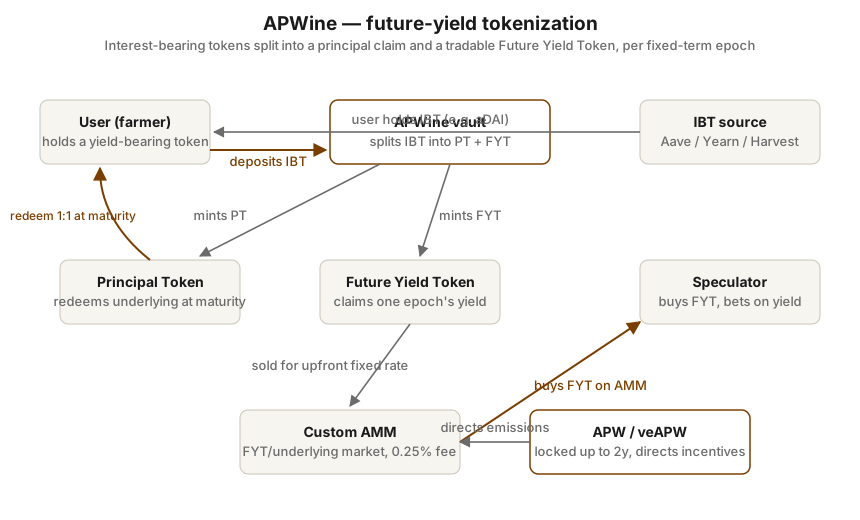 Open full-size diagram
Summary
APWine was a Paris-based protocol, started in August 2020 during DeFi summer, that let users tokenize and sell the future yield of their interest-bearing positions before it accrued. Depositors of yield-bearing tokens (e.g. Aave's aDAI, Yearn vault shares, Harvest's iFARM) received a principal claim plus Future Yield Tokens (FYTs) — ERC-20s representing the yield a position would generate over a fixed period — which could be sold immediately on APWine's custom AMM. The pitch: farmers could lock in a fixed rate by selling volatile yield up front, while speculators could buy cheap exposure to rate movements without holding the underlying capital. APWine claims the first proof-of-concept for future-yield tokenization; it shipped a mainnet beta in February 2021, raised a $1M seed led by Delphi Ventures (March 2021) and a $2.6M extension led by Greenfield Capital (November 2022), and launched V1 on Ethereum and Polygon on December 28, 2021. Despite being early, it was decisively out-scaled by Pendle. On July 10, 2023 the team rebranded to Spectra, later migrating the APW token to a new SPECTRA token on Base, where the successor protocol found meaningfully more traction.
Design (Mechanism)
- Principal/yield split. Users deposited interest-bearing tokens (IBTs) from protocols like Aave, Yearn, or Harvest. The deposit was split into a principal claim (PT) redeemable for the underlying at expiry, and Future Yield Tokens (FYTs) entitling the holder to the yield generated during a defined period.
- Fixed-term futures pools. Yield was organized into discrete "futures" epochs (V1 launched with 90-day pools). At the end of each period, FYT holders claimed the actual yield produced; the position could roll into the next epoch. This turned a continuous, variable APY into a series of discrete, tradable yield instruments — economically a zero-coupon-bond + coupon-strip structure.
- Custom AMM. V1 shipped an in-house AMM (0.25% swap fee) purpose-built for these expiring assets, with APW incentives on pools; earlier the tokens traded on SushiSwap (mainnet) and ComethSwap (Polygon).
- APW token and veAPW governance. APW (max supply 50M; 56% allocated to community) used a Curve-style vote-escrow: locking up to 2 years for veAPW governance power and incentive direction.
- APWine 2.0 (announced October 31, 2022). A modular re-architecture around emerging standards — ERC-4626 vault shares and the EIP-5095 principal-token standard — which became the technical foundation for Spectra's permissionless pool creation.
- Audits. The team cited audits by Peckshield, Quantstamp, BlockSec, Hashclock, and independent auditors at V1 launch.
Outcome
Partial success. APWine genuinely pioneered the yield-stripping primitive (its August 2020 PoC predates most rivals) and shipped working products across Ethereum and Polygon with no known exploit. But commercially the APWine era underperformed: TVL stayed small while Pendle — launching into the same design space with a better-tuned AMM and aggressive ecosystem integrations — grew to billions (peak TVL reported around $4.6B in 2024 and roughly $13B at its 2025 peak). The team concluded the brand and V1 architecture no longer fit and rebranded to Spectra on July 10, 2023, later migrating APW to SPECTRA on Base; the old APW token no longer trades on any CoinGecko-listed exchange. As Spectra, the protocol grew from roughly $20M to about $190M TVL by early 2025 on the back of permissionless pool creation and stablecoin yield assets — a real second act, though still an order of magnitude behind Pendle. Judged as "APWine," the experiment validated the mechanism but lost the market; the lineage survives as an ongoing mid-tier competitor.
Why it worked
- Real hedging demand. DeFi-summer APYs were wildly volatile; separating principal from yield created the first credible onchain fixed-rate instrument and a clean speculation surface on interest rates.
- First-mover research credibility. Being first to a PoC won APWine strong backers (Delphi, Spartan, DeFi Alliance) and a seat in early interest-rate-derivatives discourse.
- Standards-forward engineering. Betting on ERC-4626 and co-developing around EIP-5095 made the 2.0 architecture composable and enabled the permissionless-listing model that later powered Spectra's growth.
- No security failure. Multiple audits and a conservative rollout; the protocol was never exploited, which made the brand migration a choice rather than a forced ending.
Where the design broke
- Capital-efficiency race lost to Pendle. Pendle's AMM (later its V2 with a Notional-style curve) priced expiring yield assets more efficiently and slashed LP friction; APWine's custom AMM and 90-day epoch structure were clunkier for LPs and traders.
- Fragmented, expiring liquidity. Every asset × epoch pair needed its own pool — a structural problem for all yield-splitters, but fatal for the smaller player because thin liquidity makes fixed rates unattractive, which keeps liquidity thin.
- Narrative timing. V1 launched in late December 2021, at the top of the cycle; the 2022 bear crushed yields, and with low base APYs the product's core value proposition (selling juicy future yield) had little to sell.
- Brand and positioning. By the team's own admission at the rebrand, "APWine" (wine/aging metaphor) no longer reflected an interest-rate-derivatives protocol; mindshare had consolidated around Pendle's cleaner PT/YT framing.
Lessons
- Inventing a primitive earns citations, not moats: in mechanism-design races, the winner is usually whoever best solves the liquidity problem (AMM curve, LP economics), not whoever ships the concept first.
- Yield-stripping protocols live and die by base rates: their addressable market expands and contracts with the underlying APY environment, so launching a yield-selling product into a bear market is close to launching into zero demand.
- Fixed-expiry instruments fragment liquidity by construction; designs need aggregation devices (rollovers, shared curves, permissionless-but-standardized pools) baked in from day one.
- Adopting emerging token standards (ERC-4626, EIP-5095) is a cheap option on future composability — it is what made APWine's second act as Spectra possible.
- A live, unexploited codebase plus a community treasury is salvageable capital: rebrand-and-migrate (APWine → Spectra, APW → SPECTRA on Base) can be a legitimate continuation strategy rather than an exit.
Redesign (EDITORIAL — hypothesis, not fact)
This section is editorial hypothesis, not historical fact. A redesigned APWine would attack the liquidity-fragmentation problem before anything else: instead of one AMM pool per asset per 90-day epoch, use a single shared-liquidity curve per underlying where PTs of different maturities are priced off one yield curve (closer to a proper onchain fixed-income venue), with automatic rollover so LP capital never strands at expiry. Second, it would invert go-to-market: rather than listing a broad menu of farm tokens, concentrate on one or two deep, durable yield sources (e.g. staked ETH, later T-bill-backed stablecoins) where fixed rates have obvious institutional demand, and only then generalize via permissionless listing. Third, ship the veAPW flywheel after organic volume exists — incentive-directed emissions on illiquid expiring pools mostly subsidized mercenary LPs. Finally, keep the countercyclical thesis explicit: market the product as rate insurance in high-APY regimes and as fixed-income yield enhancement in low-rate regimes, so the protocol has a story on both sides of the cycle instead of going quiet in bear markets — which is, in effect, the playbook the team eventually adopted as Spectra.
Sources
- APWine is live! (V1 mainnet launch announcement) — primary (retrospective)
- Spectra (prev. APWine Finance) — IQ.wiki (analysis)
- Spectra Finance official site (successor protocol) — primary (docs)
- Introducing Spectra — Open Interest Rate Derivatives Protocol (rebrand post) — primary (retrospective)
- Spectra [OLD] (APW) — CoinGecko token page (archive)
- CoinGecko Research: Tokenizing Future Yield (analysis)
- Yield Tokenization: APWine and Pendle — Albaron Ventures (analysis)
- APWine — The Protocol for Future Yield Tokenisation (DeFiPrime) (analysis)
- DeFi Yield Competition: Pendle and Rising Star Spectra (PANews) (news)
Related experiments
Last verified: 2026-07-26 · Spot an error? Suggest a correction