Penumbra
A fully shielded proof-of-stake L1 and private DEX for the Cosmos/IBC ecosystem that made privacy the default for transfers, staking, swaps, and governance — technically landmark, commercially marginal.
▶ Run interactive simulation animated mechanism with editable parameters
How it works onchain
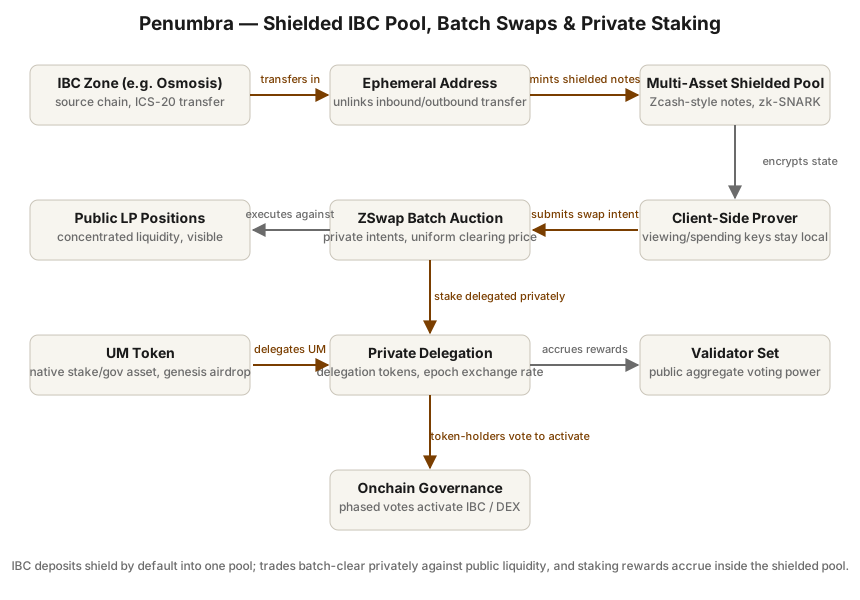 Open full-size diagram
Summary
Penumbra is a sovereign, IBC-connected proof-of-stake blockchain in which everything — transfers, staking, swaps, liquidity provision, and governance voting — is shielded by default. Founded by cryptographer Henry de Valence (previously open-source cryptography at the Zcash Foundation, co-author of curve25519-dalek), Penumbra Labs raised a $4.75M seed led by Dragonfly Capital in November 2021, with the Interchain Foundation, Lemniscap, Robot Ventures, Volt Capital, Figment, Strangelove, Informal Systems, and ZKValidator participating. The thesis, in de Valence's framing: "information leaks are value leaks" — markets that leak trading information unnecessarily destroy value, so a private market should structurally outcompete a forced-transparent one.
After a multi-year public testnet program (IBC transfers into the shielded pool were demonstrated on testnet in September 2023 — the first Cosmos assets ever shielded over IBC), mainnet Phase 0 launched in July 2024 via a community "summoning" in which validators assembled from a genesis file, with an airdrop of the UM staking token to Cosmos DeFi users and open-source contributors (snapshot April 1, 2024). IBC and the DEX were then activated by on-chain governance votes in phases. A polished DEX frontend, Veil, followed in late 2024. In April 2025 de Valence stepped down citing burnout; by around September 2025 Penumbra Labs itself had shut down — yet the chain, decentralized from genesis, continued operating under community stewardship.
Design (Mechanism)
- Multi-asset shielded pool. All assets (native UM and any IBC-transferred token) live in a single Zcash-style note-based shielded pool, proven with zk-SNARKs. Any ICS-20 transfer into Penumbra automatically mints notes into the pool — shielding is the default, not an opt-in. Ephemeral (randomized) deposit/withdrawal addresses prevent linking inbound and outbound IBC transfers.
- End-to-end encryption with client-side proving. Only end-user devices hold viewing/spending keys; the chain sees ciphertext. Users can selectively disclose activity to auditors or counterparties via view keys — privacy with opt-in transparency rather than the reverse.
- Private trades on public liquidity (ZSwap-style batch swaps). The DEX inverts the usual model: concentrated-liquidity positions are public (so pricing and routing work), but individual swaps are private. Swap intents in a block are aggregated and executed as a batch at a uniform clearing price; only aggregate per-block flows are revealed. This makes individual trade sizes and traders' identities confidential and largely neutralizes frontrunning/sandwich MEV, since there is no ordering within a batch to exploit.
- Private staking. Delegating to a validator issues validator-specific delegation tokens whose exchange rate against UM accrues rewards epoch-by-epoch, so stake amounts and reward flows stay inside the shielded pool while validator voting power remains publicly computable in aggregate.
- Governance-gated phased launch. Phase 0 enabled only transfers and governance; on-chain votes later ratified genesis and switched on IBC, then IBC transfers and the DEX — decentralizing the launch decision itself.
Outcome
Technically, Penumbra shipped essentially everything it promised: a live end-to-end-encrypted L1, shielded IBC, private staking and governance, and a working private batch-swap DEX with the Veil frontend. Commercially, adoption stayed small: third-party trackers report roughly $3–4M in shielded value, cumulative DEX volume on the order of $10M through 2024, ~6 IBC-connected chains, tens of thousands of wallets, and a UM market cap around $5M (third-party estimates; treat as approximate). The seed-stage company did not survive: de Valence stepped down in April 2025 (interim leadership to operations lead Cate Yushina; the Radiant Commons entity continued funding development), and Penumbra Labs shut down entirely around September 2025 with no foundation runway or marketing arm remaining. Notably, the network itself did not die — because it was validator-run and fully open source from day one, the chain and its community kept operating and even shipping (community explorer/portfolio tooling in 2025). Status: technically successful, commercially unsuccessful; the network itself remains ongoing.
Why it worked
- Cryptographic credibility. A team led by a respected Zcash/dalek cryptographer built novel primitives (decaf377, batch-swap execution, private delegation math) that peers regard as state-of-the-art; the design has been influential on later private-DeFi efforts.
- Privacy-by-default architecture. Shielding on every IBC deposit avoided the "opt-in privacy = small anonymity set" trap that weakened Zcash's shielded usage.
- Genuine decentralization as survivability. The phased, governance-gated launch and permissive open-sourcing meant the protocol outlived its founding company — a rare property.
Where the design broke
- Privacy demand was thinner than the thesis. Traders mostly optimize for liquidity, listings, and points, not confidentiality; Penumbra's UX (client-side sync/proving, its own wallet stack) added friction against transparent venues with deeper books.
- No sustainable business model. A sovereign privacy chain with sub-$5M shielded value generates negligible fee revenue; a single $4.75M seed from 2021 had to carry years of hard R&D through a bear market and a hostile regulatory climate for privacy tech (the Tornado Cash era), and the company ran out of runway.
- Cold-start on a sovereign chain. Liquidity had to be bootstrapped from zero behind a shielding boundary, and the Cosmos ecosystem it targeted was itself shrinking in relative activity during 2024–25.
- Founder burnout — explicitly cited in de Valence's departure post — compounded the structural funding problem.
Lessons
- Privacy is a feature users say they want and rarely pay switching costs for. Confidentiality alone does not bootstrap liquidity; it must ride on a venue that wins on price, assets, or yield first.
- Batch execution at a uniform clearing price is one of the cleanest MEV defenses known — Penumbra demonstrated it live; the idea generalizes beyond privacy chains.
- "Public liquidity, private flow" is the right decomposition for a shielded DEX: keep price-forming state visible so markets function, hide only the trader-level information.
- Decentralize survival, not just governance. Because validators, not the company, ran the chain from genesis, the protocol survived its company's death — the strongest possible test of the claim "not dependent on any one entity."
- A seed round is not a runway for a multi-year cryptography moonshot. Deep-tech protocols need either token-treasury sustainability or repeat financing planned from day one.
Redesign (EDITORIAL — hypothesis, not fact)
This section is editorial hypothesis, not fact. A redesigned Penumbra would ship the same cryptography as an embedded service rather than a destination chain: offer "shielded lanes" to existing high-liquidity venues (an IBC/interchain privacy middleware, or a shielded-batch-auction module that Osmosis/Ethereum L2s can mount), so the anonymity set and liquidity come from an already-active user base instead of being bootstrapped from zero. Monetize protocol-side (a small shielding/unshielding fee accruing to a treasury) to fund development independently of venture runway. Sequence the launch around one killer use case with demonstrated willingness to pay — e.g., private OTC-sized execution for DAOs and funds who verifiably leak alpha on transparent chains — before generalizing to retail swaps. Finally, pair selective-disclosure view keys with off-the-shelf compliance attestations at launch, to blunt the regulatory headwinds that suppressed exchange listings and institutional use of privacy assets.
Sources
- Penumbra official site (protocol, ecosystem, Veil DEX) — primary (docs)
- The Final Summoning Rites, Part 2 — Mainnet Phase 0 (governance forum, July 5, 2024) — primary (governance)
- Interchain Privacy is Here (IBC into the shielded pool, Sept 28, 2023) — primary (docs)
- Henry de Valence — Stepping down from Penumbra Labs (Apr 15, 2025) — primary (retrospective)
- Penumbra Labs Raises Seed Round To Build Private, Decentralized Exchange — primary (docs)
- Penumbra X post confirming Penumbra Labs shut down while the network kept running (Jan 2026) — primary (retrospective)
- Penumbra Labs Closed $4.75M Seed Round Led by Dragonfly Capital (news)
- Penumbra Launches Veil: A Fully Private DEX with Encrypted Transactions (StakeCito) (analysis)
- Penumbra: The Encrypted DEX Layer for Cosmos DeFi (cache256, third-party metrics) (analysis)
Related experiments
Last verified: 2026-07-26 · Spot an error? Suggest a correction