Perpetual Protocol (vAMM)
Perpetual futures DEX that invented the 'virtual AMM' — an x*y=k curve with no real liquidity that priced leveraged perps against a USDC vault, scaled to $19B+ volume, then died of chronic long-short skew.
▶ Run interactive simulation animated mechanism with editable parameters
How it works onchain
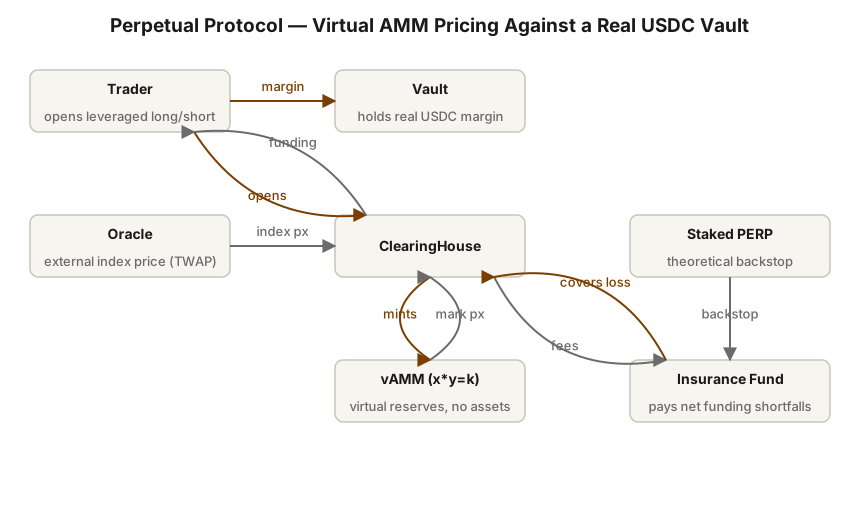 Open full-size diagram
Summary
Perpetual Protocol v1 (originally incubated as "Strike," rebranded in 2020; co-founded by Taiwanese serial entrepreneurs Yenwen Feng and Shao-Kang Lee) launched on the xDai sidechain on December 14, 2020 and introduced the virtual AMM (vAMM): a constant-product pricing curve containing no real assets, used purely as a deterministic price-discovery machine for leveraged perpetual futures. Trader collateral (USDC) sat in a separate vault; the curve only tracked virtual reserves. The design let anyone trade perps with up to 10x leverage with zero liquidity providers and no order book, and briefly made Perp the largest decentralized derivatives exchange — over $19B in cumulative volume in its first ~7 months per Messari. But the vAMM's fixed virtual liquidity had no mechanism to absorb one-sided demand: chronic long-short skew forced the protocol's insurance fund to pay funding out of its own pocket, the fund bled during the 2021 bull market and the May 2022 crash, trading was emergency-halted, and v1 was sunset by governance while v2 ("Curie," on Optimism, Nov 2021) replaced the pure vAMM with real concentrated liquidity on Uniswap v3.
Design (Mechanism)
- Virtual reserves, real collateral. Each market was an
Ammcontract holding fictional balances of, e.g., vETH and vUSDC obeying x*y=k. Opening a long meant the ClearingHouse (xDai:0x5d9593586b4B5edBd23E7Eba8d88FD8F09D83EBd) minted virtual USDC (margin × leverage) into the curve and recorded the trader's virtual position; actual USDC went to a Vault. Because no swap of real assets ever occurred, no LPs were needed — the curve was a shared bookkeeping device, and every trader's counterparty was effectively the pooled system itself. - Price convergence via funding. The vAMM price floated freely with trade flow; hourly funding payments (based on the gap between the vAMM's TWAP and an external index price from oracles) paid longs or shorts to pull the mark price toward spot, mimicking centralized perp funding.
- Insurance fund as counterparty of last resort. Since positions net against the system rather than against matched traders, any imbalance between aggregate longs and shorts meant someone's funding/PnL had to be paid by the protocol. An InsuranceFund contract (
0x8C29F6F7fc1999aB84b476952E986F974Acb3824), fed by trading fees, absorbed this, with staked PERP tokens as a theoretical further backstop. - k as a manually-set parameter. Virtual liquidity depth (k) was set and adjusted by the team per market — too small meant high slippage, too large meant the price barely moved and arbitrageurs couldn't profitably restore the peg.
Outcome
Explosive early success: top decentralized perps venue of early 2021, >$19B volume in under seven months, PERP became a DeFi blue-chip, and "vAMM" entered the design vocabulary (forks like nftperp and Drift's early design drew on it). But the structural flaw surfaced quickly: in the 2021 bull market traders were persistently net-long, the insurance fund paid the excess funding, and governance threads (e.g., "Analysis and solutions to the insurance fund problem," early 2021) show the team openly wrestling with the drain. Position-concentration incidents (including a large CREAM-market liquidation) and the April–May 2022 market collapse (LUNA/UST era) pushed the fund toward insolvency; the team executed an emergency trading halt to stop further loss, and a "Sunsetting Perp V1" governance process distributed remaining funds to users (settlement around May 15, 2022), with a later modified PERP-buyback proposal to compensate affected v1 users. The vAMM itself was abandoned: v2 "Curie" used Uniswap v3 as its execution layer with real (leveraged) maker liquidity, and the team later pivoted again to Nekodex (2024). Verdict: partial_success — the product and mechanism were historically important and commercially significant, but the pure-vAMM economic design failed and was retired.
Why it worked
- Zero cold-start liquidity problem. No LPs to bootstrap: markets launched with purely virtual depth, so Perp could list assets instantly and offer leverage on day one — a genuine unlock in 2020 when on-chain derivatives liquidity was scarce.
- No impermanent loss for anyone (there were no LPs to suffer it), and traders got guaranteed, deterministic on-curve execution.
- Cheap chain, right timing. xDai gave near-zero gas during Ethereum's fee spike, and Perp shipped a CEX-like perp product months before serious competitors (dYdX's L2 orderbook, GMX) matured.
Where the design broke
- The system was the counterparty and mispriced that risk. With fixed virtual liquidity, aggregate long-short imbalance had no natural absorber; the insurance fund structurally paid funding whenever the market leaned one way — which in a trending market is almost always. Fee income could not cover a sustained directional regime.
- k was unpriceable. Manually tuning virtual depth was a standing governance/ops burden with no market feedback; wrong k meant either unusable slippage or stale prices that invited toxic arbitrage flow.
- Tail events compounded the bleed. Concentrated positions in thin markets (CREAM) and the May 2022 crash produced bad debt faster than the backstop could recapitalize, forcing a centralized emergency halt — the very trust assumption DeFi perps were meant to remove.
Lessons
- "Virtual liquidity" is real risk transfer. If no LP bears the other side of a trade, the protocol does. Any AMM without genuine counterparties must price and provision for net-exposure risk explicitly, not treat the insurance fund as an afterthought.
- Funding rates can't fix a structural skew they themselves are drained by. Incentive payments that come from a finite protocol fund, rather than from opposing traders, convert market imbalance into slow protocol insolvency.
- Parameters that a team must hand-tune (like vAMM k) are a signal the mechanism is missing a market. v2's move to real concentrated liquidity effectively outsourced k-setting to profit-seeking makers.
- Emergency halts save funds but spend legitimacy. Perp's halt was arguably correct, yet it demonstrated the admin-key trust hidden inside "decentralized" derivatives; wind-down and compensation processes should be designed before they're needed.
Redesign (EDITORIAL — hypothesis, not fact)
This section is editorial hypothesis, not historical fact. A vAMM revival could keep the zero-LP cold-start but make skew self-correcting: (1) dynamic virtual depth — algorithmically shrink k on the crowded side so marginal one-way flow pays rapidly escalating slippage, effectively an on-curve funding payment settled instantly by takers rather than by the insurance fund; (2) cap net open interest per market as a hard function of insurance-fund size, so the backstop can never be under-collateralized relative to worst-case skew (GMX/Hyperliquid-style OI caps later normalized this); (3) auction off the residual net exposure continuously to external hedgers (a "skew market") instead of warehousing it; and (4) pre-commit an on-chain wind-down: if the fund falls below a threshold, markets auto-settle at index TWAP — replacing the discretionary emergency halt with a rule traders can price in advance. The irony worth preserving in the entry: Perp v1's failure mode (protocol-as-counterparty bleeding via funding) reappeared in later "house pool" perp designs, so the lesson remains live.
Sources
- perpetual-protocol/perpetual-protocol (v1 Solidity contracts + metadata with deployed addresses) — primary (contract)
- Perpetual Protocol GitHub org (links perp.com and @perpprotocol) — primary (docs)
- Introducing Perpetual Protocol V2 — 'Curie' (official blog) — primary (retrospective)
- Sunsetting Perp V1 (governance forum proposal) — primary (governance)
- Analysis and solutions to the insurance fund problem (governance forum) — primary (governance)
- Messari — Perpetual Protocol: Nobel Prizeworthy Derivatives? (analysis)
- DeFi Summary & Research: Perpetual Protocol v1 (SWF Lab) (analysis)
- Introducing Nekodex (official blog — later pivot of the team) — primary (retrospective)
Related experiments
Last verified: 2026-07-26 · Spot an error? Suggest a correction