EIP-1559
Ethereum replaced its blind first-price gas auction with an algorithmic, burned base fee plus a small tip, cutting fee-estimation guesswork and turning every transaction into a permanent supply-side deflation lever.
▶ Run interactive simulation animated mechanism with editable parameters
How it works onchain
 Open full-size diagram
Summary
EIP-1559 replaced Ethereum's original first-price, sealed-bid gas auction with a hybrid mechanism: a protocol-computed "base fee" per block that is burned outright, plus a user-chosen "priority fee" (tip) paid to the block proposer. First drafted by Vitalik Buterin, Eric Conner, Rick Dudley, Matthew Slipper, Ian Norden, and Abdelhamid Bakhta on April 13, 2019, it shipped as part of the London hard fork on August 5, 2021, at block 12,965,000. The change did two things at once: it made fees far easier to estimate (users set a max-fee and a tip instead of guessing a single winning bid), and it made every unit of gas consumed on Ethereum a small, automatic burn of ETH supply, permanently linking network usage to monetary contraction.
Design (Mechanism)
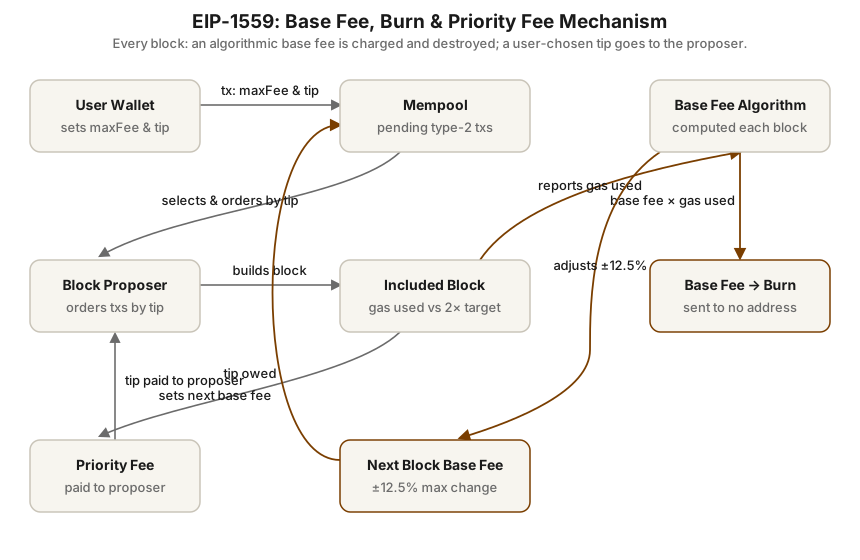
Base fee. Each block has a base fee per gas, set algorithmically by the protocol rather than by bidding. If the parent block's gas usage exceeded the "target" (the gas limit divided by an elasticity multiplier of 2), the base fee rises for the next block; if usage was below target, it falls. The maximum move in either direction is capped at 1/8 (12.5%) of the current base fee per block, so base fee is a lagging, smoothed signal rather than a spot auction price.
Elastic block size. Blocks have a gas target (the old fixed gas limit) but can expand up to 2x that target in a single block to absorb demand spikes, with the base fee then rising algorithmically to push usage back toward the target over subsequent blocks. This decouples "can this block fit my transaction" from "what do I have to bid," at the cost of allowing short bursts of larger, more expensive-to-process blocks.
Burn. The entire base fee is destroyed — sent to no address, permanently removed from circulating supply — rather than paid to the block producer. This was a deliberate design choice to prevent proposers from being able to profitably manipulate the base fee upward and pay it to themselves (self-dealing would just burn their own revenue), and, as a side effect, tied ETH's supply schedule to network activity.
Priority fee / tip. On top of the mandatory base fee, users attach a maxPriorityFeePerGas that goes to whoever proposes the block, functioning as a conventional (small) tip auction for ordering within a block and for inclusion when the mempool is contested. Total payment is min(maxFeePerGas, baseFee + priorityFee) × gasUsed, with unspent headroom between max-fee and base-fee-plus-tip refunded to the sender.
Transaction type. EIP-1559 transactions are a new EIP-2718 typed transaction (type 0x2) carrying separate maxFeePerGas and maxPriorityFeePerGas fields, coexisting with legacy transactions, which are treated as if maxFeePerGas == maxPriorityFeePerGas == gasPrice.
Outcome
EIP-1559 activated cleanly with the London hard fork on August 5, 2021, and has run without a rollback or major consensus incident since. Per ultrasound.money-style burn trackers, it has cumulatively burned well over 4 million ETH from circulation, and combined with the September 2022 Merge (which ended new-issuance-heavy proof-of-work mining rewards), it turned Ethereum's net issuance negative during many high-usage periods — the "ultrasound money" narrative. Empirical studies (including a retrospective circulated via Decentralized Thoughts) found that transaction confirmation latency and fee-overpayment fell measurably, and users adopting the new fee fields paid somewhat less on average than those still using legacy gas-price bidding, though median fee levels were not reduced — EIP-1559 changed fee predictability and payment mechanics, not Ethereum's underlying capacity constraint. Fork rates rose modestly due to the larger variable block sizes. The mechanism has since become a template: multiple EVM L2s and later Ethereum EIPs (e.g., the EIP-4844 blob base fee) reuse the same additive/multiplicative base-fee-adjustment pattern. Status: ongoing, widely regarded as technically successful at its stated predictability/burn goals, with unresolved second-order effects. Verdict: partial_success.
Why it worked
- Solved a real, felt problem. First-price gas auctions caused chronic overpayment and failed transactions during demand spikes; a formula-driven base fee that most wallets could estimate reliably was an immediate UX improvement that needed no user behavior change beyond a wallet update.
- Incentive-aligned burn. Burning the base fee (instead of paying it to the block producer) removed the obvious attack of proposers inflating the fee and pocketing the difference, which made the mechanism robust to the most direct manipulation vector — a point substantiated by Roughgarden's game-theoretic analysis of miner incentive compatibility.
- Backward compatibility. Legacy transactions kept working unchanged, so the upgrade did not require every wallet or contract to migrate simultaneously — adoption could ramp gradually.
- A clean, portable formula. The additive-update, capped-percentage base-fee rule was simple enough to implement identically across independent execution clients (Geth, Besu, Nethermind, Erigon) with no observed consensus divergence, and simple enough that other chains and later EIPs could copy it wholesale.
Limitations and criticisms
- Did not lower fees or add capacity. EIP-1559 is a pricing and payment-flow redesign, not a scaling mechanism; during sustained high demand (NFT mints, memecoin frenzies) users still pay very high absolute fees — the mechanism smooths and predicts congestion pricing, it does not relieve it.
- MEV migrated toward proposers. Because the base fee is burned rather than collected by the block producer, researchers (including Flashbots' own analysis) found that MEV — extracted via priority fees, private order flow, and bundle auctions — became a comparatively larger share of validator revenue post-1559, shifting rather than eliminating where fee-market rent is captured.
- The 12.5%-per-block cap is a lagging signal. Base fee cannot jump to the true market-clearing price within a single block, so sudden demand shocks still produce a period of underpriced blocks (over-inclusion, temporarily higher fork/latency risk) before the base fee catches up over several blocks.
- Elastic 2x blocks increase variance for node operators. Allowing blocks up to double the gas target raises worst-case per-block validation, bandwidth, and state-growth load on all full nodes, a cost borne by the network's decentralization rather than by fee payers.
- Refund/overpayment edge cases and tooling churn. Legacy tooling, some smart-contract fee-forwarding patterns, and gas-estimation libraries required nontrivial rework to correctly compute
maxFeePerGasversusbaseFee + priorityFee, and early wallet implementations sometimes mis-estimated the tip, leading to stuck or overpriced transactions during the transition period.
Lessons
- Separating "the price the protocol needs to charge" (base fee) from "the price I choose to pay a specific party" (tip) is a reusable pattern: it lets an algorithm own congestion pricing while leaving room for a genuinely competitive, low-stakes secondary auction.
- Burning a fee only works as an anti-manipulation device if the party who could otherwise collect it is also the party who would otherwise be tempted to inflate it — remove the beneficiary and you remove the direct incentive to game the formula.
- A fee-mechanism redesign can dramatically improve UX/predictability without touching underlying throughput; don't conflate "fees feel better" with "fees are lower" or "the chain scaled."
- Bounding the per-block rate of change (the 12.5% cap) trades responsiveness for stability — useful for damping oscillation, but it guarantees a lag window during real demand shocks that the design must be evaluated against, not around.
- Second-order incentive shifts (here, MEV moving from base-fee capture to priority-fee/bundle capture) are often the first thing to check after any burn-based redesign — removing one rent frequently just relocates it.
Redesign (EDITORIAL — hypothesis, not fact)
A future iteration could make the base-fee adjustment demand-aware rather than purely usage-lagging: instead of a fixed ±12.5% cap keyed only to whether the previous block was above or below target, the step size could scale with the magnitude of the overshoot (a block at 2x target adjusts faster than one at 1.05x target), shortening the catch-up window during real demand shocks without sacrificing stability during normal noise. Separately, since MEV visibly migrated toward the priority-fee/bundle-auction side of the mechanism, a redesign could extend the burn concept to a portion of realized MEV itself — for example, requiring proposer-builder-separation auctions to burn a fixed fraction of the winning bid rather than paying 100% of it to the proposer — so that the "no party should profit from manipulating the price" principle that motivated burning the base fee is applied consistently to the rent that moved rather than only to the rent that was designed away.
Sources
- EIP-1559: Fee market change for ETH 1.0 chain (official specification) — primary (docs)
- EIP-1559 FAQ by Vitalik Buterin (HackMD) — primary (docs)
- Transaction Fee Mechanism Design for the Ethereum Blockchain: An Economic Analysis of EIP-1559 (Roughgarden) (analysis)
- EIP-1559 In Retrospect (Decentralized Thoughts) (analysis)
- MEV and EIP-1559 (Flashbots) (analysis)
- Ethereum's Hotly Anticipated 'London' Hard Fork Is Now Live (CoinDesk) (news)
Related experiments
Last verified: 2026-07-28 · Spot an error? Suggest a correction