Basis
A venture-backed algorithmic 'central bank' stablecoin that raised $133M but voluntarily shut down and returned all capital in 2018 before launch, citing regulatory constraints on its bond and share tokens.
▶ Run interactive simulation animated mechanism with editable parameters
How it works onchain
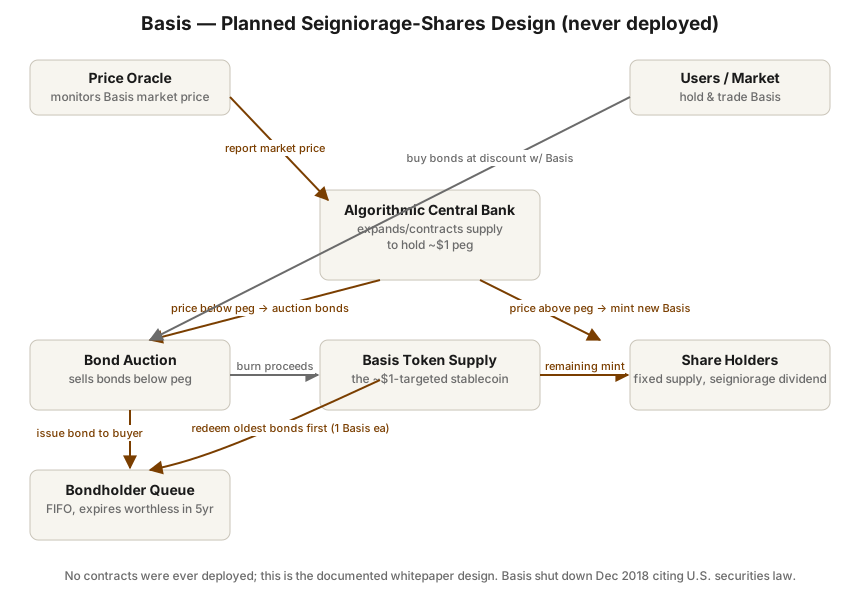 Open full-size diagram
Summary
Basis (originally "Basecoin") was an algorithmic stablecoin project built by Intangible Labs, founded by Nader Al-Naji with co-founders Lawrence Diao and Josh Chen. It aimed to hold a soft peg (targeted at roughly $1) not through fiat or crypto collateral but through an on-chain "algorithmic central bank" that expanded and contracted the coin supply in response to demand. In April 2018 the project raised approximately $133M in a private placement — at the time the largest single raise for a stablecoin startup — from a marquee investor list including Bain Capital Ventures, GV, Andreessen Horowitz, Lightspeed, Foundation Capital, Stanley Druckenmiller, former Fed governor Kevin Warsh, and Digital Currency Group. Despite the funding and pedigree, Basis never launched a token or deployed contracts. On December 13, 2018, roughly eight months after its public raise, the team announced it was shutting down and returning nearly all remaining capital to investors, citing regulatory constraints. Basis is therefore a canonical "what could have been" of the seigniorage-shares era — influential on paper, aborted in practice, and later imitated by unaffiliated projects such as Basis Cash.
Design (Mechanism)
Basis implemented a three-token version of Robert Sams' "Seigniorage Shares" concept:
- Basis (the stablecoin): the coin meant to trade near its $1 target, held and spent by users.
- Bond tokens: sold via on-chain auction to remove Basis from circulation when the price fell below peg. Bonds were bought at a discount (less than 1 Basis) as a promise to be redeemed for exactly 1 Basis later, but only when the protocol next needed to expand supply. Bonds sat in a first-in-first-out queue and — critically — expired worthless after five years if never redeemed.
- Share tokens: a fixed-supply equity-like claim on future seigniorage. Shares never expired.
A price oracle monitored Basis's market price. When price rose above peg (excess demand), the protocol minted new Basis and distributed it in strict priority order: first to bondholders in the redemption queue (oldest bonds first, 1 Basis each), and only after all outstanding bonds were cleared did remaining newly minted Basis flow pro-rata to shareholders as a seigniorage dividend. When price fell below peg (excess supply), the protocol auctioned new bonds for Basis, burning the proceeds to contract supply and push price back up. The elegance was that no collateral was required: contraction was financed by the promise of future expansion, and shareholders captured the long-run seigniorage upside as the network grew — economically analogous to a central bank paying dividends to equity holders.
Outcome
Basis was abandoned before launch. No mainnet contracts were deployed and no Basis, bond, or share tokens ever traded. In December 2018 the founders invoked a "return capital" provision to wind down and hand back the roughly $133M raise (minus operating costs) to investors. The proximate cause was regulatory: the team concluded there was no viable way to keep the bond and share tokens permissionless. Compliance would have required transfer restrictions enforced through a centralized whitelist and ownership limited to eligible investors — destroying the censorship resistance and on-chain auction liquidity the design depended on. Rather than ship a compromised, permissioned system, the team chose to shut down and return the money. The decision earned Al-Naji a reputation for integrity at the time (he returned investor capital he was arguably not contractually forced to). He later founded BitClout/DeSo, a separate venture.
Why it worked
As an intellectual artifact and fundraising exercise, Basis succeeded remarkably. It packaged the seigniorage-shares idea into a clean, legible three-token model that top-tier venture and macro investors found credible enough to back with nine figures. Its whitepaper became a reference design for an entire generation of "algo stablecoin" experiments. In the narrow sense of returning nearly all capital cleanly and avoiding a messy, litigated collapse, its wind-down also "worked."
Where the design broke
The failure was twofold. First, regulatory: the mitigations required to keep the bond and share tokens compliant (whitelisting, investor eligibility gating) were incompatible with a permissionless system. Second, and more fundamentally, the economic design was fragile even absent regulation. The model relied on perpetual future growth to redeem bonds; in a sustained contraction, the bond queue could balloon, bonds could hit their 5-year expiry unpaid, and confidence could collapse into a reflexive death spiral — precisely the dynamic that later destroyed unaffiliated seigniorage-style coins (Basis Cash, and conceptually TerraUSD). Basis was shut down before the market ever got to stress-test this, so its economics were never disproven in production — but the same structural weakness was later demonstrated repeatedly.
Lessons
- Design for permissionless compatibility from day one. A token structure that requires eligibility gating or whitelisting to operate cannot coexist with a fully permissionless system; mechanism designers must resolve that tension before launch, not bolt on compliance later.
- Seigniorage-shares stability is confidence-backed, not collateral-backed. Any design where contraction is financed purely by claims on future expansion carries latent death-spiral risk; the peg holds only while the market believes growth will resume.
- Returning capital cleanly is a legitimate and underrated outcome. Choosing to wind down rather than ship a compromised system preserved reputation and investor funds — a stark contrast to later algo-stablecoin teams that launched anyway and inflicted large losses.
- Fame of a design ≠ soundness of a design. Basis's whitepaper was hugely influential precisely because it was never battle-tested; its imitators inherited its flaws and paid the price it never had to.
Redesign (EDITORIAL — hypothesis, not fact)
The following is speculative analysis, not established fact. A modern redesign would start from the premise that pure, uncollateralized seigniorage-shares stablecoins are structurally unsafe, and would abandon the "future-growth-backs-the-peg" core. One credible path: retain Basis's elastic-supply and oracle machinery but back the peg with an over-collateralized, transparent on-chain reserve (fiat-backed tokens, ETH, or short-dated tokenized T-bills), using the algorithmic supply adjustments only as a secondary stabilization layer within tight bands — closer to a reserve-backed hybrid than a reflexive one. The seigniorage upside that Basis routed to "share" tokens could instead be (a) directed to a protocol-owned treasury governed transparently, or (b) distributed as usage rebates to actual stablecoin holders rather than as a tradable equity claim. Bonds, if kept at all, should be redeemable against the collateral reserve rather than against speculative future issuance, removing the expiry/death-spiral trap. Finally, a redesign in 2026 would pursue a design that does not depend on regulatory ambiguity for the tokens' core function — the exact bet that killed the original.
Sources
- Introducing Basis, a Stable Cryptocurrency with an Algorithmic Central Bank (founder announcement) — primary (docs)
- Basis backed with $133M... says it's shutting down and returning the money (TechCrunch) (news)
- Basis Stablecoin Confirms Shutdown, Blaming 'Regulatory Constraints' (CoinDesk) (news)
- Reserve's Analysis of the Basis Protocol (Nevin Freeman) (analysis)
- Crypto's Top Funded Startup Shutters Operations Following SEC Concerns (Forbes) (news)
Related experiments
Last verified: 2026-07-26 · Spot an error? Suggest a correction