Namecoin
The first fork of Bitcoin (April 2011): a merged-mined blockchain key/value store for censorship-resistant .bit domains and identities that proved decentralized naming was possible — and that squatters, not users, would fill it.
▶ Run interactive simulation animated mechanism with editable parameters
How it works onchain
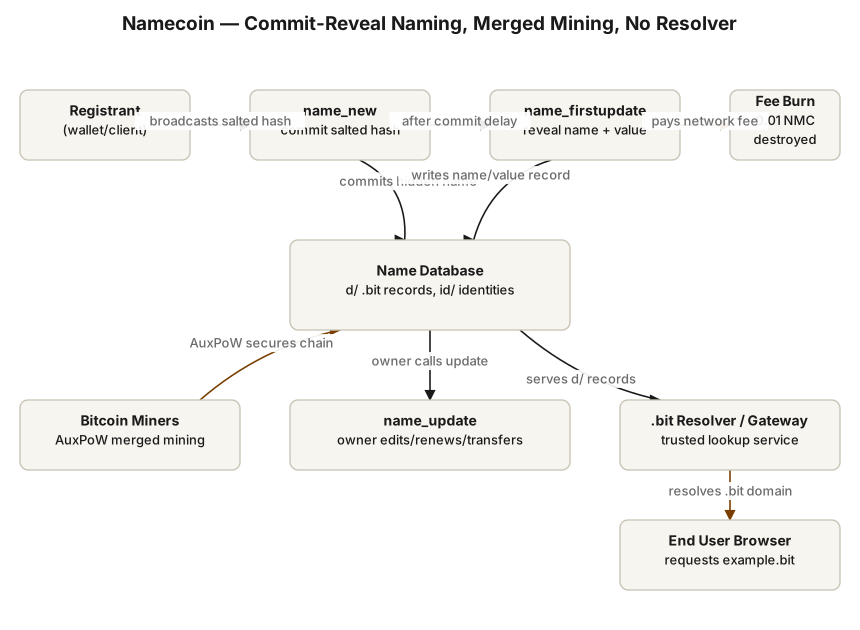 Open full-size diagram
Summary
Namecoin is the original "Bitcoin, but for something other than money" experiment. Announced on Bitcointalk on April 18, 2011 by the pseudonymous developer "vinced" (using the alias "Vincent Durham"), it was the first fork of Bitcoin's codebase, the first altcoin of consequence, and the first attempt to use a blockchain as a general key/value registry rather than a ledger of payments. Its flagship use case was decentralized DNS: names registered under the d/ namespace resolve as .bit domains that no registrar, ICANN, or government can seize or censor. The idea descends directly from the December 2010 "BitDNS" thread on Bitcointalk, in which Satoshi Nakamoto himself discussed how naming could piggyback on Bitcoin's proof-of-work — the discussion that produced merged mining, which Namecoin was the first chain to activate (block 19,200, October 2011). Namecoin is frequently credited as the first practical solution to Zooko's Triangle: names that are simultaneously secure, decentralized, and human-readable. Fifteen years later the chain still runs, but .bit never achieved meaningful use.
Design (Mechanism)
Namecoin is a near-verbatim Bitcoin fork — SHA-256 proof of work, 10-minute blocks, 21 million coin cap — extended with native name operations:
name_new— a commit-reveal first step: the registrant broadcasts a salted hash of the desired name. Because the name itself is hidden, miners and mempool watchers cannot front-run the registration.name_firstupdate— after a delay, the registrant reveals the name and its value (e.g., DNS records as JSON), completing first-come-first-served registration. A small network fee (0.01 NMC in the mature protocol) is destroyed rather than paid to anyone — an early instance of fee burning as an anti-spam sink with no rent-collecting registrar.name_update— changes the value, transfers ownership to another key, or renews the name. Names expire after 36,000 blocks (roughly 200–250 days) if not renewed, recycling abandoned entries.
Names live in namespaces by convention: d/example maps to example.bit; id/ holds identity records (GPG keys, email, Bitcoin addresses). Resolution is local — a full node holds the whole name database, so lookups generate no network traffic, a genuine privacy improvement over DNS. Merged mining (AuxPoW) let Bitcoin miners commit to Namecoin blocks inside the work they were already doing, giving the small chain rented security from Bitcoin's hashrate instead of competing for it.
Outcome
Technically, remarkably durable: the chain launched in April 2011 has run continuously ever since, and its inventions — merged mining, commit-reveal name registration, fee burning, expiry-based renewal — became standard equipment in later systems (ENS's commit-reveal and renewal model is a direct descendant). Commercially and socially, it failed to find users. The definitive 2015 Princeton study (Kalodner, Carlsten, Ellenbogen, Bonneau, Narayanan) found that of roughly 120,000 registered .bit names, only 28 carried non-trivial, non-squatted content; the secondary market was almost nonexistent, and at the time of the study a single mining pool controlled a majority of Namecoin's merged-mined hashrate, undermining the security story. In October 2013 developer Michael Gronager disclosed a protocol flaw that allowed updating names you didn't own; it was demonstrated on bitcoin.bit as a proof of concept and patched. .bit never obtained mainstream resolver support — browsers required plugins or trusted gateways — and in July 2019 OpenNIC, the main alternative-DNS root that had resolved .bit, voted to drop it after .bit domains became a favored home for malware command-and-control. NMC persists as a low-liquidity legacy asset; a small volunteer team (notably Jeremy Rand) continues development.
Why it worked
- Right abstraction, first: it correctly generalized Bitcoin from "ledger of coins" to "ledger of scarce named records," creating the template for every on-chain naming and identity system since.
- Merged mining solved bootstrap security elegantly: a niche chain inherited hashrate from Bitcoin miners at near-zero marginal cost.
- Anti-front-running by construction: the
name_new/name_firstupdatecommit-reveal scheme anticipated, by years, an attack class most later systems learned about the hard way. - Honest fee design: burning registration fees meant no privileged registrar and no misaligned fee recipient.
Why it failed or underperformed
- No resolution path to users: a name nobody's browser can resolve is a collectible, not infrastructure. Namecoin never solved last-mile integration (OS resolvers, browsers), and lightweight trusted gateways reintroduced the centralization it existed to remove.
- First-come-first-served with near-zero fees invited mass squatting: ~99.98% of registered domains were parked or empty. Scarcity pricing was absent, so the namespace filled with lottery tickets instead of websites.
- Security economics of a small chain: majority control by one merged-mining pool showed that rented hashrate concentrates; the 2013 name-theft bug showed the consensus-critical surface area of custom transaction types.
- Demand mismatch: censorship-resistant DNS is a narrow need, and its actual paying customers turned out to include botnets and malware — which got
.bitdelisted from the one resolver federation that carried it. - No sustaining ecosystem: no treasury, no token utility beyond fees, and a tiny volunteer team against a problem (replacing DNS) that demands enormous coordination.
Lessons
- A naming system's value is set by its resolvers, not its registry. Distribution into browsers/OSes is the product; the chain is the easy part.
- First-come-first-served plus trivially cheap registration guarantees a squatter-dominated namespace; later systems (ENS) added meaningful annual rent and auctions for short names for exactly this reason.
- Merged mining transfers hashrate but also transfers — and concentrates — miner power; security you rent can be pointed at you.
- Commit-reveal registration and fee burning were correct on the first try in 2011 and have been re-derived by nearly every successor; primitives outlive the projects that invent them.
- Censorship resistance is dual-use: design for abuse economics (malware, C2 domains) before your only distribution partner is forced to drop you.
Redesign (EDITORIAL — hypothesis, not fact)
This section is editorial speculation, not historical fact. A modern Namecoin would keep the commit-reveal + expiry core but change the economics and distribution. Price names with demand-sensitive recurring rent (burned), plus Vickrey auctions for expiring and premium names, to make squatting carry real cost. Ship resolution as a compact, verifiable light-client artifact — signed state proofs of the name trie that a browser extension or OS stub resolver can check without trusting a gateway — because Namecoin's fatal gap was the last mile, not the ledger. Rather than an independent merged-mined chain, deploy as a rollup or validium inheriting L1 security directly, removing the mining-pool concentration failure mode. Finally, treat abuse as a first-class design constraint: resolver-side reputational filtering (freely forkable lists, not protocol-level censorship) so infrastructure partners can carry the TLD without carrying its botnets.
Sources
- Namecoin official website and documentation — primary (docs)
- [announce] Namecoin - a distributed naming system based on Bitcoin (vinced, Bitcointalk, April 2011) — primary (archive)
- Original vinced/namecoin source repository — primary (contract)
- BitDNS and Generalizing Bitcoin (Bitcointalk thread with Satoshi Nakamoto, Dec 2010) — primary (archive)
- An Empirical Study of Namecoin and Lessons for Decentralized Namespace Design (Kalodner et al., WEIS 2015) (analysis)
- Namecoin — Wikipedia (history, 2013 vulnerability, OpenNIC delisting) (archive)
Related experiments
Last verified: 2026-07-27 · Spot an error? Suggest a correction