RAI
A non-pegged, ETH-only stable asset whose target (redemption) price floats and is steered by an autonomous on-chain PID controller instead of a fixed dollar peg.
▶ Run interactive simulation animated mechanism with editable parameters
How it works onchain
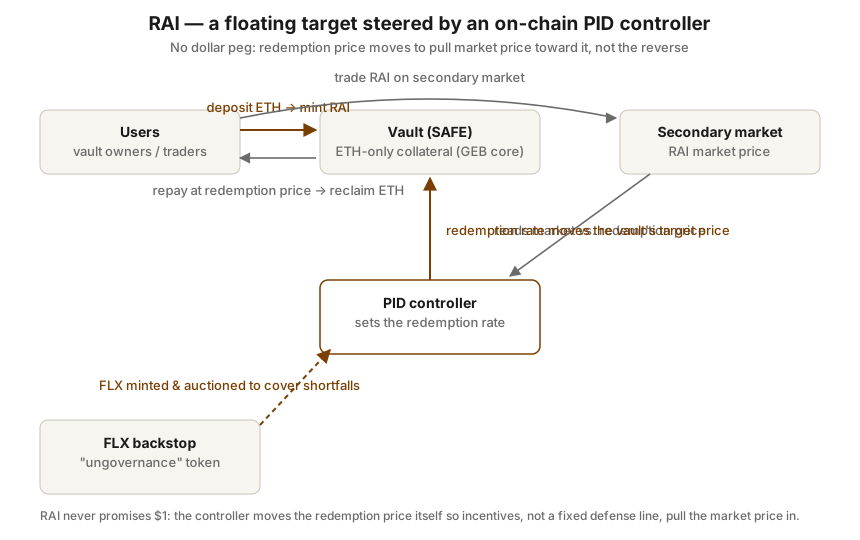 Open full-size diagram
Summary
RAI (the "Rai Reflex Index") is a decentralized stable asset built by Reflexer Labs and launched on Ethereum mainnet on 17 February 2021. It is deliberately not pegged to the US dollar or any fiat unit. Instead, RAI aims to be a low-volatility asset relative to its own collateral (ETH), with its own floating "redemption price" set by an autonomous on-chain controller rather than by a promise to redeem for $1. RAI is minted only against ETH collateral via over-collateralized vaults (a fork/derivative of MakerDAO's MCD/GEB architecture), making it a maximally simple, single-collateral, governance-minimized alternative to DAI. The founding thesis, articulated by Stefan Ionescu in "Stability without Pegs" (April 2020) and motivated by MakerDAO's "Black Thursday" failure in March 2020, was that a pegged coin inherits the fragility of its peg, whereas a coin that manages a float can dampen collateral volatility while remaining fully decentralized and censorship-resistant.
Design (Mechanism)
RAI's core innovation is separating two prices:
- Market price — where RAI trades on secondary markets.
- Redemption price — the protocol's internal target, i.e. how much a vault owner must repay per RAI and the value used to compute collateralization.
An on-chain PID controller (proportional–integral–derivative, though in practice it launched and largely ran as a proportional / P-only controller) continuously measures the deviation between market price and redemption price and sets a redemption rate — a rate of change applied to the redemption price. If RAI trades above the redemption price, the controller lowers the redemption price over time (a negative redemption rate), making it cheaper to mint RAI and incentivizing borrowers to sell, pushing the market price down. If RAI trades below, the controller raises the redemption price, rewarding holders and discouraging minting. This is a negative-feedback control loop borrowed from classical control theory: the system doesn't defend a fixed number, it nudges incentives so market and redemption prices converge, absorbing shocks by moving the target itself.
Collateral is ETH only, keeping the risk surface minimal. Governance was handled by the FLX "ungovernance" token, whose explicit purpose was the opposite of most governance tokens: to progressively remove human control. FLX also served as a backstop/lender-of-last-resort (it can be minted and auctioned to recapitalize the system in a shortfall). Reflexer publicly committed to "ungoverning" the controller — freezing its parameters so no team or DAO could steer monetary policy — with community debate through 2022 over how much residual flexibility (bands vs. fully immutable) to retain.
Outcome
Technically, RAI worked as designed. It launched, maintained a coherent managed float for years, survived market stress without a de-peg-style collapse (it has no peg to break), and demonstrated in production that an autonomous controller could stabilize a floating stable asset. Vitalik Buterin and others cited RAI as the canonical example of an "ideal" governance-minimized, ETH-backed stable asset.
Commercially, RAI never achieved meaningful scale. Its total value locked peaked under roughly $100M and declined thereafter; it captured a tiny sliver of stablecoin demand dominated by USDC, USDT, and DAI. Because the redemption price drifts persistently, over time it moved well away from its ~$3.14 (pi) launch reference — by 2026 the redemption/market price sits around the ~$3 range — which is intellectually coherent but confusing for users who expect "$1." Reflexer proceeded with ungovernance, minimizing team control over the controller, which cemented its credibly-neutral design but also removed the ability to aggressively market, integrate, or grow the asset. RAI remains live on Ethereum (contract 0x03ab458634910AaD20eF5f1C8ee96F1D6ac54919) as a small, functioning, largely autonomous system rather than a mainstream money.
Why it worked
- Sound control-theory foundation. Treating stability as a feedback-control problem (rather than a peg to defend) is robust: there is no fixed line for an attacker or a bank run to break.
- Radical simplicity. ETH-only collateral and a small, auditable contract surface minimized attack vectors and made the risk model legible.
- Genuine decentralization. No fiat backing, no off-chain redemptions, no censorable reserve — RAI is one of the few stable assets that is trust-minimized end to end, and its ungovernance roadmap made that credible rather than aspirational.
Where the design broke
- Product-market fit against "$1" expectations. The vast majority of stablecoin demand wants a unit that reads as one dollar for accounting, payments, and mental math. A floating, drifting target is a hard sell no matter how elegant.
- Ungovernance vs. growth tension. Deliberately removing the team's levers is philosophically pure but strategically limiting — it forecloses rapid iteration, aggressive integrations, and incentive campaigns that competitors used to bootstrap liquidity.
- Weak network effects and integrations. Stablecoins win via ubiquity (exchange listings, DeFi collateral slots, liquidity depth). RAI's small footprint and non-standard denomination kept it out of the flywheel that USDC/USDT/DAI enjoyed.
- Monetary drift reduces usability. The persistent redemption-price change means holding RAI is not "holding a dollar"; its behavior over long horizons is unfamiliar and hard to reason about for ordinary users and treasuries.
Lessons
- Correctness is not adoption. RAI proved an autonomous PID-controlled float can be stable and decentralized — yet mechanism elegance does not overcome the market's overwhelming preference for a $1 unit of account.
- Decentralization maximalism has a growth cost. Pre-committing to remove governance improves neutrality and credibility but sacrifices the agility (integrations, incentives, parameter tuning) needed to win a network-effects market.
- Denomination is a UX decision, not just a monetary one. Fighting the "$1" mental model imposes a permanent friction tax on every integration, quote, and accounting entry.
- A stable reference asset ≠ a stable medium of exchange. RAI may be valuable as a low-volatility building block or collateral primitive even where it fails as everyday money — matching the mechanism to the right use case matters.
Redesign (EDITORIAL — hypothesis, not fact)
The following is speculative analysis by the researcher, not established fact.
A redesign would try to keep RAI's control-theoretic core while attacking its two biggest liabilities — the "$1" expectation and the growth-vs-neutrality trade-off:
Ship two skins over one engine. Keep the autonomous float as the base primitive, but expose a derivative wrapper that markets as a dollar-denominated product (e.g. a vault or AMM strategy that quotes users in USD terms while the underlying reserve remains the neutral floating asset). Users get familiar "$1" ergonomics; the credibly-neutral engine stays untouched underneath.
Lean into RAI as collateral, not currency. Position it explicitly as a low-volatility collateral primitive for other protocols (leverage, LST-backed lending, structured products) where its ETH-relative stability and censorship resistance are the actual selling points, rather than competing head-on for payment/unit-of-account demand it cannot win.
Phase ungovernance instead of front-loading it. Preserve neutrality as the destination but retain a time-boxed, transparently-scoped ability to tune the controller (integral term, gain, collateral onboarding) during a bootstrap window, with an on-chain sunset that hands over to immutability once liquidity and integrations reach escape velocity.
Deploy natively to L2s and app-chains. The original mainnet-only, gas-heavy footprint throttled small-value usage; a modern rollout would seed RAI where DeFi activity and cheap transactions now live, improving the odds of the liquidity flywheel that RAI historically never lit.
Sources
- Reflexer Finance official site — primary (docs)
- GEB / Reflexer documentation — primary (docs)
- Stability without Pegs (Stefan Ionescu, founding thesis) — primary (retrospective)
- Rai Reflex Index (RAI) token contract — Etherscan — primary (contract)
- RAI Controller Ungovernance — Reflexer community forum — primary (governance)
- ETH Lite: Reflexer Labs Raises $1.7M — CoinDesk (news)
- Reflexer Labs Launches FLX 'Ungovernance' Token for RAI — BeInCrypto (news)
- Reflexer Launches Alternative to Ethereum Stablecoin DAI, Called RAI — Decrypt (news)
Related experiments
Last verified: 2026-07-26 · Spot an error? Suggest a correction