Fake World Assets
An onchain, verifiably-random NFT gacha protocol by TokenWorks where depositors back NFTs with ETH and buyers pay a pool-derived price to pull a random position, parodying the Real World Assets (RWA) narrative.
▶ Run interactive simulation animated mechanism with editable parameters
How it works onchain
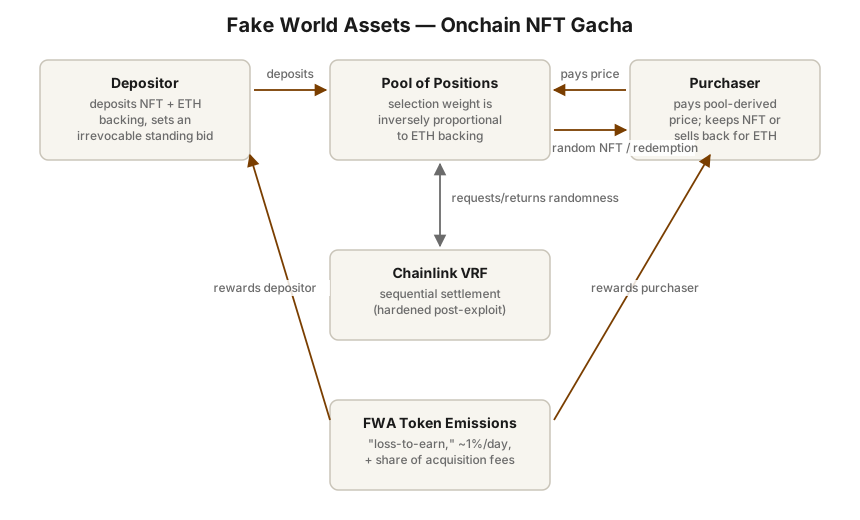 Open full-size diagram
Summary
Fake World Assets (FWA) is an Ethereum protocol built by TokenWorks that turns illiquid NFTs into a fully onchain, verifiably-random "gacha" (loot-box) marketplace. Its name is a deliberate parody of the Real World Assets (RWA) narrative pushed by VCs: instead of tokenizing bonds or real estate, FWA financializes JPEGs — "fake world assets." Depositors list an NFT together with committed ETH backing (functioning like one side of a Uniswap V2-style pair), and any buyer can pay a pool-derived price to receive one randomly selected NFT position. The buyer then chooses to either keep the NFT or accept the depositor's standing bid and sell it back for most of its ETH backing.
The protocol is run by a self-funded two-person team — Adam (@Rhynotic, also known as Adam Lizek) and Teto (@tetonotsorry) — with no VC funding, and sits alongside their other TokenWorks experiments PunkStrategy ($PNKSTR) and Ten Thousand Tokens. FWA first launched in early July 2026, suffered a Chainlink callback exploit on July 3, 2026 that drained a CryptoPunk, and relaunched on July 20, 2026. Within four days of relaunch it reportedly flipped Solana's Collector Crypt in 24-hour revenue, moving roughly 2,000 ETH across ~90,000 transactions. The FWA token (contract 0xa0df17b5ac76ababa36e1450e2cbcd18a620c845, 1B supply) traded around a ~$28–36M FDV at time of research.
Design (Mechanism)
The protocol has three roles: depositors, purchasers, and the protocol itself.
- Depositors contribute an NFT plus an amount of ETH backing. The backing determines the position's selection weight and funds an irrevocable standing bid to reacquire their own NFT. Selection probability is inversely correlated with backing: lightly-backed NFTs are more likely to be pulled, so backing acts as a lever between "I want to keep exposure" and "I'm happy to sell."
- Purchasers pay a pool-derived acquisition price and receive one randomly selected NFT position. Randomness is supplied by Chainlink VRF, and (post-exploit) requests settle sequentially to prevent callback-timing manipulation.
- After a pull, the purchaser must choose: keep the NFT, or accept the depositor's standing bid and sell it back for most of its ETH backing (payable in ETH or FWA-equivalent). "You can never keep both."
The FWA token is a reward/incentive token that "pays both sides for showing up early and ties the protocol's revenue to buy pressure." It compensates depositors and purchasers via emissions (documented as ~1% of daily supply through August 4, a "loss-to-earn" model) plus a share of acquisition fees. Protocol revenue comes from bounded fees on the spread between NFT value, ETH backing, and participant choices. Because depositors risk their NFT being pulled before fee accrual compensates them, the docs explicitly warn of loss risk — the "loss-to-earn" framing.
Outcome
Status: ongoing (too early for a durable verdict, but with a live commercial signal).
- Early exploit (July 3, 2026): An attacker front-ran the Chainlink callback, altering protocol state before the callback finalized to control which NFT was selected. Chainlink's randomness itself was not broken — the flaw was a state-manipulation/timing window. CryptoPunk #5450 (the pool's highest-value asset, ~$66k in ETH) was lost. The team suspended trading, moved the protocol to withdraw-only at block 25452023, snapshotted holders, contacted the Punk's owner, and committed to covering the loss.
- Relaunch (July 20, 2026): Hardened design with sequential VRF settlement. Within four days it reportedly surpassed Collector Crypt in 24-hour revenue, with ~2,000 ETH volume, ~90,000 total transactions and ~35,000 purchases. The FWA/ETH pair (Uniswap V4) showed multi-million-dollar daily volume.
Because the relaunch is only days old at time of research, longevity, emission sustainability, and post-emission demand are unproven.
Why it worked
- Sharp, meme-native positioning. "Fake World Assets" as an anti-RWA parody is instantly legible on Crypto Twitter and gives the protocol distribution that a dry "NFT liquidity primitive" would never get.
- Real utility on top of a joke. Beneath the meme it solves a genuine problem — NFT illiquidity — by making the protocol itself the counterparty, so any pooled NFT has an instant, backing-derived exit.
- Gacha psychology + verifiable fairness. Randomized pulls tap loot-box dopamine while Chainlink VRF makes the randomness auditable, differentiating it from opaque centralized mystery boxes.
- Aligned early incentives. FWA emissions paying both sides for early participation bootstrapped liquidity and volume fast, tying token value to genuine buy pressure rather than pure farming.
- Credible builders. The same team's PunkStrategy ($PNKSTR) had already reached a ~$150M peak, lending reputation and a warm audience.
Limitations and criticisms
- A real exploit happened. The July 3 callback front-running cost a $66k CryptoPunk and forced a full withdraw-only halt and relaunch — a serious security black mark for a randomness-dependent protocol.
- Emission-driven metrics. The headline "flipped Collector Crypt" numbers coincide with aggressive FWA emissions (~1%/day). Volume juiced by token rewards may not persist once emissions taper.
- Structural loss risk for depositors. The "loss-to-earn" model means depositors can lose their NFT before fees/rewards make them whole; sustained deposit supply is not guaranteed.
- Narrative fragility. A gacha/loot-box mechanic riding a meme is subject to the same reputational volatility that killed prior NFT-financialization fads once attention moves on.
Lessons
- Distribution can be a mechanism. A precise cultural parody (anti-RWA) is not decoration — it was arguably the biggest driver of adoption, outperforming better-capitalized competitors on attention.
- Verifiable randomness is necessary but not sufficient. Chainlink VRF guaranteed unbiased draws, yet the integration (callback timing / state mutation before finalization) was the exploitable surface. Randomness security lives in the settlement flow, not just the RNG.
- Ship the fix as a relaunch, own the loss. Covering the lost Punk and re-architecting to sequential settlement converted a hack into a credibility event rather than a death sentence — transparent postmortem behavior mattered.
- Emission-fueled leaderboards need an asterisk. "Flipped competitor X in revenue" days after launch, during peak emissions, is a marketing metric, not proof of durable product-market fit.
Redesign (EDITORIAL — hypothesis, not fact)
The following is the researcher's editorial hypothesis, not established fact.
If I were redesigning FWA for durability rather than launch velocity, I would attack three weak points: emission dependence, depositor loss risk, and randomness-integration security.
Convert emissions into a decaying, fee-anchored floor. Rather than a flat ~1%/day emission that creates a cliff, tie FWA rewards to a moving average of real acquisition-fee revenue, so incentives auto-throttle as organic volume rises. This keeps the token's value proposition ("revenue tied to buy pressure") honest after the farm ends.
Give depositors optional insurance / tranching. Let depositors buy into a shared backstop pool (funded by a fee slice) that partially compensates the "pulled too early" case, or offer senior/junior deposit tranches so risk-averse suppliers can accept lower FWA yield for a higher retained-backing guarantee. This should deepen and stabilize NFT deposit supply — the protocol's true scarce resource.
Commit-reveal + batched VRF settlement as a first-class invariant. Beyond sequential settlement, require that acquisition price and selection are committed before VRF fulfillment is observable, with a formally-verified guarantee that no state mutation between request and callback can change the selected position. Pair with a public bug-bounty and a re-audit specifically of the callback path.
Add a transparent fairness guardrail. Optional per-wallet cooldowns/limits and a clear expected-value display per pull would reduce reputational risk while preserving the gacha thrill — turning a fad-risk into a more durable, trustworthy product.
The through-line: FWA won the attention game on day one; the redesign is about surviving the second and third months once the meme and the emissions both cool.
Sources
- Fake World Assets — official site — primary (docs)
- How it works | Fake World Assets docs — primary (docs)
- TokenWorks — studio site — primary (docs)
- FWA token contract (Etherscan/CoinGecko listing) — primary (contract)
- Chainlink Callback Exploit Hits TokenWorks, CryptoPunk Lost (news)
- Token Works' Fake World Assets surpasses Collector Crypt in revenue (news)
- Adam (@Rhynotic) announcement of Fake World Assets — primary (analysis)
Related experiments
Last verified: 2026-07-26 · Spot an error? Suggest a correction