CMD
A TokenWorks onchain game ('TenCommandements') in which the community collaboratively mutates a live ERC-20 across 10 randomized rounds — each round a paid prompt is picked by Chainlink VRF and patched into the contract — turning token design itself into the game.
▶ Run interactive simulation animated mechanism with editable parameters
How it works onchain
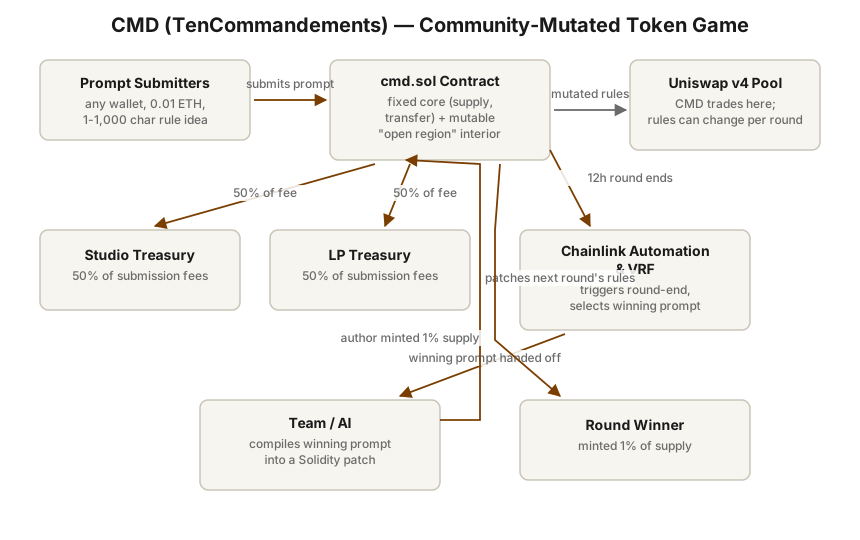 Open full-size diagram
Summary
CMD (full name TenCommandements, symbol CMD) is an experiment from TokenWorks, the Ethereum "playground for onchain financialized ideas" run by developer Adam Lizek (known onchain as Rhynotic). Its GitHub repository, token-works/cmd, carries the one-line description "The people contract." The premise is a game about token design: instead of a team shipping a finished ERC-20, the community writes the token into existence over ten rounds. Each round, any wallet can submit a natural-language "prompt" — a rule idea such as "no trading on weekends" or "add a 1% tax that buys and burns every 24h" — for 0.01 ETH. One submitted prompt per round is selected at random via Chainlink VRF, then applied by the team (with AI assistance translating the prompt to Solidity) to produce the next version of the contract. The author of each winning prompt is minted 1% of total supply. After the tenth round, gameCompleted flips to true and the resulting Frankenstein contract becomes permanent. CMD launched participation on 10 April 2026 on Ethereum mainnet. It fits TokenWorks' pattern of turning a piece of onchain infrastructure into a spectacle — here, the spectacle is watching a token's own ruleset mutate live.
Design (Mechanism)
The repository ships three files: README.md, the main contract cmd.sol, and a supporting cmdHook.sol (a Uniswap v4 hook, consistent with other TokenWorks launches). Per the official rules:
- Fixed identity, mutable body. Token identity, total supply, and the ERC-20 core (
transfer,approve,transferFrom,totalSupply) are locked by design. Only designated "open regions" — custom state, transfer policies, taxes, and helper functions — can be changed by winning prompts. This is the central design idea: a contract with a hard, immutable skeleton and a soft, community-defined interior. - Rounds. Exactly 10 rounds, each lasting 12 hours.
- Submission. Any wallet submits a prompt (1–1,000 characters) for 0.01 ETH. The fee splits 50% to the TokenWorks treasury / 50% to an LP (liquidity) treasury.
- Selection. Chainlink Automation triggers end-of-round settlement, which requests randomness from Chainlink VRF; a winning index is derived from the returned random word, choosing one submitted prompt.
- Prize / emission. The winning prompt's author is minted 1% of total supply for that round. Across ten rounds this emits ~10% of supply to winners; the remainder is minted to the deployer at launch and seeded into liquidity.
- Finality. After round 10, the game closes permanently and no further mutations occur.
Actor/value flow: prompt-submitters pay ETH → split to studio + LP treasuries; Chainlink supplies verifiable randomness and automation; the team/AI compiles the winning prompt into a new contract version; winners receive supply; traders hold/trade CMD on a Uniswap v4 pool whose behavior can literally change round to round as new taxes and transfer policies are voted in by chance. Note the metrics discrepancy across sources on total supply — the README/rules snapshots variously reference a 1,000,000,000 vs. 10,000,000,000 fixed supply; the fraction-based mechanics (1% per winner, ~10% to participants) are consistent regardless, but the exact integer supply should be treated as unconfirmed pending the verified onchain contract.
Outcome
too_early_to_judge. CMD is a recent, deliberately bounded experiment. It launched 10 April 2026 with a clear, self-terminating structure (10 rounds × 12 hours ≈ 5 days of active play), and it demonstrably functioned as a TokenWorks primitive: by the time of the studio's later mint campaigns, "holding CMD" appeared as an eligibility tier for allocation alongside PNKSTR and S01/S02 NFTs (per Rhynotic's own announcement), which is evidence the token shipped, distributed, and was integrated into the studio's ecosystem. Beyond that, hard outcome data is thin: the live leaderboard did not resolve at time of research, so the final winning prompts and the exact end-state of the mutated contract could not be confirmed, and no verified mainnet contract address could be located. Public price aggregators (CoinGecko/CoinMarketCap) do not track this specific CMD, consistent with a small, niche experiment rather than a broad market. Importantly, the July 2026 Chainlink-callback exploit widely associated with TokenWorks hit a different product — Fake World Assets (FWA) — not CMD; CMD is not named in any exploit reporting, though it does share the studio's reliance on Chainlink randomness. Market cap, volume, participant count, and treasury figures were not found and should be treated as Unknown.
Why it worked
- Legible, self-contained game loop. A fixed 10-round, 12-hour cadence with a clear entry price and a clear prize (1% of supply) is easy to understand and creates natural, time-boxed attention spikes.
- Novelty as distribution. "A token whose rules are written by strangers, one dice roll at a time" is a genuinely new spectacle; it converts the usually invisible act of contract design into content, which suits TokenWorks' audience.
- Credible operator with built-in demand. Rhynotic/TokenWorks had an existing, engaged following and a track record of shipping (PunkStrategy, NFTStrategy, btc/acc), plus cross-project utility (CMD as a mint-allocation tier), giving the launch warm rather than cold-start demand.
- Provable fairness. Using Chainlink VRF for selection makes the "which prompt won" question tamper-resistant and verifiable, which matters when real ETH is staked on random selection.
Where the design broke
- Randomness is not curation. Because winners are picked at random from paid submissions, the resulting contract is a lottery of ideas, not a design — adversarial or self-serving prompts (e.g., taxes routed to the submitter) can win purely by chance, and there is no quality filter beyond the 0.01 ETH toll.
- Trust bottleneck in the middle. The winning prompt is applied by the team (AI-assisted), not autonomously by the contract. That human/AI compilation step is unverifiable to players and reintroduces exactly the centralization the "the people contract" framing rhetorically removes.
- Ephemeral by construction. A 5-day, self-terminating game produces a frozen artifact, not a living product; attention and liquidity have little reason to persist after round 10, which caps durable value.
- Shared systemic risk. The studio's Chainlink-callback exploit on FWA showed how VRF/automation-dependent TokenWorks designs can be front-run or manipulated; CMD's dependence on the same primitives is a latent risk even though CMD itself was not exploited.
Lessons
- Making the mechanism itself the game is a real primitive. "Mutate the contract as content" is a novel and repeatable idea — but it only produces good tokens if selection rewards quality, not just payment plus luck. Pay-to-submit + random-pick optimizes for spectacle, not design.
- "The people contract" needs the people (or the code) to actually hold the pen. If a human/AI team compiles winning prompts off-contract, the decentralization is theatrical. A stronger version would apply changes trustlessly (constrained, on-chain-executable rule modules) so no privileged party can reinterpret a prompt.
- Immutable skeleton + mutable interior is a genuinely useful pattern. Locking supply and the ERC-20 core while exposing bounded "open regions" (tax, transfer policy, helper state) is a clean, generalizable way to let a contract evolve without letting it rug — worth reusing even outside a game.
- Self-terminating experiments trade durability for clarity. A hard 10-round end date makes the game easy to reason about and safe to bound, but guarantees the result is a collectible artifact, not a going concern — pick the format that matches the goal.
Redesign (EDITORIAL — hypothesis, not fact)
The following is analysis and speculation, not reported fact.
The most interesting failure mode in CMD is the gap between the "the people contract" narrative and the reality that a team hand-applies the winning prompt. A redesign would close that gap by making rule changes trustlessly executable. Instead of free-text prompts compiled by AI, players would submit from a constrained module library — parameterized, pre-audited rule primitives (buy/burn tax rate, transfer cooldown, max-wallet, LP-fee routing) whose parameters are the only free variables. Chainlink VRF still picks a winner, but the winning module is applied directly by the contract, eliminating the human compilation step and the manipulation surface it creates.
To fix "randomness rewards spam," I'd replace pure random selection with quadratic or stake-weighted signaling on top of VRF: submitters (or a broader holder set) signal support for candidate prompts, VRF then samples from the top-signaled subset. This keeps provable fairness while filtering out obviously adversarial rules, so the emergent contract reflects some collective taste rather than raw luck. I'd also make the 1%-per-round emission vest for winners to discourage grief-prompting purely to farm supply.
Finally, to give the artifact life after round 10, the frozen contract could ship with a permanent, minimal "amendment" governance module (a New Testament to the Ten Commandments) — a high-quorum, time-locked path for holders to make bounded changes later — converting a five-day spectacle into a small, genuinely community-owned token. Given the July 2026 FWA exploit, any such redesign should also harden the VRF/automation path against callback front-running (commit-reveal on submissions, callback-source checks) before real value depends on it. All of this is hypothesis; none of it is claimed to reflect TokenWorks' actual plans.
Sources
- token-works/cmd — 'The people contract' (Solidity: cmd.sol, cmdHook.sol, README) — primary (contract)
- CMD / TenCommandements official game rules — primary (docs)
- CMD / TenCommandements site (leaderboard, rules, claim, 'new-testament') — primary (docs)
- TokenWorks official studio site (links X @token_works, GitHub token-works, Farcaster) — primary (docs)
- Rhynotic (Adam Lizek) mint-allocation tweet listing 'holding CMD' as an eligibility tier — primary (governance)
- Tekedia — 'TokenWorks Announces CMD Token which Uses Randomized Frankenstein Approach' (news)
- BanklessTimes — Chainlink callback exploit hits TokenWorks (FWA, not CMD) (news)
Related experiments
Last verified: 2026-07-26 · Spot an error? Suggest a correction