TokenStrategy
A permissionless launchpad from TokenWorks that lets anyone deploy autonomous, self-consuming 'Strategy' tokens whose 10% trading fee is routed on-chain via a Uniswap v4 hook into a buy-and-burn/asset-accumulation flywheel.
▶ Run interactive simulation animated mechanism with editable parameters
How it works onchain
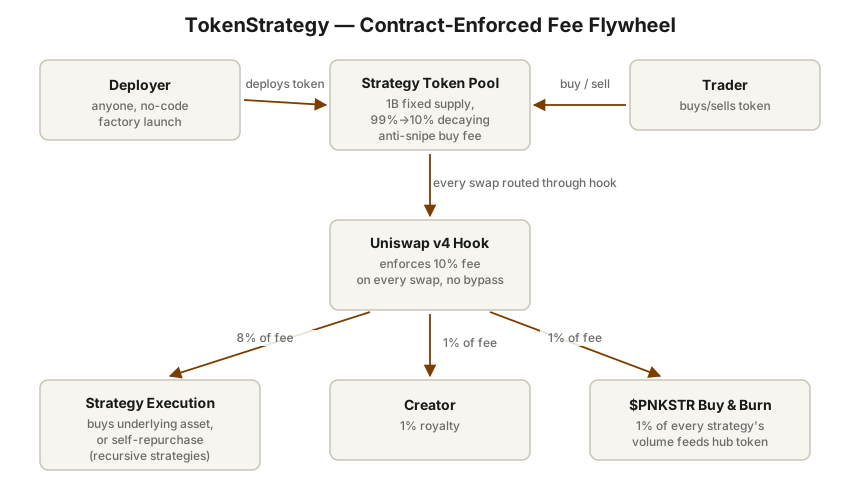 Open full-size diagram
Summary
TokenStrategy is a permissionless, no-code launchpad from the pseudonymous dev studio TokenWorks that generalizes the "Strategy token" pattern the studio pioneered with PunkStrategy ($PNKSTR) in September 2025. It went live for public launches on December 2, 2025 on Ethereum mainnet. Every token deployed through TokenStrategy carries a 10% trading fee enforced at the contract level via a custom Uniswap v4 hook, and that fee is programmatically split and recycled into a self-reinforcing "flywheel": part of it accumulates an underlying asset (or repurchases the token itself), part pays the creator, and part buy-and-burns the ecosystem token $PNKSTR. The stated design goal is autonomy: strategies run "fully on-chain, independent of oracles" and are meant to keep functioning "as long as the underlying blockchain runs." The platform supports four strategy categories: ERC-721 (NFT), ERC-1155, ERC-20 (fungible), and a net-new "Recursive" category with no underlying asset.
Design (Mechanism)
The core primitive is a contract-enforced trading fee implemented as a Uniswap v4 hook, so the fee cannot be bypassed — every swap must pay it for the transaction to execute. Per the official docs, the 10% resting fee on a standard strategy token is split:
- 8% → the token contract itself, to execute its Strategy (e.g., buy the underlying NFT / batch of ERC-20s, or, for recursive strategies, repurchase the token).
- 1% → the creator / asset owner as royalties.
- 1% → buy-and-burn of $PNKSTR, the ecosystem token that ties all strategies together.
Tokens are fair-launched with a fixed supply of 1,000,000,000 and seeded into a liquidity pool. An initial 99% buy fee decays to the 10% resting fee to deter snipers at launch.
Strategy types:
- NFT strategies (ERC-721 / ERC-1155): accumulated fees buy a target collection's assets. The original PunkStrategy "Perpetual Punk Machine" bought the cheapest CryptoPunk, relisted it at a premium (~1.2x), and buy-and-burned tokens on sale.
- Fungible strategies (ERC-20): fees accumulate a target ERC-20.
- Recursive strategies: "net-new assets that buy themselves." With no underlying asset, the docs specify the fee split as 8% future self-repurchases, 1% creator royalties, 0.8% $PNKSTR burn, and 0.2% to TokenWorks; accrued fees are deployed roughly every 30 minutes to buy-and-burn the strategy token. Deploying a recursive strategy costs 0.01 ETH (0.008 ETH to burns, 0.002 ETH to TokenWorks).
$PNKSTR (contract 0xc50673EDb3A7b94E8CAD8a7d4E0cD68864E33eDF) is the shared ecosystem token; its contract is described as fully renounced. TokenStrategy fees across the ecosystem create continuous buy-and-burn pressure on it, positioning $PNKSTR as the value-capture layer for the whole launchpad.
Outcome
Status: too_early_to_judge. TokenStrategy launched publicly on December 2, 2025 — roughly seven months before this entry's verification date. The precursor $PNKSTR (Sept 2025) demonstrated real market traction and is actively traded on Uniswap v4 with live CoinGecko/GeckoTerminal listings, and TokenWorks shipped named strategies (PNKSTR, and references to APESTR, PUDGYSTR, REKT) that validated the flywheel mechanically. TokenStrategy generalizes this into a permissionless factory. However, comprehensive, independently verified metrics on how many strategies have been deployed, aggregate TVL/volume, or survivorship of individual strategy tokens were not found as primary data at the time of writing, so a durable success/failure verdict cannot yet be rendered.
Why it worked
- Contract-enforced fees close the leakage that kills most fee-funded tokens. By embedding the fee in a Uniswap v4 hook rather than a transfer tax that DEX routers evade, the flywheel actually collects on every swap.
- Oracle-free, renounced, autonomous design minimizes trust surface and operational dependency — the mechanism keeps running without a team pressing buttons, which is attractive in a market skeptical of admin keys.
- A proven template. PunkStrategy showed the "buy-the-asset, relist, buy-and-burn" loop could bootstrap demand and a recognizable brand; TokenStrategy productized that into a repeatable, no-code launchpad — lowering the barrier from "build a bespoke contract" to "deploy in a few clicks."
- Ecosystem token as shared value sink. Routing 1% of every strategy's volume into $PNKSTR burns gives every new launch a reason to reinforce the hub token, aligning incentives across otherwise independent tokens.
Where the design broke
(Editorial caution: it is too early to call this a failure; these are structural risks, not confirmed outcomes.)
- Reflexivity with no external cash flow. "Recursive strategies" that buy themselves have no external cash flow; their price is sustained purely by trading volume feeding back into buybacks. When volume dries up, the flywheel stalls and the buy pressure vanishes — a well-known failure mode for self-referential fee tokens.
- Permissionless launchpads attract a long tail of low-effort deployments. Opening deployment to everyone means many strategies go unmaintained or fail to sustain volume, which can dilute brand trust, as happened with prior no-code launchpads.
- The 10% fee is a heavy tax that suppresses organic trading and can leave strategies illiquid; the anti-snipe 99% initial fee also concentrates early ownership risk.
- $PNKSTR concentration risk. Because the ecosystem token captures value from all strategies, its price and the health of the whole system are coupled — a $PNKSTR drawdown weakens the perceived point of launching new strategies.
Lessons
- Enforcement location matters more than fee size. Moving the fee into a Uniswap v4 hook (vs. a transfer tax) is the load-bearing design choice — it makes the flywheel non-optional and router-proof, a reusable pattern for any fee-funded mechanism.
- Productizing a proven meme/mechanism scales reach but transfers curation risk to users. A permissionless factory multiplies output but replaces the team's quality filter with caveat-emptor; the hub token's brand becomes a shared reputational commons that any bad deployment can erode.
- Self-referential ("recursive") value loops are only as strong as their volume. Mechanisms whose only input is their own trading activity should be understood as reflexive by construction; sustainability claims ("runs forever as long as the chain runs") are true mechanically but say nothing about price sustainability.
- Renounced + oracle-free is a genuine trust feature but removes the ability to fix bugs or adapt — immutability cuts both ways.
Redesign (EDITORIAL — hypothesis, not fact)
The following is the researcher's editorial analysis, not established fact.
If redesigning TokenStrategy to harden its weakest points, I would hypothesize the following:
Decouple the ecosystem token from mandatory coupling. Instead of every strategy hard-burning $PNKSTR (which makes the whole launchpad's fortunes rise and fall with one token), let deployers opt into a value-sink of their choice, or route the 1% into a diversified basket / POL vault. This reduces single-point reflexive risk while preserving a hub incentive.
Gate or grade recursive strategies. Because recursive tokens have no external cash flow, I would surface an explicit, on-chain "sustainability meter" (trailing volume vs. buyback runway) and require a higher deploy bond, so speculators price the reflexivity honestly rather than discovering it in a drawdown.
Tiered/decaying fees instead of a flat 10%. A fee that scales down with holding time or pool maturity would preserve anti-snipe protection at launch while lowering the long-run tax that suppresses liquidity — arguably improving the very flywheel the fee funds.
Optional, timelocked upgrade guardian rather than full renouncement. A minimal, timelocked, community-vetoable guardian for pausing a demonstrably exploited hook would trade a small amount of "pure immutability" narrative for real resilience against a bug in a permissionlessly deployed contract.
These are hypotheses for discussion, not claims about what TokenWorks should or will do.
Sources
- TokenStrategy Docs — Overview — primary (docs)
- TokenStrategy Docs — New Launches and Trading Fees — primary (docs)
- TokenStrategy Docs — Recursive Strategies — primary (docs)
- TokenStrategy Docs — PunkStrategy the Ecosystem Token — primary (docs)
- TokenWorks official site — primary (docs)
- TokenWorks X — TokenStrategy live announcement — primary (governance)
- PNKSTR token contract (Etherscan) — primary (contract)
- Bankless — TokenWorks Is Opening Strategy Deployments to Everyone (analysis)
- Bankless — The Strategy Meta Goes Permissionless with TokenStrategy (analysis)
- Coindar — PunkStrategy to Release TokenStrategy on December 2nd (news)
Related experiments
Last verified: 2026-07-26 · Spot an error? Suggest a correction