PunkStrategy
An ERC-20 whose swap-fee treasury autonomously buys floor CryptoPunks, relists them at 1.2x, and burns the token with the profits — a self-reinforcing NFT-accumulation flywheel.
▶ Run interactive simulation animated mechanism with editable parameters
How it works onchain
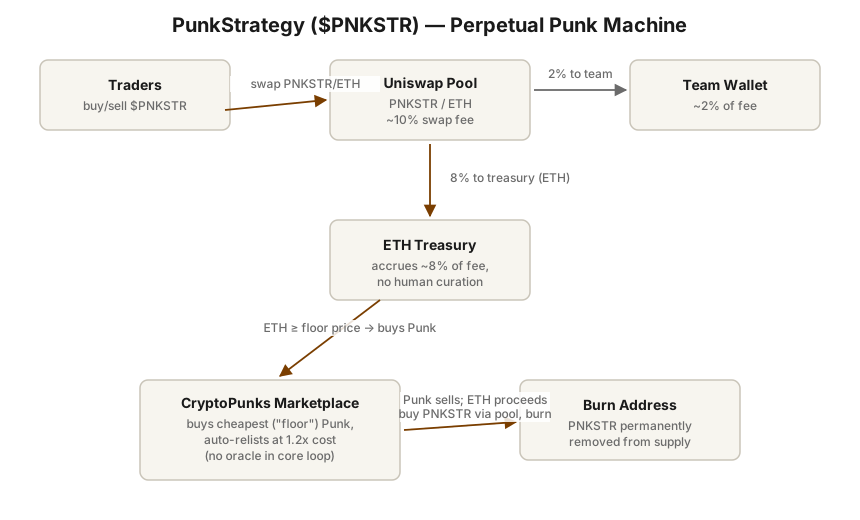 Open full-size diagram
Summary
PunkStrategy ($PNKSTR) is an Ethereum-mainnet experiment launched on 6 September 2025 by TokenWorks, an "onchain financialization playground" run by developer Adam Lizek (pseudonym Rhynotic). It fuses a deflationary ERC-20 with autonomous CryptoPunks accumulation. Every $PNKSTR swap on Uniswap pays a ~10% fee; the bulk of that fee streams into an onchain treasury. When the treasury holds enough ETH to buy the cheapest ("floor") CryptoPunk, the contract does so automatically and immediately relists the Punk at 1.2x its purchase price. When that Punk sells, the entire ETH proceeds are used to market-buy $PNKSTR and send it to a burn address, permanently shrinking supply. TokenWorks brands this loop "The Perpetual Punk Machine™" / "The Yoyo™." The token rode a strong meme-and-narrative wave, briefly reaching a market cap above $50M before settling into the single-digit millions, and it spawned an entire "NFTStrategy" category letting any ERC-721 collection deploy a paired strategy token.
Design (Mechanism)
- Fee-funded treasury. Every buy/sell of $PNKSTR through the DEX pool incurs a ~10% fee. Reporting is consistent that roughly 8% flows to the protocol treasury and ~2% goes to the team; the treasury accrues in ETH.
- Dynamic sell tax. To blunt post-acquisition dumping and sniping, the sell tax spikes sharply (reported up to ~90%) immediately after certain protocol actions and then decays back toward baseline over time — a reflexivity dampener.
- Autonomous acquisition. Once the ETH treasury ≥ the current floor Punk price, the contract executes an onchain purchase of the cheapest available CryptoPunk directly from the CryptoPunks marketplace. No human curation of which Punk is bought — it targets the floor.
- Automatic relist at 1.2x. The acquired Punk is instantly listed for sale at 1.2x its cost. The 20% spread is the protocol's target "profit" per cycle.
- Buyback-and-burn. When the Punk sells, 100% of the ETH is used to buy $PNKSTR from the pool and burn it, and the value is described as cycling back into the LP — creating deflationary pressure and a reflexive link between NFT demand and token scarcity.
- Chain / assets. Ethereum mainnet. Token contract:
0xc50673edb3a7b94e8cad8a7d4e0cd68864e33edf(PNKSTR); PNKSTR/ETH pool:0xb32470df3478a67ccc3726297de1e95ecc407b5d0758c83190a04a6c5d6fd1f4. The protocol interacts with the canonical CryptoPunks contract for buys/sells. - No native governance / no oracle in core loop. The floor logic reads marketplace state directly; the acquisition/relist/burn steps are automated by the contract rather than DAO-voted.
Outcome
Status: partial_success. As a narrative and cultural product PunkStrategy was a hit: it "took over the timeline," rose roughly 160% in its first two days, and peaked at a market cap north of $50M (later cited around $43M) before retracing. As a mechanism, it demonstrably worked — reporting documents the protocol completing full buy-relist-sell cycles on multiple CryptoPunks (the first acquisition was Punk #1628 for just under 49 ETH; later coverage cites ~12 completed cycles, ~700 ETH in cumulative fees, and ~2.8% of supply burned). The concept was influential enough to seed "NFTStrategy," generalizing the flywheel to arbitrary ERC-721 collections. Against that, the token settled far below its peak (single-digit millions of market cap at various checkpoints, with thin liquidity ~$0.68M), which is typical of reflexive meme assets whose value is tightly coupled to attention.
A separate but relevant event: on 3 July 2026 a different TokenWorks protocol — Fake World Assets (FWA), not PunkStrategy — was exploited when an attacker front-ran a Chainlink randomness callback to steer selection to a high-value CryptoPunk (#5450), acquired for ~$66k in ETH. TokenWorks moved FWA to withdraw-only mode and pledged compensation. This did not directly drain PunkStrategy but is material context for the team's engineering risk profile and shared brand.
Why it worked
- Legible, meme-native narrative. "A coin that buys CryptoPunks and burns itself" is instantly graspable and viscerally aligned with the most iconic NFT collection — perfect for the timeline.
- Reflexive flywheel with real onchain settlement. Unlike pure meme coins, the burn and the Punk purchases are verifiable onchain, giving holders a tangible "the machine is working" feedback loop.
- Fee capture as fuel. High swap fees, which normally repel traders, were reframed as the engine — the more it trades, the faster it accumulates and buys Punks.
- Credible-ish operator. A named-in-public (if pseudonymous) builder, Rhynotic, with a prior track record and an org (TokenWorks) shipping multiple experiments, lent narrative durability.
Where the design broke
- Attention-coupled value. The token's price is reflexive: fee revenue and burns scale with trading volume, which scales with hype. As attention faded, so did volume, fees, and buy-pressure — market cap fell well off its peak.
- Structural drag of the 1.2x model. A 20% target spread on illiquid, slow-moving floor Punks means capital can sit idle for long stretches (the app has shown periods holding ~0 ETH and no Punks), so the "perpetual" machine can stall between cycles.
- High fees deter organic use. A 10% swap tax (and punitive dynamic sell taxes) caps the token's utility as anything but a speculative vehicle.
- Shared-brand engineering risk. The FWA Chainlink-callback exploit showed that TokenWorks' financialization primitives can carry subtle MEV/front-running vulnerabilities; reputational spillover across the shared brand is a real cost even when PunkStrategy itself wasn't the exploited contract.
Lessons
- Reflexive flywheels amplify both directions. Coupling token scarcity to trading-fee-funded asset buys creates a beautiful up-cycle narrative but an equally fast down-cycle when volume dries up; sustainability requires a demand source not purely dependent on its own hype.
- Autonomous NFT acquisition needs MEV-hardening. Any onchain mechanism that reads floor/marketplace state and executes buys is a target for front-running and sandwiching; the sibling FWA callback exploit is a concrete warning that "let the contract pick and buy" logic must assume adversarial ordering.
- Fee design is a two-sided lever. High fees can bootstrap a treasury and fund a compelling mechanic, but they simultaneously suppress the very trading volume the mechanic depends on — the equilibrium is fragile.
- A legible mechanism can become a category. PunkStrategy's clarity let it template into NFTStrategy across many collections; simple, verifiable onchain loops travel further culturally than complex ones.
Redesign (EDITORIAL — hypothesis, not fact)
The following is the researcher's editorial analysis, not established fact.
If rebuilt, the priority would be decoupling the flywheel from raw attention and hardening acquisition against MEV. Concretely: (1) Replace the fixed 1.2x relist with a decaying-price Dutch auction on acquired Punks so capital doesn't stall waiting for a rigid 20% markup; a Punk that won't clear at 1.2x should still eventually clear and recycle ETH into burns. (2) Make acquisition commit-reveal or batch-auction based and avoid any single-block, oracle-callback-dependent selection path — the FWA incident shows floor-targeting logic is front-runnable; buying via a sealed intent that settles after a delay would neutralize the timing attack. (3) Diversify treasury inflows beyond swap fees — e.g., allow the idle ETH treasury to earn yield (staking/LST) between purchases so the machine still burns during low-volume droughts, breaking the pure attention-coupling. (4) Add transparent, onchain accounting dashboards with proofs (treasury, realized profit per cycle, cumulative burn) as a first-class contract feature rather than a fragile front-end, since the value proposition is "watch the machine work." (5) Consider a floor-tolerance band and per-cycle spend caps so a single mispriced acquisition can't consume the whole treasury. These changes trade some of the meme-simple charm for durability, which is the central tension of this design.
Sources
- PunkStrategy™ — The Perpetual Punk Machine (official site) — primary (docs)
- TokenWorks — A playground for onchain financialized ideas (official org site) — primary (docs)
- Adam (@Rhynotic) launch announcement tweet — primary (retrospective)
- PNKSTR/ETH pool on GeckoTerminal — primary (contract)
- A Beginner's Guide to PunkStrategy and $PNKSTR (analysis)
- The Rise of 'NFT Strategy': How PunkStrategy Uses CryptoPunks Flywheel (PANews) (analysis)
- I didn't expect PunkStrategy to really take off (ChainCatcher) (retrospective)
- Chainlink Callback Exploit Hits TokenWorks, CryptoPunk Lost (BanklessTimes) (news)
- Collecting Art in The 21st Century: A Conversation with Adam Lizek, AKA Rhynotic (The Monty Report) (retrospective)
Related experiments
Last verified: 2026-07-26 · Spot an error? Suggest a correction