Jupiter
Solana's dominant swap aggregator and perps/DeFi superapp that routes protocol revenue into hourly open-market JUP buybacks locked for three years.
▶ Run interactive simulation animated mechanism with editable parameters
How it works onchain
 Open full-size diagram
Summary
Jupiter is a Solana-based swap aggregator, launched in October 2021 by the pseudonymous developer "Meow" and Siong Ong, that has grown into a multi-product "DeFi superapp": a routing engine (Jupiter Swap/Ultra), a perpetuals exchange (Jupiter Perps, backed by the JLP liquidity pool), limit orders, DCA, a mobile app, and a launchpad. Its JUP governance token launched via airdrop on January 31, 2024. The mechanism of interest is not the swap itself — core aggregation routing is free to end users — but the revenue layer built on top of Perps, Ultra, Lend, DCA, and Limit Order fees, half of which is committed to hourly, on-chain, open-market JUP buybacks, with the repurchased tokens locked for three years in a vehicle nicknamed the "Litterbox Trust."
Design (Mechanism)
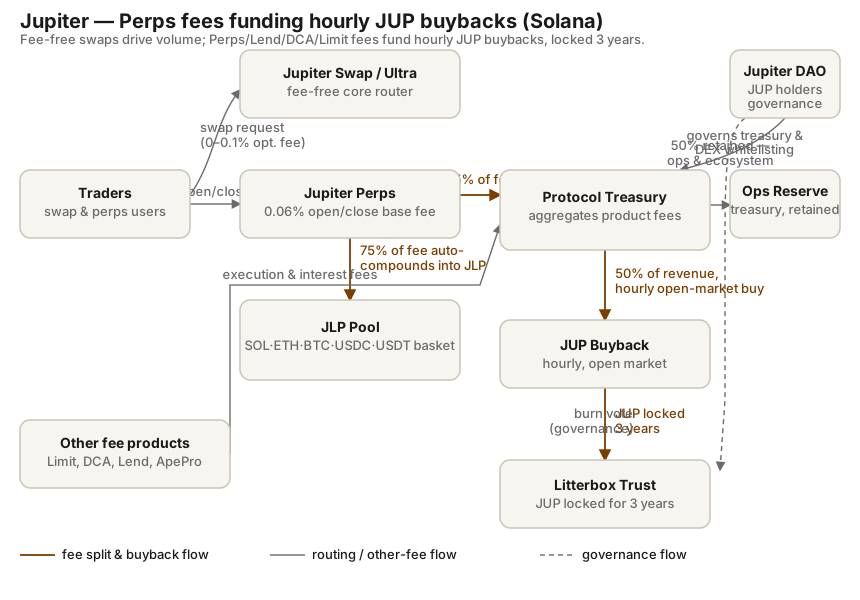
Jupiter's aggregator core (Jupiter Swap/Ultra) charges no protocol fee by default; integrators may optionally attach a platform fee in basis points (Ultra routes range from ~0% up to roughly 0.1%, with 0.02% quoted for SOL-to-stable pairs), and a separate Referral Program lets partners split any fee they add with Jupiter. Historically this made the core swap product a loss-leading distribution layer rather than a revenue source in itself.
Revenue instead concentrates in Jupiter Perps, the leveraged trading product collateralized by the JLP pool (a basket of SOL, ETH, BTC, USDC and USDT). Perps charges a base fee of roughly 0.06% of notional size on both opening and closing a position, plus separate borrow/funding and price-impact fees. That base trading fee splits 75% to JLP holders (auto-compounded into the pool, lifting JLP's unit price rather than issuing separate rewards) and 25% to Jupiter's protocol treasury. Additional protocol revenue streams — execution fees from Limit Order and DCA, interest/protocol fees from Jupiter Lend, and keeper fees from Jupiter ApePro — feed into the same treasury pool.
Starting February 17, 2025, Jupiter DAO adopted a policy directing 50% of this aggregate protocol revenue toward buying JUP on the open market, hourly, with purchased tokens locked in the Litterbox Trust for a three-year period rather than being immediately burned or redistributed. The remaining revenue stays with the protocol treasury for operations and ecosystem funding. JUP itself functions as the governance token for Jupiter DAO, which votes on treasury allocation, which DEXs/pools get whitelisted for routing, and — as of a later 2025 proposal — whether previously bought-back tokens held in the trust should be burned outright rather than merely locked. This buyback-and-lock design ties real, usage-driven revenue (trading volume and fees) to standing spot demand for JUP without directly rebating fees to holders as a cash dividend, and without changing what end users pay to swap.
Outcome
Jupiter is the largest DEX aggregator on Solana by routed volume and one of the highest-fee-generating protocols in the ecosystem, with Perps regularly ranking among the top fee-generating Solana applications on DefiLlama. The buyback program has executed continuously since February 2025, with tens of millions of dollars in cumulative JUP repurchases reported by mid-2025 (media reporting cites roughly $70 million), funded entirely from protocol revenue rather than token emissions. JLP has become a widely held yield-bearing instrument, with its "real yield" (fees paid in the underlying basket assets) marketed as a differentiator from inflationary liquidity-mining rewards. Governance activity (DAO votes on treasury use, whitelisting, and the later burn proposal) shows an operating, if lightly used, on-chain governance layer.
Why it worked
- Keeping the free layer free. By not charging protocol fees on the core aggregator, Jupiter maximized volume and became Solana's default swap venue, which in turn maximized the surface area (Perps, Lend, Ultra fee tiers) available to monetize.
- Concentrating fees where leverage and impermanent risk justify them. Charging fees primarily on Perps (a product with real counterparty risk and LP capital at stake) rather than on simple spot routing kept user-facing swap costs competitive against other aggregators.
- Buybacks over pure treasury accumulation. Committing a fixed, public, hourly-executed share of revenue to buybacks (rather than discretionary treasury spending) gave token holders a transparent, verifiable link between protocol usage and JUP demand.
Limitations and criticisms
- Locking bought-back tokens for three years defers the question of ultimate disposition (recirculation, burn, or governance-directed distribution); until the later burn vote, holders had a revenue-linked buy pressure mechanism without a resolved end state for the accumulated supply.
- Revenue funding the buyback is concentrated in Perps trading fees, so buyback volume is structurally tied to leveraged-trading activity and JLP pool usage rather than diversified across all Jupiter products evenly.
- Because the core swap product remains fee-free, the buyback mechanism depends on users adopting fee-bearing products (Perps, Ultra's fee tiers, Lend) rather than being funded by the aggregator's primary, highest-volume use case.
- The split between JLP holders (75%) and protocol treasury (25%) on Perps fees means JUP buyback funding is a second-order claim on trading fees, arriving only after JLP liquidity providers are compensated.
Lessons
- A high-volume, fee-free core product can function as a distribution funnel that subsidizes monetization elsewhere in a product suite, rather than every feature needing to charge fees directly.
- Tying token buybacks to a fixed, transparently executed percentage of measurable protocol revenue is a more falsifiable commitment than discretionary treasury-funded purchases, letting outside observers audit the mechanism against on-chain fee data.
- Separating "buyback" from "burn" (via a locked trust rather than immediate destruction) preserves future governance optionality but leaves the token's terminal supply policy unresolved until a separate decision is made.
Redesign (EDITORIAL)
Hypothesis, not fact. An alternative design could route the treasury's 25% share of Perps fees (and equivalent shares from other products) through a single unified "protocol fee" auto-swapped into JUP and burned immediately upon receipt, rather than accumulating in a discretionarily-governed trust. This would remove the multi-year lock's ambiguity about eventual disposition and make the fee-to-burn pipeline fully mechanical and auditable in real time, at the cost of removing the DAO's flexibility to redirect that value toward other uses (grants, insurance funds, further product subsidies) if circumstances change.
Sources
- Jupiter Developers — Add Fees To Swap — primary (docs)
- Jupiter Support — What are the fees associated with Jupiter Perps? — primary (docs)
- CryptoSlate — Jupiter to buyback JUP tokens with 50% of fees starting next week (news)
- Discuss Jupiter — New DAO vote: Proposal to Burn the Litterbox — primary (governance-forum)
- DefiLlama — Jupiter Perpetual Exchange TVL, Fees, Revenue & Volume (analytics)
- CoinGecko — What Is Jupiter (JUP)? Solana's largest DeFi Superapp (explainer)
- Solscan — JUP token address — primary (block-explorer)
Related experiments
Last verified: 2026-07-28 · Spot an error? Suggest a correction